
6 min read
Cash Isnt The Only Thing That Runs Out First

Cash isn’t the only thing a founder can run out of before a community becomes self-sustaining. There’s a second, quieter burn rate running in parallel, and it’s measured in a founder’s own attention, willingness, and disproportionate early effort, not dollars. Runway on that resource is real and finite, and it’s the one nobody tracks on a spreadsheet, right up until it hits zero and the founder simply stops showing up.
If you’ve read the piece on the cold start problem, you already know the founder has to carry a disproportionate share of the early work, posting daily, replying within hours, doing the things that don’t scale. This piece is about the runway on that specific effort, and what happens when it runs out before the community does.
In this pieceThe other burn rate, stated plainly
Why founder energy runs out faster than expected
A real, empty space, the visible result of a founder who ran out first
Three real ways to extend this specific runway
The warning signs before the tank hits empty
The pushback: “if it needs this much of me, maybe it’s not working”
Where this actually lives inside BuddyNext
Turning it into something you actually check
The other burn rate, stated plainly
A financial burn rate measures cash spent against cash on hand. This one measures something harder to quantify but just as real: how much of a founder’s daily willingness to post, reply, welcome, and personally carry a young community gets spent every single day, against a finite, if invisible, reserve of that same willingness. Every unanswered post that a founder has to personally respond to, every day they show up to a quiet space and post anyway, draws down the same resource, and the resource does not refill itself just because the founder wants it to.
Ignoring this because it isn’t a number on a bank statement doesn’t make it less real. It just means nobody’s watching it until the exact week it runs out, usually the same week the community most needed the founder to still be showing up.
Why founder energy runs out faster than expected
The specific reason this runway burns faster than founders plan for: the effort required during the cold-start phase is emotionally different from ordinary work. Posting into a space that only a handful of people are reading, day after day, without the validation of a large, responsive audience, is genuinely more draining per hour than the same amount of effort spent somewhere already alive and busy. A founder budgeting their time the way they’d budget for any other task underestimates how much faster this specific kind of unrewarded, repetitive effort depletes real motivation.
It compounds with ordinary founder overload, the rest of the business doesn’t pause while the community is being seeded, and the community effort is frequently the first thing sacrificed when something else demands attention, precisely because it’s the task with the least immediate, visible consequence for skipping it on any single day.
A real, empty space, the visible result of a founder who ran out first
Here’s what it looks like when this specific runway hits zero before the community was ready to run without it, reachable without an account.
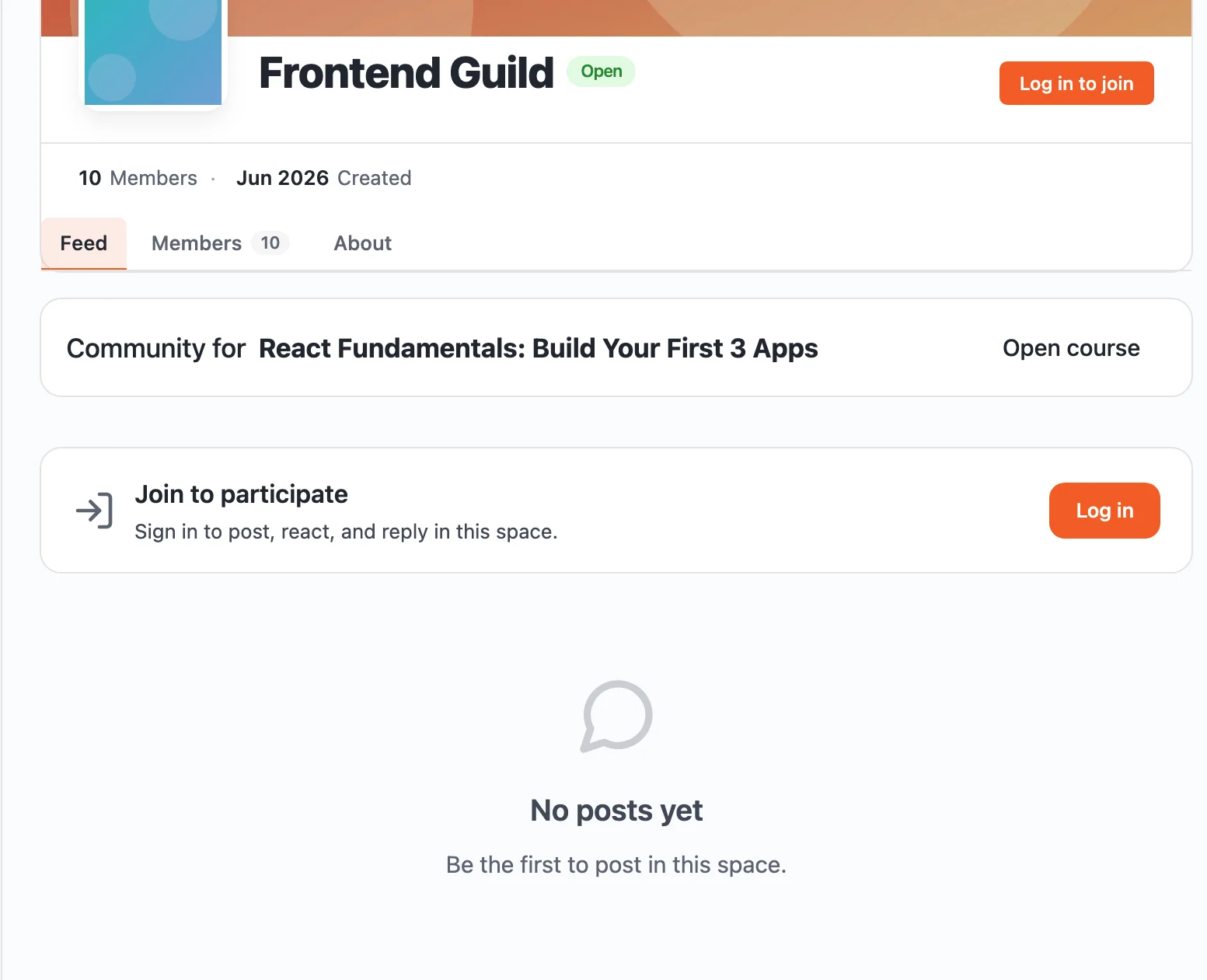
Ten real members, zero posts. This isn’t necessarily a space that was seeded badly, in many cases it’s a space where the founder’s early effort simply stopped before the space had accumulated enough of its own momentum to continue without it. The empty room described throughout the cold start piece and a founder’s own burned-out runway frequently produce the identical visible result, which makes this specific failure mode easy to misdiagnose as a bad idea or a bad audience, when it was actually a resource-planning problem.
Three real ways to extend this specific runway
The co-seeding team described in the cold start piece is the single biggest lever here, not just for content diversity but for spreading the actual emotional cost across more than one person, so no single founder’s individual runway is the only thing keeping the space alive. Concrete, small milestones, ten real posts from non-founders, five consecutive days of real activity, matter for the same reason they matter in the general bootstrapping piece: visible, near-term progress refills motivation faster than an abstract, months-away goal ever does. And deliberately scheduled rest, planned in advance rather than taken reactively once burnout has already set in, protects the runway the same way a cash reserve protects a company’s financial runway, a buffer built before it’s needed rather than scrambled for after.
The warning signs before the tank hits empty
Worth naming explicitly, because founder energy burn rate tends to have real warning signs before it fully runs out, the same way a company usually shows signs of financial trouble before the account actually reaches zero. Posts starting to feel like an obligation rather than something the founder wants to share. Response times to new members quietly stretching from hours to days. A growing temptation to skip a day “just this once,” followed by another, and another.
Any one of these, noticed early, is a solvable, temporary problem, worth addressing with the extensions described above before it compounds. Ignored, they tend to resolve themselves the hard way, in a sudden, complete stop rather than a gradual, manageable pullback.
The pushback: “if it needs this much of me, maybe it’s not working”
A fair, honest question worth taking seriously rather than dismissing as doubt to push through. Some ideas genuinely don’t have a real audience, and no amount of founder effort fixes that, worth confirming honestly using the two-month diagnostic the cold start piece covers, narrow niche, real personal outreach, genuinely useful seed content, all three actually in place.
If all three check out and the space still requires disproportionate founder effort at month three, that’s not necessarily a sign the idea is wrong. Every community in this piece’s cold-start phase requires exactly this, for exactly this long. The question worth asking isn’t whether it still needs the founder. It’s whether the founder’s own runway is being managed deliberately enough to still be there when it stops needing quite as much.
Where this actually lives inside BuddyNext
If you’re running the community on BuddyNext, notifications tuned specifically rather than generically mean a founder isn’t manually checking every space daily just to know where their limited attention is actually needed, real time saved that directly extends this specific runway. Multiple real moderators, not just one founder account, spreads the same load the co-seeding team described above spreads across content, applied to the ongoing moderation and welcome work a growing space keeps generating.
Turning it into something you actually check
Weekly, alongside the activity metrics the general bootstrapping piece recommends tracking: an honest, one-to-ten check on how sustainable this week’s effort actually felt, tracked over time the same way a cash balance gets tracked over time. A single low week isn’t a crisis. A steady, multi-week decline is the exact early warning worth acting on, before the visible result becomes indistinguishable from the empty room this entire piece has been describing.
A financial runway that hits zero is at least visible on a bank statement well before the actual crisis. A founder’s own runway on this specific, unglamorous work often isn’t visible to anyone, including the founder, until the posts simply stop. Watching it on purpose is the only real defense against running out of it by surprise.
Related reading