
6 min read
You Can Buy Sales. You Have To Earn A Name.

Most course creators trying to grow do the same thing: they buy attention. Ads, launches, affiliate pushes, a funnel that sprays a pitch at as many people as possible and converts whatever small percentage it can. It works, technically, for as long as the money holds out. And it produces a specific, hollow result, sales without a name, a business that has customers but no reputation, that has to buy every single student because it never became the kind of teacher students seek out on their own.
The alternative is slower and produces something the ad model never will: authority. If you’ve read the piece on relationship marketing over automation, this is what those three habits do for a course creator who wants to both sell more and actually build a name in their space, which turn out to be the same project.
In this pieceWhy buying sales never builds a name
Relationship marketing when you teach
Teaching for free is the marketing
Why you should teach fewer people better
A real course, and the trust it’s actually selling
The flywheel: reputation that sells the next course
Where this lives inside Learnomy
Turning it into something you actually check
Why buying sales never builds a name
An ad-bought sale and a reputation-driven sale look identical on a revenue chart and are completely different underneath. The ad-bought student found you because you paid to be in front of them, bought once, and has no particular reason to remember you existed. The reputation-driven student found you because someone they trust mentioned you, or because they’d been quietly learning from your free content for months, and they arrive already believing you’re worth learning from.
The first kind of student has to be bought again for every course. The second kind buys the next one on their own, and tells someone else. A creator who only ever buys sales is renting an audience they never get to keep. A creator who builds a name owns one, and the difference is entirely in whether they ran the relationship playbook or the ad playbook.
Relationship marketing when you teach
For a creator, relationship marketing means being genuinely reachable and genuinely responsive, before, during, and after the course, in a way that an automated drip sequence can only pretend to be. A real reply to a student stuck on a lesson. A real answer to a question asked publicly, where the next hundred prospective students can see that this is a teacher who actually shows up.
This is the single highest-leverage thing a creator can do, and it maps directly onto the founding-cohort idea from the piece on your first cohort as a founding community. The first students who get real, personal attention become the people who vouch for you, and a genuine vouch from a real student is worth more than any ad, because it carries the one thing ads can’t buy, trust that was actually earned.
Teaching for free is the marketing
The second habit is the one course creators resist hardest, because it feels like giving away the thing they’re trying to sell. Teach openly, for free, before anyone has paid, publishing genuinely useful answers to the questions your future students are already asking. The fear is that people who get the free version won’t buy the paid one. The reality is the opposite: the free teaching is what proves you can teach, and proving you can teach is the entire buying decision.
Nobody buys a course from someone they’ve never learned anything from. The creators who sell the most are almost always the ones who taught the most for free first, because every useful free lesson is a small, honest demonstration that the paid version is worth it.
This principle deserves stating plainly, because so many creators get it backwards. This is educational storytelling as a growth engine, the same mechanism the opening case study used to turn common questions into content, applied to a creator building the reputation that eventually sells everything else.
Why you should teach fewer people better
The third habit protects the creator from the burnout that kills most course businesses. You do not need to be everywhere, post constantly, or answer every message within minutes. You need a smaller number of genuinely good interactions and genuinely useful pieces of teaching, which do far more for your reputation than a high volume of shallow ones.
This matters for a creator specifically because a creator is usually a single person, and a single person’s attention is the entire business. Spread it thin across high-volume, low-quality output and both the teaching and the relationships suffer, which is the exact founder-energy burn that ends so many promising course businesses before they compound. Concentrate it on fewer, better things and the reputation builds faster, because reputation is made of depth, not frequency.
A real course, and the trust it’s actually selling
Here’s a real, live course, reachable without an account, worth looking at for what it’s really selling.
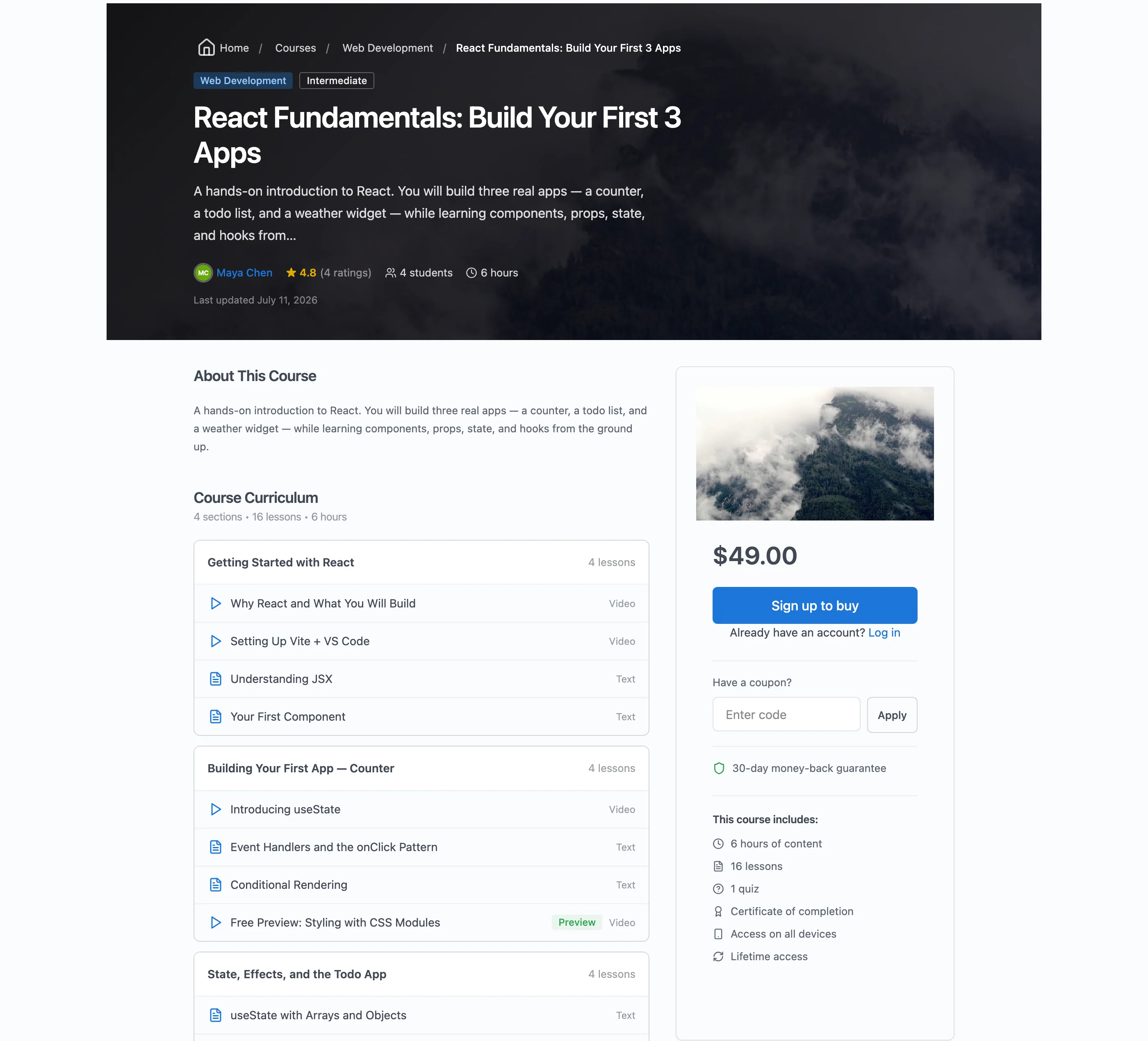
Notice the ratings and the real, named instructor. A prospective student looking at this page isn’t primarily evaluating the curriculum, they’re evaluating whether they trust this specific person to teach them. The ratings are other students vouching. The instructor’s name is a reputation, or the absence of one. Everything the three habits build, the relationships, the free teaching, the earned authority, is what turns that name from unknown into someone worth learning from, which is what actually converts a page like this into a sale.
The flywheel: reputation that sells the next course
When the habits are running, a course creator’s business stops depending on the next ad campaign and starts running on its own momentum. Students who got real attention refer other students. Free teaching keeps pulling in people who arrive already trusting you. A good reputation makes the next course easier to sell than the last one, because you’re no longer starting from zero, you’re selling to people who already know you deliver.
That’s a flywheel the ad model never builds. Ads stop the moment you stop paying. A name keeps working, sells the next launch, and compounds, which is the difference between a creator who has a business and a creator who has a reputation that happens to make money.
Where this lives inside Learnomy
If you’re running courses on Learnomy, real ratings and a real instructor identity make the reputation you’re building actually visible on the page, so the trust earned through relationships and free teaching shows up exactly where the buying decision happens. Verifiable certificates give students something real to share, turning each graduate into a piece of your reputation out in the world, the mechanism the growth loop piece on course certificates covers. Pair it with BuddyNext and the relationships have a real place to happen, not just an automated email sequence.
Turning it into something you actually check
Per launch, honestly: of your new students, how many came from paid attention versus from a referral, your free teaching, or your existing reputation. The first number is what you’re renting. The second is what you actually own, and the entire goal of the playbook is watching the second number grow until it dwarfs the first.
Buying sales is faster at the start and produces nothing that lasts. Building a name is slower and produces the one asset that keeps selling after you stop paying for attention. The case study that grew thirty-six times organically wasn’t lucky. It just chose the slow thing early, and let it compound.
Related reading