
6 min read
The Rule of 40 For Online Course Businesses


Somewhere in every course creator’s second year, a strange kind of anxiety sets in. Revenue is growing, which feels good, except the margin keeps thinning as it grows, because growth is being bought with launches, ad spend, and increasingly complicated funnels. Or the opposite happens: margin is fat and stable, and growth has quietly stalled, because nothing about a comfortable, profitable course business forces anyone to go find the next thousand students.
Both of those businesses can be healthy. The Rule of 40 is the framework that tells you which one you’re actually running, and whether the tradeoff you’re making is a sustainable one or a warning sign dressed up as a strategy.
In this pieceWhat the Rule of 40 actually says
Why it comes from software, and why it still applies here
What actually counts as growth for a course business
What actually counts as margin for a course business
A real course, priced and scoped, not a hypothetical
Why the tradeoff is the whole point
Where this actually lives inside Learnomy
How the tradeoff shifts by course-business type
The test, if you want one
What the Rule of 40 actually says
Take your revenue growth rate, as a percentage, and add it to your profit margin, also as a percentage. If the two numbers together add up to 40 or more, the business is considered healthy, regardless of how the 40 is split between them. A business growing 35% a year with a 5% margin passes. A business growing 10% a year with a 30% margin also passes. A business growing 15% with an 8% margin does not, and that’s the number worth sitting with.
The insight isn’t that growth or margin individually matters most. It’s that a business can be unbalanced in either direction and still be healthy, as long as the sum holds. What the Rule of 40 actually catches is the business that’s mediocre at both, quietly, with no single bad number ever alarming enough to trigger a real conversation about it.
Why it comes from software, and why it still applies here
The Rule of 40 was built for SaaS companies, where the growth-versus-profitability tradeoff is unusually visible: burn cash acquiring users fast, or slow down and let the unit economics breathe. Course businesses share the exact same structural tension, just at a smaller scale and with less venture money around to disguise it.
A course business can burn margin the same way a SaaS company does, through paid ads, expensive launch funnels, or affiliate commissions that eat deep into each sale. It can also throttle growth the same way, by relying entirely on repeat buyers and word of mouth, never spending the money or effort that would bring in a genuinely new audience. Same tradeoff, same math, a smaller number of zeroes.
What actually counts as growth for a course business
Revenue growth rate, year over year or launch over launch, is the honest number, not enrollment count on its own. A course that doubles its student count by halving its price hasn’t grown by any measure that matters to the business, even though the vanity metric looks great in a screenshot.
The subtler trap is counting a single big launch as “growth” when it’s really a one-time spike that won’t repeat. A cohort that sells out once, loudly, followed by two quiet quarters, isn’t a growing business, it’s a growing business having one good month. Real growth, the kind that belongs in this equation, is the trend across multiple periods, not the peak of your best one.
What actually counts as margin for a course business
Course businesses have a genuinely unusual cost structure compared to almost any other kind of company, and it’s worth being precise about what actually eats margin here specifically. Content production is a real cost, but it’s mostly front-loaded, spent once before the first sale rather than recurring per unit. Hosting and delivery are close to free at any real scale. The costs that actually determine margin are ongoing: support, community moderation if there’s a cohort or discussion component, live instructor time if any exists, and payment processing and affiliate fees on every single sale.
The businesses that quietly bleed margin are almost never the ones with expensive video production. They’re the ones where every sale requires a human to personally onboard the buyer, answer the same five questions, or manually issue a certificate, because none of that scales the way the actual course content does.
A real course, priced and scoped, not a hypothetical
Here’s what the actual inputs to this equation look like on a real, live course, reachable without an account.
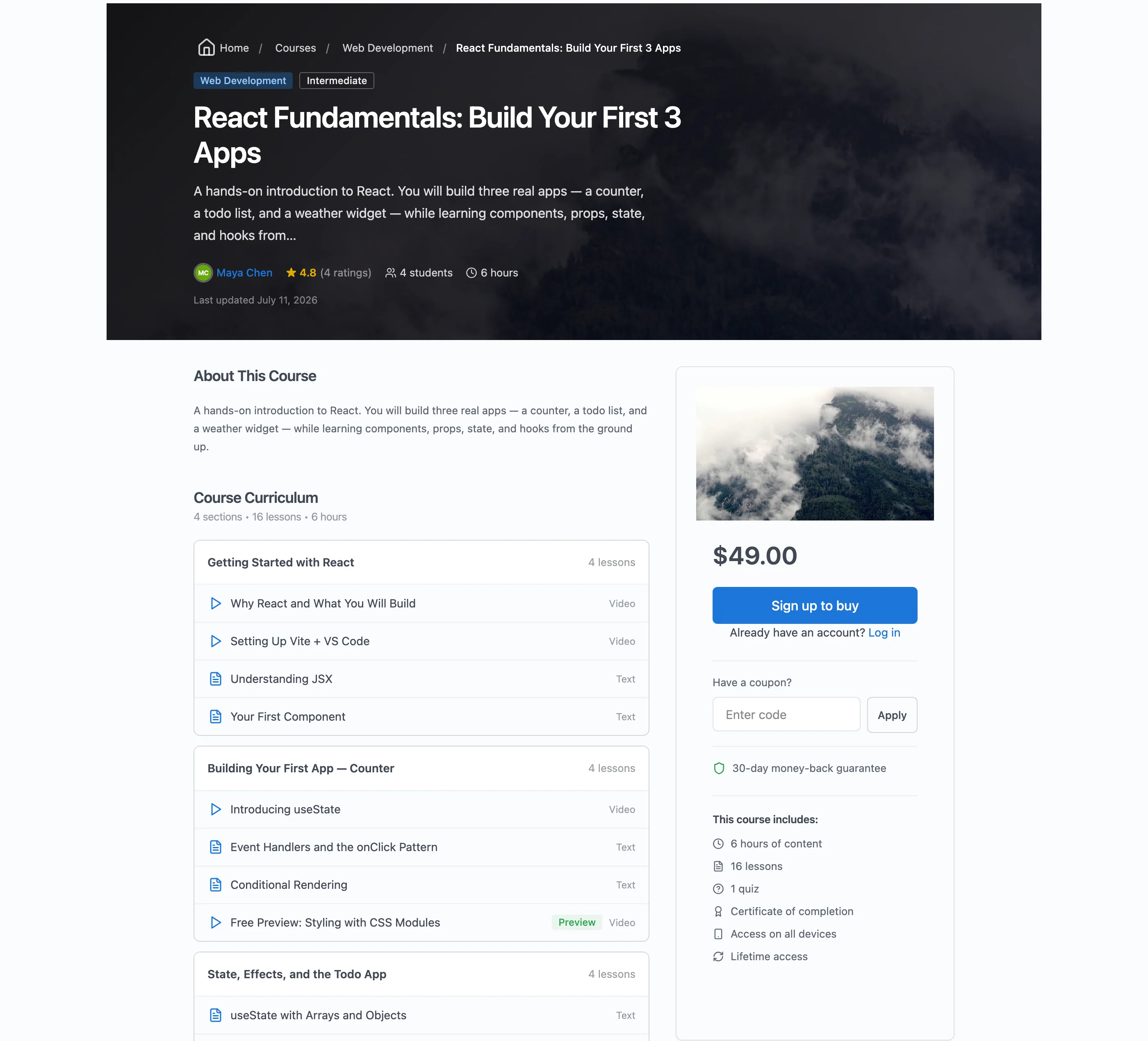
A one-time $49 price, 16 lessons across 6 hours, lifetime access, a certificate on completion. Every one of those details is an input into this specific course’s Rule of 40. The one-time price and lifetime access mean marginal cost per new student is close to zero after the course is built, good for margin. It also means there’s no recurring revenue pulling growth forward automatically, every month starts back at zero unless something brings in new students. That’s the tradeoff, made visible in one real course listing instead of an abstract formula.
Why the tradeoff is the whole point
The mistake most course creators make isn’t picking the wrong side of the tradeoff, it’s not realizing they’ve picked a side at all. A creator running hot on ad-funded growth and thin margin isn’t necessarily doing anything wrong, as long as they know that’s the game they’re playing and the number still clears 40. The same is true running the opposite way, comfortable margin, minimal growth spend, as long as it’s a deliberate choice and not just what happened by default.
What actually signals trouble is a business that’s drifting toward the middle of both numbers without anyone deciding to put it there. Nobody chose 15% growth and 8% margin. It just happened, one under-optimized launch and one un-scrutinized support cost at a time.
Where this actually lives inside Learnomy
If you’re running courses on Learnomy, the free tier already removes several of the costs that quietly eat margin elsewhere: signed certificates with a public verify page instead of a manual PDF process, built-in progress tracking instead of a support ticket every time a student asks “how far along am I,” and a real course dashboard instead of a spreadsheet. None of that manufactures growth. It protects the margin side of the equation so growth spending doesn’t have to compensate for costs that shouldn’t have existed in the first place.
Pairing it with BuddyNext, the way the growth loop piece on course certificates describes, adds a real, low-cost growth channel, a shared certificate doing recruiting work an ad budget would otherwise have to buy. That’s margin-friendly growth, the good kind, the kind that doesn’t force the tradeoff in the first place.
How the tradeoff shifts by course-business type
The specific balance of growth and margin changes shape by what kind of course business you’re actually running. A cohort-based, live course tends to run hot on growth and thin on margin, instructor time and launch marketing are real, recurring costs. An evergreen, self-paced course tends to run the opposite, fat margin once built, slow growth without deliberate ongoing traffic investment. A membership or subscription academy changes both sides of the equation at once, because churn now matters as much as new signups do. A certification or compliance course plays an entirely different game, often B2B, often employer-paid, with a margin structure that has almost nothing in common with a consumer course sold one student at a time.
The test, if you want one
Pull your actual year-over-year revenue growth rate and your actual net margin, honestly, including the costs that are easy to forget: support time, payment processing, affiliate payouts, the instructor hours that never show up on an invoice. Add the two percentages together.
If it’s comfortably above 40, you’ve found a real, sustainable version of the tradeoff, whichever side you’re weighted toward. If it’s hovering in the high teens or low twenties, that’s not a business that failed. It’s a business that hasn’t yet decided which side of the tradeoff it’s actually trying to win.
Related reading