
5 min read
The Quiet Plateau Every Evergreen Course Hits


An evergreen course is the closest thing course-selling has to a machine you build once and walk away from. Record it, price it, publish it, and every sale after the first one costs almost nothing to deliver. That’s a genuinely enviable margin position. It’s also, quietly, the reason so many evergreen courses stop growing and nobody notices for a year.
If you’ve read the piece on the Rule of 40 for course businesses, this is the margin-heavy, growth-slow end of that spectrum, and it has its own specific failure mode.
In this pieceWhy margin comes easily to an evergreen model
The quiet plateau nobody notices
A real evergreen course, priced and scoped
The specific trap: comfort mistaken for health
The pushback: “I don’t want to run ads or chase growth”
Where this actually lives inside Learnomy
Why “passive income” is doing some quiet lying here
Turning it into something you actually check
Why margin comes easily to an evergreen model
Once an evergreen course is built, the marginal cost of the hundredth student is close to the marginal cost of the tenth: nearly zero. No live instructor time, no cohort scheduling, no delivery cost that scales with enrollment. That’s the entire structural advantage, and it’s real, not a myth course creators tell themselves.
The problem is that this advantage is completely silent about growth. Nothing about a well-built evergreen course generates new demand on its own. It just sits there, ready to convert whoever happens to find it, and “whoever happens to find it” is a shrinking number every month that no new marketing effort replaces.
The quiet plateau nobody notices
Here’s the specific way this goes wrong. Month one after launch is strong, existing audience, launch buzz, maybe a few affiliate pushes. Month two is decent, riding leftover momentum. By month four or five, sales have quietly settled into a low, steady trickle, mostly search traffic and the rare word-of-mouth referral, and because the course is still profitable on every sale, nothing about that trickle feels like a crisis.
That’s the plateau. Margin stays excellent the entire time, which is exactly what makes it easy to miss that growth has effectively stopped. A business with 2% growth and 55% margin technically clears the Rule of 40 on paper, comfortably, while quietly becoming a business that isn’t actually going anywhere.
A real evergreen course, priced and scoped
Here’s what the actual economics look like on a real, live evergreen course, reachable without an account.
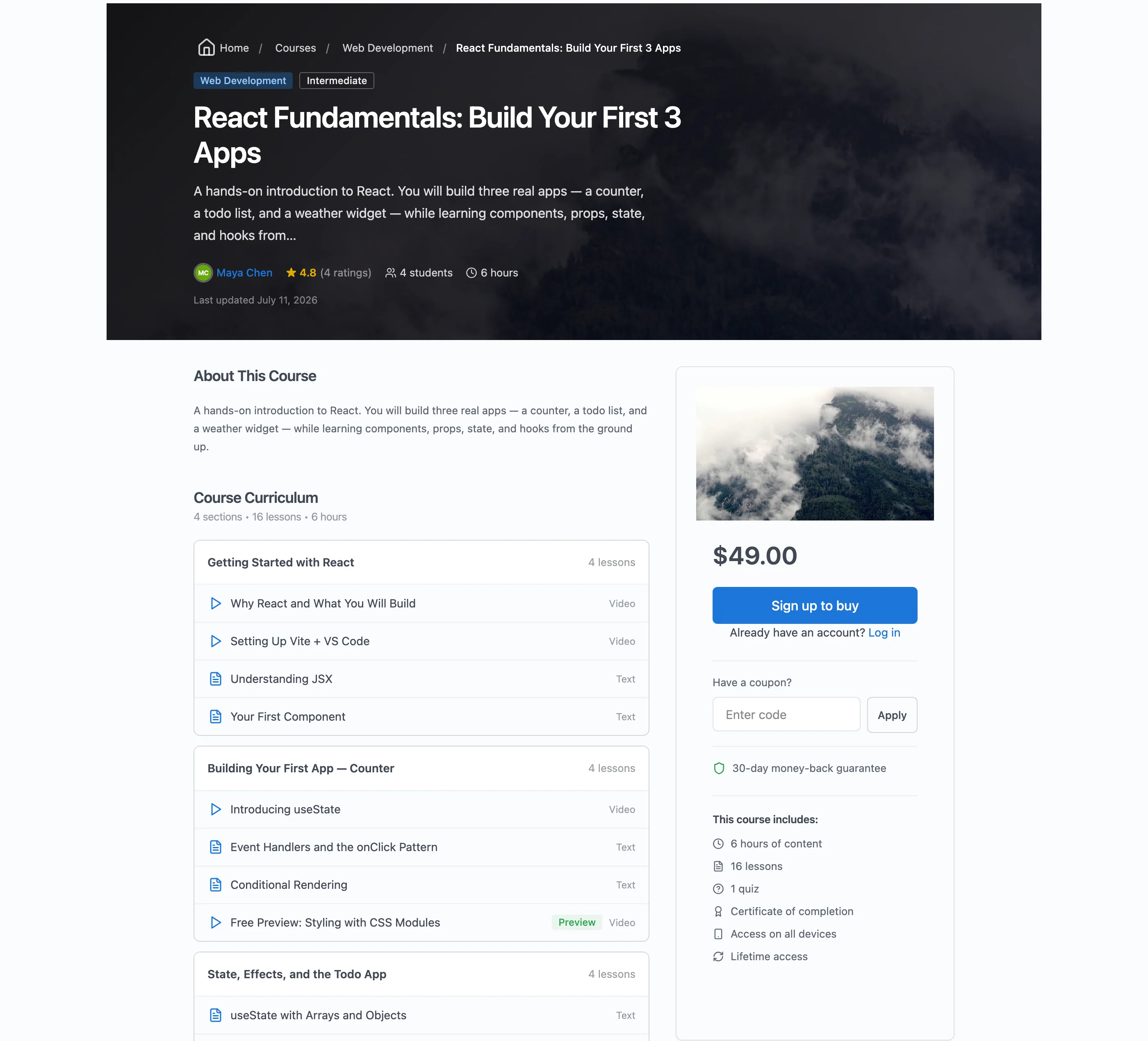
A one-time $49 price, lifetime access, sixteen self-paced lessons, no live component anywhere in the listing. Everything about this structure is optimized for margin: no instructor hours per student, no cohort scheduling cost, no live support window. What it isn’t optimized for, visible by what’s absent, is any built-in mechanism that brings a new wave of students in without the creator actively going out and finding them.
The specific trap: comfort mistaken for health
The trap isn’t the plateau itself, plenty of evergreen courses plateau at a genuinely comfortable, sustainable income and that’s a legitimate outcome, not a failure. The trap is not noticing the difference between “we chose this plateau on purpose” and “we drifted into this plateau and stopped checking.”
A course creator who deliberately caps growth at a comfortable, low-effort level, having made that tradeoff consciously, is running a healthy business by any reasonable definition. A course creator whose growth quietly died eight months ago, who hasn’t touched the marketing or the content since, and who’s only now wondering why revenue feels flat, is running the exact same numbers for a completely different, much less healthy reason.
The pushback: “I don’t want to run ads or chase growth”
Completely legitimate, and worth stating plainly: nothing about the Rule of 40 requires aggressive growth. A course business sitting at 8% growth and 45% margin clears 40 comfortably without any hustle-culture growth chasing at all. The framework isn’t an argument for growth at all costs. It’s a tool for noticing when a business has drifted below the healthy threshold in both directions at once, not a mandate to maximize either number individually.
If low-effort, high-margin, modest growth is genuinely the outcome you want, the Rule of 40 confirms you’re already there instead of telling you to want something else.
Where this actually lives inside Learnomy
If you’re running an evergreen course on Learnomy, the free tier’s signed certificates with a public verify page and one-click LinkedIn sharing do something specifically useful for the growth-slow side of this equation: they turn every completion into a small, real, low-cost growth event, the exact mechanism the growth loop piece covers in depth. It’s not aggressive growth. It’s growth that doesn’t cost the margin the rest of the evergreen model was built to protect.
Why “passive income” is doing some quiet lying here
The phrase “passive income” gets attached to evergreen courses constantly, and it’s worth being precise about what it actually means versus what it implies. It accurately describes the delivery cost, once built, the course genuinely does deliver itself with minimal ongoing effort. It inaccurately implies that growth is also passive, that students will simply continue arriving without any ongoing input.
They won’t, past the initial wave. Passive delivery and passive growth are two completely different claims, and conflating them is exactly what produces the quiet plateau: a creator who correctly stopped working on delivery and incorrectly also stopped working on the one thing that was never actually passive.
Turning it into something you actually check
Quarterly, not monthly, since evergreen sales are naturally slower-moving: revenue growth rate against the same quarter last year, and net margin after every real cost, support, payment processing, hosting. Add them. If the sum is comfortably above 40 and the plateau was a deliberate choice, there’s nothing to fix. If it’s drifting downward and nobody decided that on purpose, that’s the actual signal, not the flat monthly number that looks fine in isolation.
An evergreen course that stops growing isn’t failing. It’s just no longer making a choice, it’s just coasting, and coasting and choosing produce identical revenue charts right up until they don’t.
Related reading