
5 min read
Why Certification Courses Play A Different Rule of 40 Game


A certification course sells to someone completely different than a consumer course does, even when the platform, the content format, and the video quality all look identical from the outside. The buyer is often not the student. The price tolerance is often ten times higher. And the margin structure runs on assumptions that would bankrupt a consumer course business overnight if you swapped them by accident.
If you’ve read the piece on the Rule of 40 for course businesses, this is the variant that breaks the most assumptions from the other three, because the entire buyer relationship is different.
In this pieceWhy the buyer usually isn’t the student
What that does to the margin side of the equation
A real, verifiable certificate, not a mockup
The specific trap: treating it like a consumer course
The pushback: “our certificate isn’t accredited by anyone official”
Where this actually lives inside Learnomy
Why this isn’t the same as a vanity certificate
Turning it into something you actually check
Why the buyer usually isn’t the student
In a consumer course, the person paying and the person learning are almost always the same individual, making their own decision with their own money. In a large share of certification and compliance courses, that’s simply not true. An employer pays for mandatory compliance training. A professional body requires continuing education credits and reimburses the cost. A company budgets for upskilling and picks the course, not the employee taking it.
That single difference changes almost everything downstream. Price sensitivity drops sharply, because the person choosing to buy usually isn’t the person feeling the cost. Growth channels shift from consumer marketing toward B2B sales and institutional partnerships. And the actual product being sold quietly becomes “documented, verifiable proof this requirement was met,” not just “the learning itself,” which is a subtly different thing to build and price.
What that does to the margin side of the equation
Certification and compliance courses can sustain radically higher prices than consumer courses covering similar material, sometimes ten times higher, because the buyer is budgeting institutionally, not personally. That’s a real, structural margin advantage most consumer course creators don’t have access to at all.
The advantage comes with a cost most creators underestimate until it’s already been paid: verification infrastructure. A consumer course certificate that nobody ever checks can be a simple PDF. A compliance certificate that an employer, auditor, or licensing body might actually verify has to be genuinely checkable, or the entire premium price the buyer paid for “documented proof” collapses the moment someone tries to confirm it and can’t.
A real, verifiable certificate, not a mockup
Here’s what genuinely verifiable proof looks like, reachable without an account, the actual product a compliance buyer is paying the premium for.
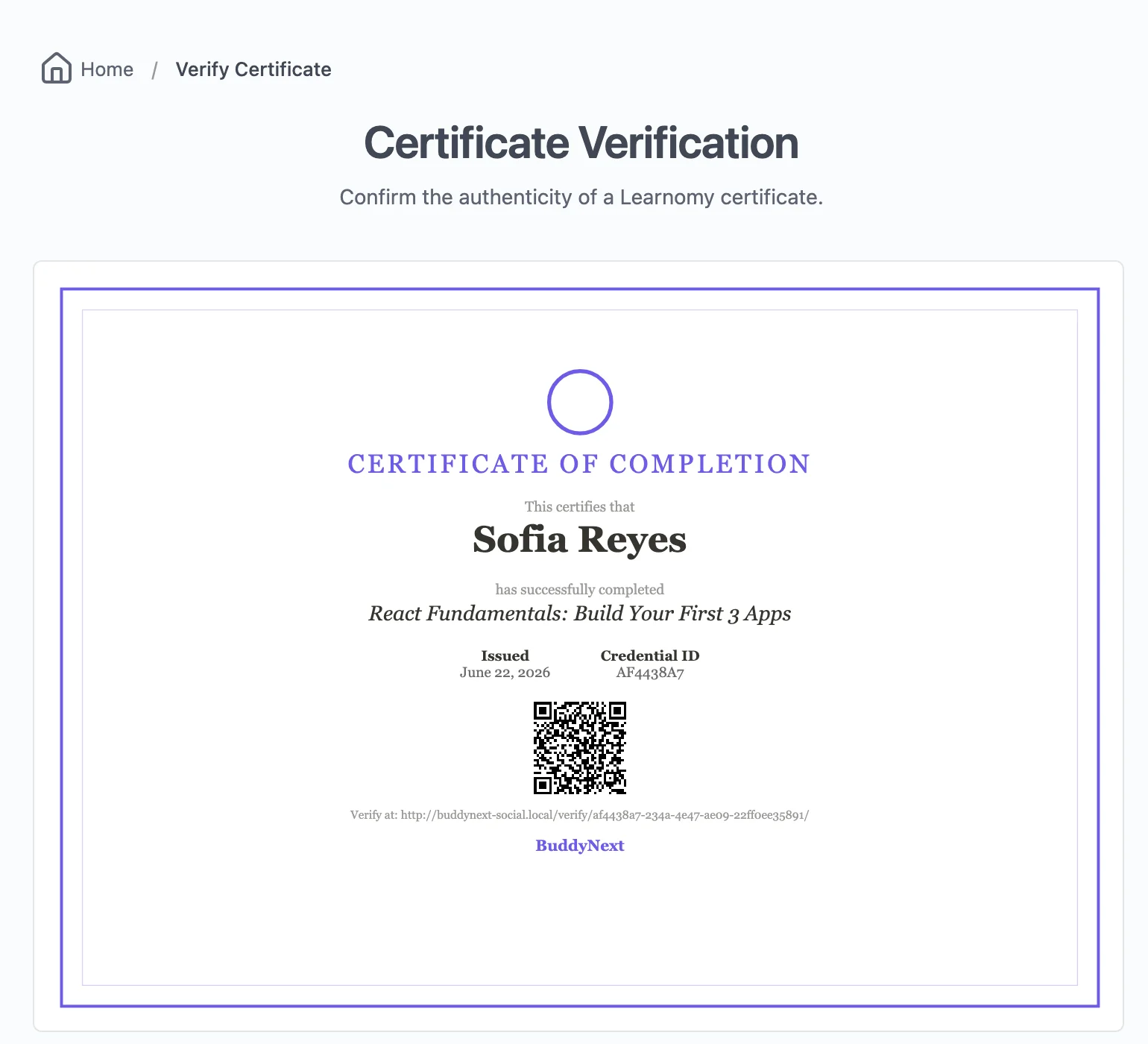
A real credential ID, a real QR code that resolves to a live public verification page, a real issue date. This is the entire product for a compliance buyer, not a bonus attached to the learning. An employer or auditor can check this exact page without an account and without trusting the student’s word for it. Remove this page, and a certification course quietly becomes a much harder sell at a much lower price, regardless of how good the underlying content is.
The specific trap: treating it like a consumer course
The trap is applying consumer-course instincts to a certification business and quietly destroying the margin advantage that made it worth building in the first place. Discounting aggressively to drive volume, the way a consumer course creator would during a launch, undermines the institutional pricing that compliance buyers actually expect and rarely questions. A serious buyer paying for documented compliance is not shopping on price the way a hobbyist browsing an evergreen catalog is, and treating them like one leaves real margin on the table for no growth benefit at all.
The second version of this trap is skimping on the verification infrastructure to save money, treating the certificate as an afterthought the way a consumer course reasonably can. For a compliance buyer, that afterthought is the actual product, and cutting corners there doesn’t just look bad, it can make the certificate functionally worthless for its actual purpose.
The pushback: “our certificate isn’t accredited by anyone official”
A fair and common concern, and worth being precise about what actually matters here. Formal accreditation from a recognized body matters enormously for some use cases, medical licensing, legal continuing education, anything with a regulator attached. It matters considerably less for a large, growing category of internal compliance and skills verification, where what an employer actually needs is proof a specific person completed specific, verifiable training, not a credential from a national accrediting body.
The honest fix, if formal accreditation genuinely isn’t available yet, is being explicit about what the certificate does and doesn’t claim, rather than either overstating its authority or underselling the very real value of a genuinely verifiable, tamper-resistant record.
Where this actually lives inside Learnomy
If you’re running certification or compliance courses on Learnomy, the free tier already includes the verification infrastructure this entire business model depends on: Ed25519-signed certificates, a real credential ID, a public verify page reachable without an account, and a QR code that resolves directly to it. That’s not a Pro upgrade sitting behind the actual product. It’s there from the first certificate issued, which matters considerably more here than it does for a consumer course where nobody’s likely to click verify at all.
Why this isn’t the same as a vanity certificate
Worth being explicit about the difference, because the two get conflated constantly. A vanity certificate, the kind most consumer courses issue, exists mainly to make the student feel good and give them something to post. Nobody downstream is likely to check it, and it doesn’t need to survive scrutiny to do its job.
A compliance certificate has to survive scrutiny, sometimes years later, sometimes from an auditor who has every incentive to find a reason to reject it. That’s a fundamentally higher bar, and it’s exactly why the margin premium exists: the buyer isn’t paying more for nicer video production, they’re paying for a document that will actually hold up when someone official goes looking.
Turning it into something you actually check
Per contract or per institutional buyer, not per individual student: revenue per buyer relationship, weighted against the real cost of maintaining verification infrastructure and any renewal or audit support that relationship requires. That number, not a per-student average pulled from a consumer-course spreadsheet template, is what actually belongs in this business’s Rule of 40 calculation.
The margin advantage of certification and compliance courses is real and substantial. It only holds up as long as the verification behind the certificate is actually as solid as the price implies it is.
Related reading