
9 min read
Learnomy 1.4.0: Run Real Certification Exams and Enterprise Content on WordPress

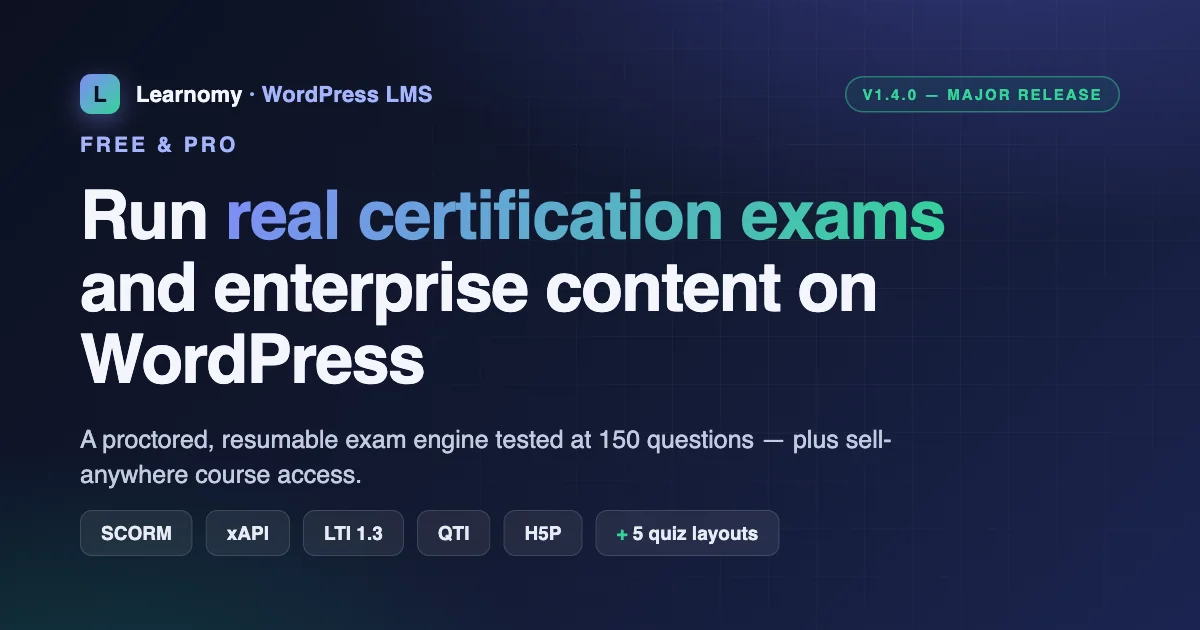
Ask most people what a WordPress LMS is for and you will hear the same answer: sell a video course, quiz the buyer at the end, hand over a certificate. Useful, but small. It is the reason serious training teams, universities, and certification bodies never took WordPress seriously as a learning platform. They needed exams that hold up under pressure, content that follows industry standards, and reporting that talks to the systems they already run. WordPress could do the first 20% of that job and none of the rest.
Learnomy 1.4.0 is the release that answers all three. This is a major version for both the free plugin and Learnomy Pro, and rather than march you through a changelog, here is the more useful question: what can your WordPress site actually do now that it couldn’t last week?
1.4.0 is the version where Learnomy stops being a courses-and-certificates plugin and becomes something you can run a real certification program on, exams, standards, and all.
Run an exam people pay to sit
There is a real difference between a quiz and an exam. A quiz forgives. An exam has to survive a dropped connection, a 150-question length, a candidate who alt-tabs to Google, and a grader who needs to trust the result months later. Learnomy now handles all of that, and it is the part of this release we are most confident about.
You pick the format to match the stakes. A timed certification final, a sectioned SAT-style paper where candidates choose their own order, a long professional exam that runs to a hundred questions, or a quick end-of-lesson check, each is a distinct layout, labelled in the editor with the job it is built for, so you are never bending one format to fit a situation it was not meant for. An instructor picking a layout reads “Focused, timed exams” and “Review board, long certification exams” and chooses correctly without a support ticket.
Put a candidate in a 150-question paper and the experience holds together. They get a clickable map of every question, can flag anything for a second look, and every answer saves the instant it is given. If the laptop dies mid-exam, they reopen it on the exact question with the exact time remaining. Nothing is lost, nothing is re-shuffled, no progress evaporates. We verified this at 150 questions, not five, because 150 is where lesser tools quietly fall apart and take a paying candidate’s afternoon down with them.
When the exam matters, so does integrity. Learnomy watches for browser tab-switching during a quiz, flags each switch for the grader, and can auto-submit the attempt after a threshold you set. It is not a gotcha: the candidate reads the rules on the start screen before they begin, so the monitoring is disclosed, not sprung. Every attempt then produces an integrity report carrying the tab-switch count, the submission IP address, and any late-submission signal, the evidence a grader needs if a result is ever disputed.
And the score finally means something. Group your questions by subject or category and the results come back broken down per category, so a flat 72% turns into “strong on algebra, weak on geometry.” That is the line between a grade and a diagnostic. A grade closes the book; a diagnostic tells the learner exactly what to study next, and tells you where your course is failing people.
Bring your existing content in, it doesn’t have to be built here first
This is the change that moves Learnomy out of the hobbyist bracket entirely. Training content in the real world already exists, and it exists in standard formats, SCORM packages exported from authoring tools, question banks in QTI, interactions built in H5P, activity streams flowing into a corporate LRS. Until now, WordPress couldn’t read a single one of them. You either rebuilt everything by hand or you bought a different platform. Learnomy Pro 1.4.0 speaks five of those languages fluently.
Drop a SCORM 1.2 or 2004 package in as a lesson and it plays inside a sandboxed runtime, reporting CMI completion straight into Learnomy’s own progress and a tracking report, no separate SCORM cloud, no iframe to a third party. Point Learnomy at any xAPI LRS and it streams answered, passed, and failed statements out with retry and a delivery log you can actually inspect when something looks off. Register Learnomy as an LTI 1.3 tool inside a parent platform and a university’s system can launch your course, sign the learner in over validated OIDC, and receive the grade back automatically through AGS. Import a QTI 2.x or 3.0 assessment and it becomes native Learnomy questions that grade in the engine you already use, parsed safely with no XXE exposure. Author H5P interactions as lessons and their native xAPI completion lands in the same single progress pipeline as everything else.
The practical effect is worth saying plainly: a corporate training team can migrate off an expensive enterprise LMS without rebuilding a single course, and a WordPress site can now sit inside an institutional learning stack instead of off to the side as the cheap option. That is not one more feature on a list. It is a different weight class, and it is the reason we called 1.4.0 major.
What changed, in one view
| The job | A typical WordPress LMS | Learnomy 1.4.0 |
|---|---|---|
| 150-question timed exam | Loses progress on refresh; no resume | Autosave, question map, resume to exact question and time |
| Exam integrity | Trust-based, no signals | Tab-switch tracking, IP, auto-submit, grader report |
| Existing SCORM / QTI content | Cannot import | Imports and reports natively |
| Reporting to an LRS or parent LMS | None | xAPI to any LRS; LTI 1.3 grade passback |
| Selling off-platform | Manual account creation | Signed webhook, CSV, or email, auto-revoke on refund |
| Quantitative subjects | String-match only | Numeric, symbolic, and calculated math with KaTeX |
One progress pipeline, not five silos
Speaking five content standards would mean little if each one reported into its own corner. The quiet engineering win in 1.4.0 is that they don’t. A native Learnomy quiz, a SCORM package’s CMI completion, an H5P interaction’s xAPI statement, and a grade passed back over LTI all land in the same progress and reporting pipeline. One learner record. One completion state. One place to look.
That matters the moment you try to run a real program. A compliance manager asking “who finished the safety course?” should not care whether that course was a native quiz or an imported SCORM module, and now they don’t have to, the answer comes from one report either way. The same single path means that as more standards arrive (cmi5 already has a code-verified implementation plan for a later release), they plug into machinery that already exists rather than bolting on another silo. You get consistency today and a clear runway for what comes next, instead of a pile of half-connected integrations that each need their own dashboard.
Sell it wherever you already sell
Your best sales channel might not be WordPress at all. It could be Gumroad, a course marketplace, a partner’s site, an affiliate, or a CRM checkout your sales team already runs and does not want to move. The new Closed pricing model is built for exactly that situation: sell the course anywhere you like, and grant the access here.
Enrol a single buyer by email, upload an entire corporate cohort by CSV, or wire your external checkout to a signed webhook that grants access the instant payment clears and revokes it automatically the moment a refund goes through. The webhook is HMAC-signed, so Learnomy only honours a request it can cryptographically verify, an unsigned call at the door that grants paid access is rejected, not processed. And because the point is to remove friction, there is a copy-paste connection recipe sitting right on the Webhooks screen, so connecting your existing stack does not require a developer on the call. Sell however your business actually works. Fulfil it all in one place.
Teach subjects that need real math
If you teach anything quantitative, matching answer strings is worse than useless, it marks a correct answer wrong because a learner wrote 1/2 instead of 0.5. Learnomy Pro now grades numeric answers with a tolerance you set, checks symbolic math for genuine equivalence rather than an exact character match (and never runs eval to do it, so an answer field can’t become an attack surface), and can randomize the variables in a question so every learner sits a slightly different version of the same problem. All of it renders through KaTeX, so a quadratic formula looks like a formula instead of a line of slashes and carets. Engineering, finance, statistics, physics, chemistry, the courses WordPress LMS plugins usually cannot assess at all, are now genuinely on the table.
Shape the platform to your model, not the reverse
Not everyone wants a marketplace. If you are a single expert running your own academy, every instructor-registration link and commission setting is clutter that also confuses your students. One switch, Solo Academy mode, hides every marketplace surface at once (instructor registration, commissions, earnings, become-an-instructor prompts) and turns the revenue-split module off, leaving a clean single-owner LMS with nothing to hunt down and disable by hand.
Running a multi-instructor operation instead? Leave it on, and in Pro you can organize larger cohorts into sub-groups, each with its own managers and its own scoped course access, so a 500-person client program does not collapse into one undifferentiated member list. The same install serves the solo coach and the multi-team academy. The platform bends to how you run; you don’t rebuild your operation to fit the platform.
Who 1.4.0 is really for
A few pictures of who this release unlocks WordPress for, because “major release” means little until you see yourself in it:
- Certification bodies that need a defensible, proctored, resumable exam with a per-attempt integrity trail, and a certificate at the end that actually verifies.
- Universities and training providers whose central system speaks LTI and expects a tool to launch cleanly, sign the student in, and hand a grade back.
- Corporate L&D teams sitting on a library of SCORM courses who want to leave a costly enterprise LMS without throwing that library away.
- Test-prep and exam-coaching businesses running sectioned, SAT/GRE-style papers with subject-by-subject scoring that tells a student where to focus.
- Course sellers whose real checkout lives on Gumroad, a marketplace, or a CRM, and who just need access granted here without manual account admin.
- Instructors of quantitative subjects who have never been able to auto-grade a maths answer properly on WordPress.
How big is 1.4.0, really?
Big. The free plugin alone adds around a dozen new capabilities on top of a long list of refinements, the exam engine and its five layouts, subject grouping, proctoring, Closed pricing, Solo Academy mode, native Fediverse (PeerTube) video, course-search autocomplete, and the content-standard foundation that the Pro modules plug straight into. Learnomy Pro adds the five content standards, the advanced math question types, a WP Fusion bridge so CRM tags can gate courses and enrol members, and Spaces sub-groups. Nine free locales ship at full translation coverage: German, French, Spanish, Italian, Dutch, Brazilian Portuguese, Polish, Swedish, and Russian.
The dividing line between free and paid is simple. The exam engine, the quiz layouts, proctoring, subject scoring, Closed pricing, Solo Academy, and Fediverse video are all in the free plugin. The five content standards, the math question types, the WP Fusion bridge, and Spaces sub-groups are in Pro. Learnomy Pro 1.4.0 requires Learnomy 1.4.0, so update the pair together in one sitting rather than one now and the other later.
If you have only ever seen Learnomy as a courses-and-certificates plugin, this is the version that changes the category it belongs to. New to it? The story of why we shipped an LMS this late, and the case for it being built to outscale the field, are both worth reading first. Then update, load the demo, it now seeds a categorized certification exam, so you can see grouped scoring and the question map on a fresh install without building anything, and run the exam engine through its paces yourself. It holds up. That was the whole point.
Related reading