
10 min read
We Are Late to the WordPress LMS Market. On Purpose.

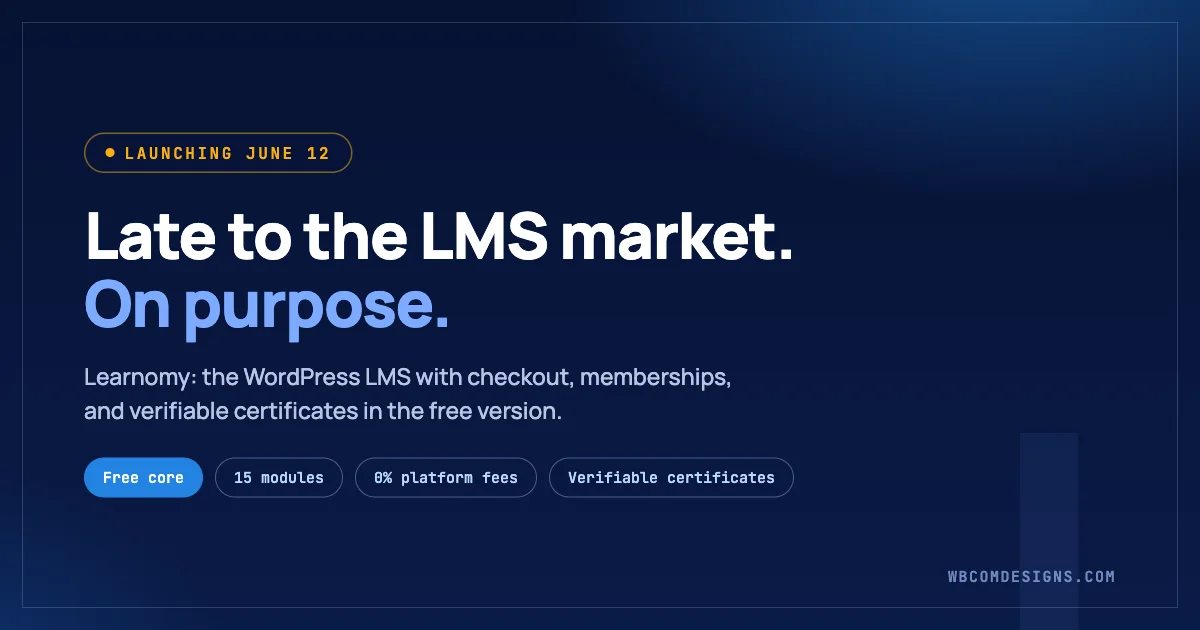
On June 12 we ship Learnomy, our first LMS. After sixteen years and more than a hundred WordPress products, an LMS is the one category we never touched. That was deliberate, and this post is the honest version of why.
Are we too late? We asked ourselves the same question.
The WordPress LMS market is crowded and mature. LearnDash has been selling since 2013. Tutor LMS and LifterLMS have six-figure install bases. Hosted platforms like Teachable and Thinkific spent the last decade convincing educators that renting a school is normal. Walking into that in 2026 sounds like bad timing.
We see it differently, and not as a motivational poster. Markets get re-won at platform shifts, and the LMS category is sitting on three of them at once.
First, the architecture shift. Every major LMS plugin was designed before 2020, on WordPress post types and post meta, with addon economics layered on top. They cannot restructure without breaking their installed base. Their biggest asset is also their cage. A new entrant is not racing them; it starts where they cannot go.
Second, the ownership shift. Hosted course platforms raised prices repeatedly while keeping transaction fees and the student list. Creators are actively moving toward platforms they own. That audience barely existed when the incumbents were designed, and none of them were built to serve it.
Third, the AI shift. Software is starting to be operated by agents, not just clicked by humans. No existing LMS is built for that. Learnomy registers every LMS action with the WordPress Abilities API, which means an AI assistant can discover and safely operate your school with proper permission checks. On this axis we are not late. We are first.
We are not late to the LMS market. The incumbents are early: they shipped before built-in payments, data ownership, and AI mattered. It is never too late to enter a market. You just have to be better, and stable.
History agrees with the pattern. Zoom arrived a decade after WebEx. Notion arrived a decade after Evernote. In a growing market, and e-learning is still growing fast, the prize is not the incumbent’s existing customers. It is everyone who starts an academy next year.
What ten years of support tickets taught us
We did not learn the LMS market from analyst reports. We learned it from support queues, because a large share of the sites running our BuddyPress community plugins and Reign and BuddyX themes also run a course plugin next to them. The same four problems came up year after year.
The free tier is usually a demo. Most LMS plugins give you a course builder for free and hold checkout, memberships, and certificates hostage behind a yearly license. You pay before your first student does. For a teacher testing an idea, that is backwards: the risk should sit with the software vendor, not the educator.
The addon economy punishes growth. A quiz addon here, a membership plugin there, a payment gateway connector somewhere else. Three vendors, three renewal dates, three support queues, and one fragile stack where every update day is a small gamble. The cost is not just the invoices. It is the integration debt.
Post meta does not scale. Storing enrollments, attempts, and progress as WordPress post meta works beautifully in a demo and painfully at ten thousand students. By the time a site owner feels it, migrating away is a project nobody budgeted for.
Certificates are decorative. A PDF with a gold border proves nothing. Employers cannot verify it, registrars cannot trust it, and students cannot do much with it beyond attaching it to an email.
Learnomy is our answer to all four, in one plugin.
We integrate Claude and OpenAI directly into existing CRM and business apps with cost controls and observability built in. See the service.
Better: what the free version refuses to hold back
The free Learnomy ships with 15 toggleable modules, and they include the ones that make money. This is the part that makes Learnomy structurally different rather than incrementally nicer:
- Stripe and PayPal checkout built in. Students pay into your own account, with 0% platform fees. A WooCommerce adapter is there if you already sell through Woo. Coupons with usage limits and expiry dates are included.
- Membership plans included. Monthly or yearly billing, free trials, invoice history, and one-click cancel. Bundle your catalog into an all-access plan without buying a separate membership plugin.
- Certificates anyone can verify. Every certificate is cryptographically signed and carries a QR code pointing to a public verification page. An employer or registrar confirms authenticity in one click, no account needed. We believe this is a first in the LMS market, hosted platforms included.
- Instructor revenue sharing. Udemy-style commission splits tracked automatically on every sale, with instructor dashboards and withdrawal requests in the free version. Multi-teacher academies do not need a marketplace addon.
- The complete teaching core. Unlimited courses with video, audio, PDF, and reading lessons. Six quiz question types with partial credit and an essay grading inbox. Full-text course search, JSON-LD schema for SEO, student dashboards with dark mode, and GDPR export and erase tools.
- App-ready from day one. A 164-endpoint REST API with JWT authentication, batch requests, offline progress sync, and a PWA, so the mobile app you are planning talks to the same API the site already uses.
The 15 modules, by name
Modularity is its own feature. Each capability below is a switch on a single Modules screen; a disabled module disappears from your admin menu and registers nothing, so the plugin is exactly as big as your school needs it to be.
Courses for the builder and catalog (walkthrough here). Enrollments for free, paid, manual, or membership access per course. Progress for completion tracking and resume-where-you-left (see how it’s tracked in our analytics deep dive). Quizzes for the six question types, the question bank, and the grading inbox, full breakdown here. Certificates for signed credentials and the public verification page (details here). Reviews for ratings with moderation. Notifications for the in-app bell, announcements, and email templates. Search for instant full-text course search. SEO for schema and sitemaps. Payments for Stripe, PayPal, and the WooCommerce adapter (why WooCommerce is optional). Memberships for plans and trials (see the eight pricing models). Commissions for instructor revenue sharing (how the split actually works). Coupons for discounts with limits and expiry. PWA for the installable app experience with offline sync (covered in detail here). AI Abilities for the agent-ready action registry.
Run a simple corporate library with five modules, or a full marketplace academy with all fifteen. The toggle is yours.
The honest comparison
Here is the same checklist most educators end up making by hand, side by side. We kept it factual: these are launch-day capabilities of free versions, not roadmap promises.
| Capability | Learnomy free | Typical LMS free tier | Hosted platform |
|---|---|---|---|
| Cost to start | $0 | $0 | $39 to $199 per month |
| Take payments | Built in, 0% fees | Paid addon or Woo required | Up to 10% transaction fees |
| Membership plans | Included | Separate plugin | Higher tiers only |
| Verifiable certificates | Signed, public verify page | Static PDFs | Static PDFs |
| Revenue sharing | Included | Pro or addon | Not offered |
| Your student data | Your database | Your database | Their servers |
| Mobile app path | REST + JWT + offline sync | Per-app licensing | Their app, their brand |
Stable: the part that does not fit in a feature list
Better features are the easy half of the promise. The stable half is structural, and it is the half we are proudest of, because it is the part you cannot bolt on later.
Real database architecture. Learnomy stores LMS data in 40 dedicated tables with composite indexes designed for sites holding 100,000+ enrollment rows. Catalog search runs on MySQL full-text indexes rather than LIKE queries. No custom post types, no meta bloat, no mystery slowdowns the month your academy succeeds.
A release gate that cannot be talked out of. Every release passes static analysis, WordPress coding-standard checks, end-to-end flow tests, and a browser-driven smoke suite before it can even be packaged. The smoke suite is built from a catalogue of 191 real user journeys: a student finishing a lesson on a phone, an essay moving through the grading inbox, a refund correctly reversing an instructor commission, a webhook retrying after a timeout. If a journey fails, the release zip is never produced. There is no override path for customer releases.
Beta discipline. Learnomy spent months in internal beta against seeded sites with realistic data volumes. We fixed the boring bugs, the ones that only appear at row 80,000, before asking anyone for money.
Sixteen years of release scars. We maintain a hundred-plus plugins on thousands of live sites. That history shaped one rule for Learnomy: a feature is not done when it works in a demo. It is done when it survives a semester.
Who we built it for
Independent educators and coaches get a first paid course live the same afternoon, with checkout and certificates working before any license is purchased.
Schools and training centers move classroom material online without per-student fees, keep completion records on their own server for compliance, and enroll whole classes at once.
Universities and departments get instructor-level revenue tracking, cryptographically verifiable credentials, and, with Pro, isolated spaces per department with their own rosters.
Training companies are the reason Learnomy Pro exists. Companies buy 10, 50, or 500-seat packs straight from your pricing page, get a branded space, and manage their own roster while you keep the revenue. Instructor payouts run themselves through Stripe Connect. The analytics speak MRR, churn, and cohort retention, because a growing academy is a business and deserves business numbers.
What Pro adds, and what it costs
Learnomy Pro is one license that activates all 16 extensions in every tier: Spaces for B2B seat packs, learning paths, content drip, cohorts, advanced quizzes, assignments, automatic Stripe Connect payouts, membership operations with proration and dunning, analytics, student notes, webhooks, user journeys, a frontend course builder, Open Badges 3.0 and Credly export for portable credentials, white-label, and ecosystem bridges. Tiers differ only by site count: Personal at $149, Professional at $249 for five sites, and Agency at $399 for unlimited sites, each with a lifetime option and a 30-day money-back guarantee.
No extension is sold separately, and nothing in this paragraph is gated by tier. We watched the addon economy long enough to know we did not want to run one.
Questions we are already getting
Is the free version actually enough to run a school? Yes. Courses, quizzes, grading, certificates, checkout, memberships, and revenue sharing all work with no time limit and no student cap. Pro exists for growth features, not for basics held back.
Can we migrate from LearnDash or Tutor LMS? Importers are on the roadmap for the first post-launch releases. If you are planning a migration, join the notify list and reply to the launch email; migration cases are shaping the importer priorities.
Does Pro require the free plugin? Yes. Pro extends free Learnomy rather than replacing it, so your data lives in one place and the free plugin keeps improving for everyone.
Will it work with our theme? Any WordPress theme, classic or block. Templates can be overridden in your theme the same way WooCommerce templates can, and the student-facing pages inherit your typography and colors.
Is there a lifetime option? Yes, on every Pro tier: $399 for Personal, $599 for Professional, and $999 for Agency. Pay once, keep every future update, no renewal calendar to manage.
What exactly happens on June 12? Both plugins go on sale, the waitlist gets one email with a launch-week discount code, and the free download opens to everyone. The documentation is already public today, and free and Pro ship in lockstep versions from day one.
June 12
Learnomy and Learnomy Pro launch on June 12. The pages are already live if you want the full picture before then:
- Learnomy for educators and schools, including the complete free vs Pro breakdown, all 40 rows of it
- Learnomy Pro for institutions and training companies
- The documentation, all 52 guides, public before launch day
Join the notify list on either page and you will get exactly one email on launch day, with a launch-week discount code attached.
We took our time building this one, and we intend to keep working at the same pace after launch day. Your school gets the benefit of both, on June 12 and on every release that follows.
Related reading