
17 min read
How to Become an Online Community Leader: Practical Guide for Founders


Most people who start online communities do not think of themselves as leaders. They think of themselves as builders. They get the platform up, seed the first posts, invite the first fifty members, and then wait for something to happen. When it does not, they wonder what went wrong with the technology.
The technology is almost never the problem. The problem is that no one stepped into the leadership role. Someone has to set the direction, shape the norms, kick off the hard conversations, and pull the right people forward. That job is community leadership, and it is different from being an influencer, a moderator, or a content creator.
This guide is for founders, course creators, and indie creators who are building a community from scratch or have one that has stalled. By the end you will have a clear picture of what the role actually requires, a 90-day plan for your first phase, and a framework for scaling once the community outgrows you as the sole leader.
Updated August 2026: this guide now covers BuddyNext.
What Community Leadership Actually Means
The word leadership gets attached to a lot of roles that do not quite fit. Here is what community leadership is not, and what it actually is.
It is not the same as being an influencer
Influencers broadcast. Their metric is reach. They publish content to an audience that consumes it passively. A community leader facilitates. Their metric is participation. The goal is to make other members the protagonists, not themselves. The moment a community becomes a content channel with comments, it stops being a community.
It is not the same as being a moderator
Moderation is reactive. It catches problems after they appear. Leadership is proactive. It shapes the conditions so that fewer problems appear in the first place. You need both, but a moderator who has never been given a vision will enforce rules without understanding the intent behind them. That creates a community that feels policed rather than guided.
What community leadership actually is
Community leadership is the sustained practice of holding the purpose, protecting the culture, accelerating connections between members, and making it possible for the community to function without you being present for every interaction. A well-led community does not collapse when the founder takes a two-week break. A poorly led one does.
Three concrete responsibilities define the role:
- Vision clarity: Members should be able to explain in one sentence what the community is for and who it serves. If they cannot, that is a leadership gap.
- Culture maintenance: Every norm, every welcome message, every piece of public moderation sets a precedent. Leaders set those precedents deliberately.
- Enabling participation: The best community leaders make it easy for shy or new members to contribute something. Low-friction participation paths are a leadership design choice.
The Five Leadership Roles You Will Play
In early-stage communities, one person holds all five of these roles. As you scale, you distribute them. But you cannot distribute what you have not first understood and practiced yourself.
1. Vision-Setter
The vision-setter defines the community’s purpose and repeats it often. Not in a corporate mission-statement way, but in the specific, contextual way that answers the question every new member silently asks: Is this for someone like me?
Practical actions for the vision-setter role:
- Write a founding post that explains why this community exists and what it is specifically not trying to be.
- Revisit the welcome message every 90 days. Communities drift. Your positioning should drift with them, or against them, deliberately.
- Use member language, not founder language. Read your members’ posts and steal their vocabulary.
2. Culture-Keeper
Culture is not what you write in the rules. It is what you allow when no one is paying attention, and what you shut down when everyone is watching. Culture-keepers treat every public interaction as a signal to the whole community about what is and is not acceptable.
The culture-keeper’s toolkit:
- Public praise for the behavior you want more of. When a member posts something vulnerable and generous, call it out by name.
- Private correction for minor violations. Public shaming creates defensiveness; private messages create change.
- Hard removal when behavior is toxic and persistent. Every day you tolerate a bad actor, you signal to good members that you do not have their backs.
3. Conflict-Resolver
Conflict in communities is inevitable. The quality of your conflict resolution determines whether conflict destroys trust or builds it. Most new community leaders avoid conflict, hoping it resolves itself. It rarely does.
A simple conflict resolution framework for community leaders:
- Acknowledge fast. Do not let a thread fester for 48 hours while you decide what to do. A brief note that you see the issue stops escalation.
- Move to private. Get the parties into a DM or a private thread. Public disputes perform for an audience; private ones solve problems.
- Name the standard. The resolution should reference the community’s stated values, not your personal preferences.
- Close the loop publicly. After a conflict is resolved, a brief public note reassures everyone else that leadership is present.
4. Content-Prompter
In a young community, the leader is often the primary content generator because members are still watching to see what kind of participation gets rewarded. The content-prompter role is less about creating content and more about creating conditions for others to create content.
Three prompting techniques that work:
- Weekly questions: A standing weekly thread with a specific question pulls in members who would not initiate a post on their own.
- Win shares: Ask members to share a recent win. These posts create social proof and pull lurkers out of hiding.
- Introductions with a twist: Instead of a plain introduce-yourself prompt, ask members to share the last thing they shipped or the one thing they wish someone had told them earlier. Constrained prompts generate better responses than open ones.
5. Growth-Driver
This is the role most founders default to, often at the expense of the others. Growth-driving means bringing in new qualified members, keeping existing members active, and identifying the moments where members are most likely to churn.
The growth-driver thinks in three horizons: acquisition (who joins and why, measured by qualified member growth rate), activation (the first 7 days experience, measured by new member post rate), and retention (month two through six engagement, measured by 90-day active rate). Retention is where most community leaders spend too little time. Acquiring members while leaking them at the back end is a treadmill. A community with 200 highly active, long-term members is worth more than one with 2,000 members and a 10% monthly active rate.
Your First 90 Days: Rituals, Kickoff Posts, and Milestones
The first 90 days of a community are the highest-leverage period you will ever have. Norms are not yet set. Members are still paying attention to the leader. You have the most influence and the lowest cost per interaction.
Week 1: Foundation rituals
Before anyone else joins, create the structural posts that every member will encounter:
- A founding post: Why this community exists, who it is for, and what you will not tolerate. Pin it.
- A community handbook: Three to five ground rules in plain language. Not “do not be rude” but “when you disagree, describe the idea you are pushing back on, not the person who raised it.”
- An introduction template: Make it easy for new members to introduce themselves in a way that surfaces the information your community values.
- A first question post: Something specific and answerable that invites the first ten members to contribute. Generic questions get no responses.
Milestone: First 10 members
Your first ten members are not a sample of your eventual audience. They are the people who will define the community’s initial culture. Recruit them deliberately: pick ten people whose work you respect and who represent the community you want to build. Invite them personally, not with a broadcast announcement. Tell each one specifically why you want them there. Ask them to post something in the first 48 hours and give them a specific prompt. The quality of the first ten posts sets the standard. Future members will pattern-match against what they see.
Days 8-30: Weekly rituals
Consistency beats intensity. A community that has one major event and then goes quiet for three weeks trains members to be passive. Build a simple weekly rhythm:
- Monday: Weekly question or challenge post. The same slot, every week.
- Wednesday: Highlight a member or a piece of member content. Call out what made it worth sharing.
- Friday: A short leader update. What you learned, what you shipped, or what you are thinking about. This keeps you visible and models the kind of sharing you want from members.
Milestone: First 50 members
At 50 members you will start to see natural connectors: people who reply to multiple threads, welcome newcomers without being asked, and generate more conversation than they consume. These are your future moderators and ambassadors. Do not wait until you need them to start nurturing the relationship. Start having one-on-one conversations with them now.
At this stage, also run your first explicit feedback loop: ask members what they joined for and whether the community is delivering it. You will almost always find a gap between what you thought the community was and what members actually experience.
Days 31-90: Depth over breadth
Resist the temptation to focus entirely on member count. At 50 members, you have enough people to create genuine value. The priority now is engagement depth: are members forming relationships with each other, not just with you? Are they tagging each other in relevant threads? Are they connecting outside the community?
If the answer is no, the community has a hub-and-spoke problem. Everything routes through you. Fix it by creating spaces where members can find each other by interest, skill, or project type. Subcategories, tags, and curated groups serve this function. If you are building on WordPress with BuddyNext, the free Community OS for WordPress, Spaces (open, private, or secret) and hashtag-based discovery give you this architecture directly, without a custom build.
Milestone: First 100 members
At 100 members, the dynamics change. You can no longer maintain a personal relationship with everyone. You need systems to replace memory: onboarding sequences, automated welcome messages, and a clear process for how new members find their feet without depending on your direct attention. This is also the stage where you should define your first moderation delegation. Identify two or three members who have been active since early days, understand the culture, and handle disagreements with good judgment. Give them a formal role with clear scope and regular check-ins.
Tools You Actually Need
Community technology has a habit of expanding to fill whatever budget and attention you give it. Resist the tool sprawl. In the first year, you need four things.
1. A community platform with moderation depth
Your platform needs to support member profiles, activity streams, groups or subcommunities, and moderation controls that go beyond a simple block button. For communities built on WordPress, BuddyNext, the free Community OS for WordPress, is the most flexible free option - it stays on your infrastructure, integrates directly with your user management, and ships reports, strikes, suspensions, and appeals natively, without vendor lock-in.
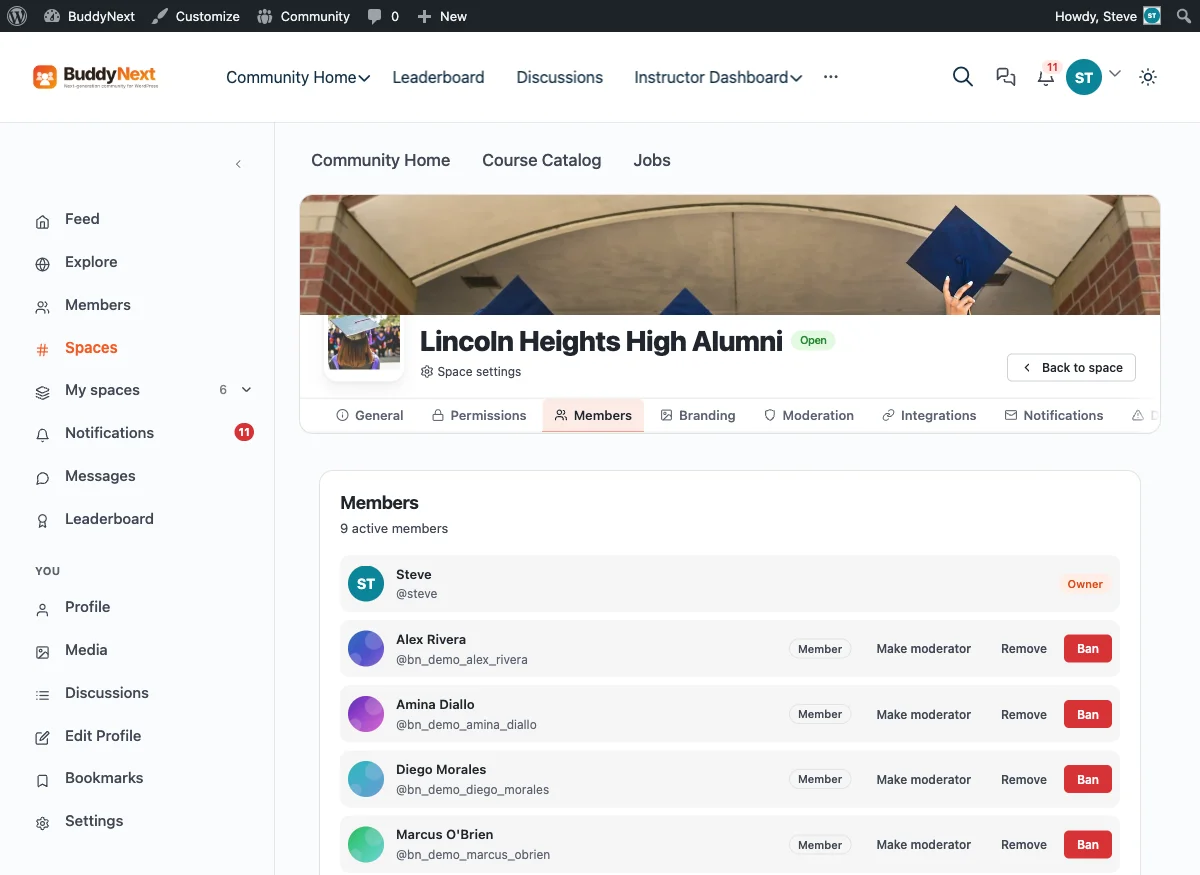
The specific features to evaluate when choosing a platform: Can moderators flag content without removing it immediately? Is there an appeal process for bans and suspensions? Can you control what activity is visible to non-members? Does the platform support private groups alongside public ones? These questions matter because they determine how much leadership leverage your platform gives you. Here’s what delegating a moderator role actually looks like once you have real members - a live BuddyNext Space, not a mockup:
2. A simple CRM or member tracker
You do not need Salesforce. You need a place to note which members are high-potential connectors, who has been quiet for 30 days, and who you want to promote to a leadership role. A spreadsheet with member names, join date, last active date, and a notes column is enough for the first 200 members. The discipline of maintaining it matters more than the tool you use.
3. Moderation tooling
Reactive moderation does not scale. As your community grows, you need keyword filters, automated flagging for certain types of content, and a queue system that lets moderators review flagged posts before they go live in sensitive areas. BuddyNext ships this natively - banned words/hashtags/domains, auto-hide thresholds, and a moderation log visible to the leadership team - free, with no separate plugin. See our full community moderation guide for the complete workflow.
4. An analytics layer
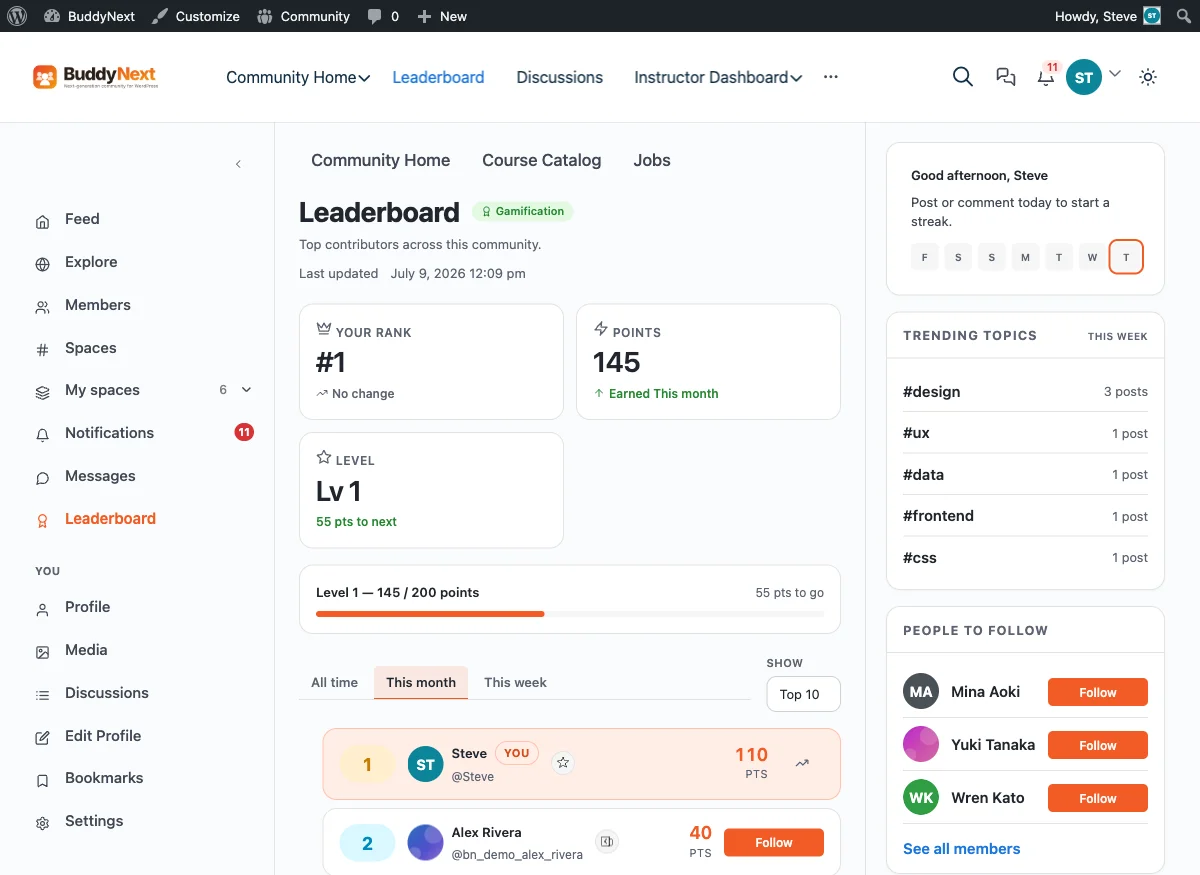
You need to track three numbers at minimum: daily active users, new member post rate in the first 7 days, and 90-day retention rate. Most community platforms expose these in some form - BuddyNext’s free tier includes a leaderboard that surfaces your top contributors at a glance, which is the fastest way to spot the connectors worth promoting to moderator before you’ve read a single thread:
If your platform exposes none of this, set up a simple event tracking system. You cannot improve what you cannot measure, and the metrics you ignore in month two are usually the ones that cause problems in month six.
Mistakes New Community Leaders Make
Building before you have members
Most founders spend 80% of their early energy on platform configuration and 20% on finding people. This ratio should be reversed. A plain forum with 50 active members is worth more than a beautifully designed platform with five. Get your first ten members committed before you build anything beyond the essentials.
Treating all members the same
Not all members create the same value. Twenty percent of your members will generate 80% of the valuable content and connections. Identify those people early, invest in those relationships, and design programs specifically for them. A tiered membership structure, an invite-only inner circle, or a contributor recognition program are all ways to acknowledge and retain your highest-value members.
Optimizing for size over quality
A community of 500 people who share a specific, well-defined problem is more valuable to each member than a community of 5,000 people with loosely overlapping interests. Narrow your definition of who the community is for. Be willing to turn away applicants who do not fit. The tighter the filter, the higher the average value of every connection.
Disappearing after the launch
Community leaders underestimate how much the community’s energy tracks their own presence, especially in the first six months. You do not need to post ten times a day, but you do need to be reliably present. If members cannot predict when you will show up, they stop expecting you to, and they stop showing up themselves.
Waiting too long to delegate
The founder who tries to remain the single point of contact for a 500-person community will burn out, and the community will feel the strain. The goal of the first 90 days should be to identify the first two people you can hand moderation and content prompting to. These are not replacements. They are a structure that lets you operate at the strategic level instead of being in every thread.
Scaling Leadership: Moderators, Ambassadors, and Community-Led Growth
The test of good community leadership is whether the community could survive six months without you. Most cannot. Here is how to build toward a community that runs on distributed leadership.
The moderator layer
Moderators handle the operational side of community health: flagging bad content, welcoming new members, enforcing rules consistently. Good moderators share the leader’s values but need not share their vision. They need clear guidelines, a direct line to leadership for edge cases, and regular recognition for the work they do.
How to recruit and onboard moderators: watch for members who naturally correct misinformation, welcome newcomers, and de-escalate arguments without being asked. Invite them privately and tell them what you noticed and why you think they would be good at this. Give them a trial period with limited permissions. Create a private moderator space where the team can discuss edge cases and maintain consistent standards. Check in with moderators monthly, because burnout is the leading cause of moderator attrition.
The ambassador layer
Ambassadors are your growth drivers. They bring in new members, represent the community in external channels, and create the informal social proof that turns potential members into actual ones. Unlike moderators, ambassadors operate primarily outside the community platform.
Ambassador programs work best when they are tied to something specific. Not “tell people about us” but “when you meet someone who is dealing with X problem, send them here and tell them why.” Give ambassadors a specific invite path, a referral tracking mechanism, and a visible reward that acknowledges their contribution publicly.
Community-led growth
Community-led growth is the stage where the community itself becomes the primary acquisition channel. Members bring in members not because they are in an ambassador program but because they genuinely want the people they respect to have access to the same resource. This emerges from two conditions: high member satisfaction and low friction to share.
You can accelerate it by making it easy for members to share specific posts or discussions outside the platform, running member-generated events like office hours or peer workshops, and publishing a community-sourced digest that members can share as a regular artifact of what happens in the community.
The platform infrastructure that makes scaling possible
Scaling leadership is not just a people problem. It is a platform problem. A community that runs on a platform that was never designed for distributed moderation or activity at scale will hit architectural ceilings that no amount of leadership skill can overcome.
When we build community platforms for clients at Wbcom Designs, the architecture decisions made at the start determine how much leadership can scale three years later. The platforms that scale best have fine-grained permission systems, content moderation workflows that do not require an admin for every decision, and analytics that surface the members and content worth paying attention to - this is exactly what BuddyNext’s Space-level roles, native moderation, and leaderboard are built to do. You can see how we approach this work on our community platform services page.
If you are evaluating whether your current platform can support your growth, ask: Can you delegate moderation without giving away admin access? Can members self-organize into sub-groups with their own norms? Can you identify your most active and at-risk members without manually scanning every thread? If you cannot answer yes to all three, your platform is going to create a leadership bottleneck before your community does.
Building on the Right Foundation
Leadership strategy and platform architecture compound each other. A founder who understands community leadership but is on a platform that cannot support their moderation needs will spend leadership bandwidth on operational problems. A founder with a solid platform but no leadership framework will have a well-organized community with nothing to organize around.
At Wbcom Designs, we have built community platforms across a range of contexts: paid membership communities, open professional networks, course-and-community combinations, and enterprise social intranets. The founders who succeed combine a clear-eyed view of their leadership role with a platform architecture that can grow with them.
If you are building a community platform and want to make sure the architecture supports your leadership model, the two most common questions we get at this stage: Should you build on WordPress or a dedicated community SaaS? For founders who are serious about data ownership, customization, and long-term cost, WordPress with BuddyNext is the better foundation - free to start, no per-member SaaS fees. The post on why community and membership sites should think carefully before going headless covers this decision in full.
The second common question: how do you set up moderation without it consuming all of your team’s time? Automated moderation at the content level, combined with clear escalation paths for moderators, handles 90% of cases without human review. This is why every community platform we build includes a moderation workflow layer from the start, not as an add-on once problems appear.
The Practical Summary
Community leadership is a practice, not a personality type. You do not need to be charismatic or prolific or always online. You need to be consistent, deliberate, and willing to play five different roles depending on what the community needs at a given moment.
The founders who build communities that last are the ones who treat leadership as a serious skill to develop, invest in the platform infrastructure that makes scaling possible, and distribute leadership to trusted members before they are desperate for help.
Start with your first ten members. Get them posting. Build the weekly rhythm. Watch for the connectors who show up naturally. And build on a platform that can grow with you.
The best community leaders make it easy for other people to step forward. Their job is not to be the center of the community; it is to make the center irrelevant.
Ready to Build Your Community Platform?
If your community is outgrowing its current platform, or you are starting from scratch and want to get the architecture right the first time, our team at Wbcom Designs builds custom WordPress community platforms using BuddyNext with integrated moderation, roles, and leaderboard analytics built in from the start. We have delivered community platforms for membership sites, professional networks, learning communities, and enterprise intranets.
Start a project conversation with our team or review our work on the community platform development page. If you are evaluating options, the guide to organizing community content at scale on WordPress is a useful reference for understanding what the build decisions look like in practice.
Related reading