
6 min read
Burn Rate For Online Course Businesses

Every course business has a runway, whether or not anyone’s bothered to calculate it. Cash goes out every month, content production, ads, tools, contractor invoices, and cash comes back in from sales, usually on a slower, lumpier schedule than the spending. The gap between those two timelines is the actual number that decides whether a course business gets to see its second year, and most creators never sit down and compute it until the gap has already become a crisis.
If you’ve read the piece on the Rule of 40 for course businesses, that one was about whether the growth-and-margin tradeoff was healthy. This one is about something more immediate: how much time is actually left before the answer to that question stops mattering.
In this pieceWhat burn rate and runway actually mean
Gross burn versus net burn, and why the difference matters
What actually counts as burn for a course business
A real course, and what it actually costs to keep selling
The front-loaded trap: mistaking a launch spike for a stable burn rate
Where this actually lives inside Learnomy
How burn rate changes by course-business type
The test, if you want one
What burn rate and runway actually mean
Burn rate is simply how much cash a business spends, net of what it earns, in a given month. Runway is what that number implies: current cash on hand, divided by monthly burn, equals the number of months left before the account hits zero. Neither number requires complicated accounting. Both require someone to actually add up the real numbers instead of operating on a vague sense that things feel fine right now.
The reason this matters more than it seems for a course business specifically is that course revenue is lumpy in a way subscription SaaS revenue usually isn’t. A launch week can produce most of a quarter’s revenue in five days, followed by six quiet weeks where spending continues at the same pace while income trickles to almost nothing. A creator who only checks their bank balance during a good week gets a badly misleading picture of their actual runway.
Gross burn versus net burn, and why the difference matters
Gross burn is total cash going out, full stop, regardless of what’s coming in. Net burn subtracts revenue from that number, giving the real, net drain on the bank account. The distinction matters because a course business can have healthy-looking net burn, close to breakeven, while gross burn is quietly climbing every month, more tools, more contractors, more ad spend, offset for now by sales that happen to be strong this quarter.
That’s a fragile position dressed up as a stable one. The moment sales dip, even briefly, net burn jumps immediately, because gross spending doesn’t automatically shrink just because revenue did. Tracking gross burn separately, not just the net number, is what catches this before it becomes an emergency instead of after.
What actually counts as burn for a course business
The obvious costs are the easy ones to track: platform fees, ad spend, contractor payments for editing or design. The costs that quietly get missed are the founder’s own unpaid or underpaid time, valued at zero on a spreadsheet but very much a real cost of running the business, and the tooling subscriptions that accumulate one at a time, each individually small, collectively a real monthly number nobody’s added up in a while.
A realistic burn calculation includes all of it, not just the expenses that show up as a clean line item on a bank statement. The founder’s time specifically deserves an honest hourly value, even if no check is actually being written, because the real question burn rate is answering is “how long can this be sustained,” and a founder working unpaid hours indefinitely is not actually a sustainable, zero-cost input.
A real course, and what it actually costs to keep selling
Here’s a real, live course, reachable without an account, worth thinking about in terms of ongoing cost, not just the price a student sees.
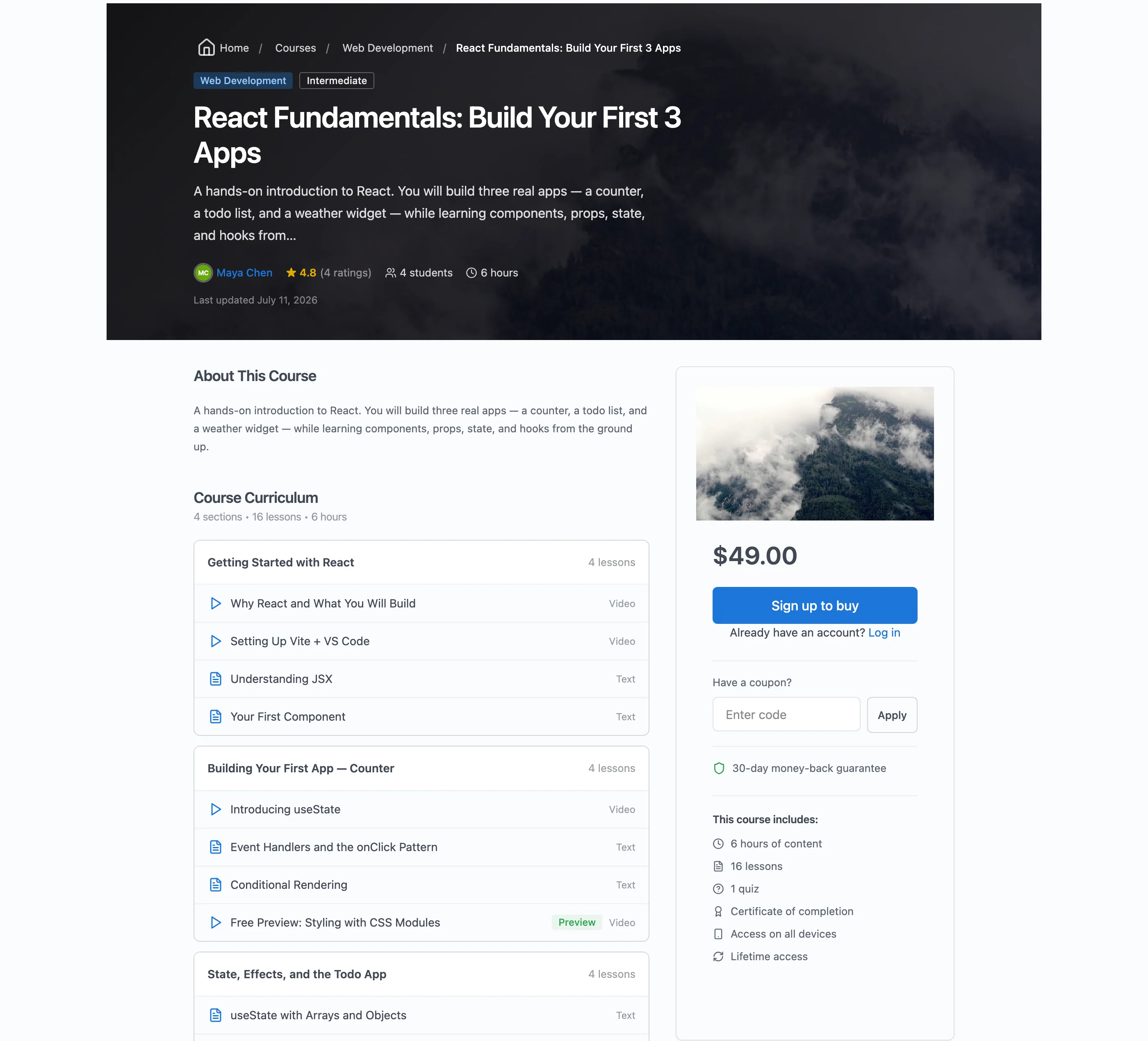
A $49 one-time price, real students, a real instructor. Behind that simple listing sits a real, ongoing cost structure: hosting, any paid tools the instructor uses to answer questions or maintain the material, and the instructor’s own time spent on updates, support, and the next piece of content. None of that shows up on the course page itself, and all of it is part of the actual burn this specific course business is carrying every month, whether or not four students is currently enough revenue to cover it.
The front-loaded trap: mistaking a launch spike for a stable burn rate
The single most common error in a course business’s burn rate math is calculating it during or right after a strong launch, when the numbers look healthiest, and treating that snapshot as representative of every other month. A launch week’s revenue can make three months of accumulated burn look completely fine in a single afternoon, and then the business quietly returns to actual burn for the following two months while the founder is still mentally living off the launch high.
The honest fix is calculating burn rate as a trailing average across several months, including the quiet ones, not as a snapshot taken at the best possible moment. A business that looks great in launch week and rough in the six weeks after it isn’t actually a healthy business having one great week. It’s a business whose real, average burn rate the launch week was temporarily masking.
Where this actually lives inside Learnomy
If you’re running courses on Learnomy, the free tier removes several of the recurring costs that quietly inflate burn elsewhere: signed certificates with a public verify page instead of a manual, contractor-built solution, and built-in progress tracking instead of a separate paid tool. None of that increases revenue directly. It protects the burn side of the equation, the same way the Rule of 40 piece describes Learnomy protecting margin, which extends runway without requiring a single additional sale.
How burn rate changes by course-business type
The shape of burn is different depending on what kind of course business is actually being run. A cohort-based, live course burns fastest and most predictably, real, recurring costs every single cohort. An evergreen, self-paced course front-loads almost all of its burn into the build phase, then drops to near zero, a completely different runway shape than a cohort model. A membership or subscription academy has to track a second, related number alongside cash burn: how fast it’s burning through its own member base via churn. A certification or compliance course burns heavily upfront on verification infrastructure and typically faces a longer, slower sales cycle before revenue catches up, requiring more runway than a consumer course of similar size.
The test, if you want one
Pull the last three months of real bank statements, not the best month, all three. Add up every real cost, including a fair hourly value for unpaid founder time. Subtract from actual revenue received, not revenue promised or pending. Divide current cash on hand by that trailing average, not by a single good month’s number.
Whatever number comes out is the actual, honest answer to how much time is left to make this work before it has to work. Most course creators have never run this calculation. Running it once, even if the answer is uncomfortable, is strictly better than finding out the hard way, mid-month, with no cash left to fix it.
Related reading