
7 min read
Is Anyone Actually Learning Together in Your Course?


Course creators obsess over completion rate, and it’s not the wrong number exactly. It’s just answering a narrower question than most people think it is. Completion tells you someone finished watching. It doesn’t tell you whether the thing you’re actually charging for, the “learn together, not alone” promise, ever happened.
Here’s the uncomfortable version. If your course has a community layer bolted on and nobody’s using it, you’re not running a social learning platform. You’re running a video library with a chat window nobody opens, and completion rate will happily climb the whole time that’s true.
In this pieceWhat “social learning” was supposed to mean
The number that doesn’t exist as one chart yet
What a real course-plus-community pairing looks like
What makes social learning fail specifically
The pushback you’ll get from a course platform vendor
Why this isn’t just an LMS with a forum bolted on
Where to actually check this
What “social learning” was supposed to mean
The pitch for adding a community to a course is specific, even if nobody says it out loud in those words. Students who feel stuck alone quit. Students who can ask a real question and get a real answer, from a peer or from you, stick around long enough to finish and tell other people to buy in. That’s the entire economic case for the community layer. It’s a retention and refund-reduction bet, not a nice-to-have.
So the honest value moment isn’t “watched a lesson.” It’s a student posting a real question tied to something they’re actually stuck on, and getting a reply that unstuck them, in the same week they were making progress. Or joining their cohort’s space and seeing that other people are also somewhere in chapter four, which on its own is worth more than people give it credit for.

The number that doesn’t exist as one chart yet
Here’s where I have to be honest instead of tidy. If you’re pairing a course platform like Learnomy, free, no cut of your revenue, with a community layer like BuddyNext, there isn’t a single merged dashboard that hands you “made progress and engaged socially” as one number. That data lives in two places. Learnomy tracks who’s moving through the course. BuddyNext tracks who’s posting and replying in the Space.
Nobody’s shipped the button that overlays those two charts for you. So you build the habit by hand instead, and it’s a habit, not a one-time setup. Weekly, per cohort: pull the list of students who made real progress this week, and cross it against who was active in that cohort’s Space the same week. The overlap between those two lists is closer to your actual north star than either number alone.

What a real course-plus-community pairing looks like
This is easier to picture with an actual example instead of a hypothetical. Here’s a real course, published and live, called React Fundamentals: Build Your First 3 Apps.

That’s the Learnomy side, the curriculum, the lessons, the progress tracking. On its own it tells you exactly one thing: who watched what. It has no idea whether anyone understood it, got stuck, or gave up quietly on lesson six without ever formally dropping the course.
Pair that with a real community Space built for the same audience, in this case one called Frontend Guild, explicitly labeled as the community for this exact course.
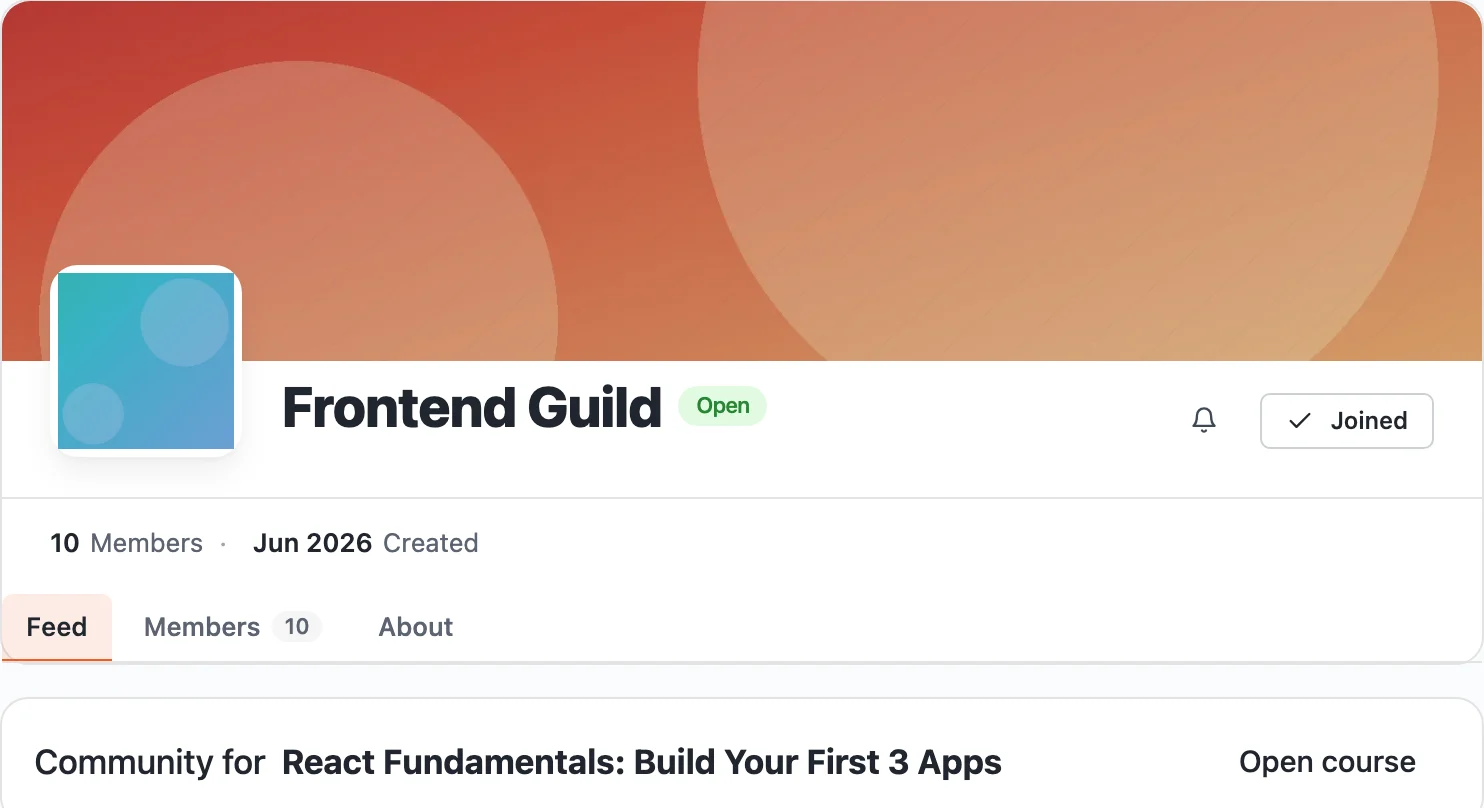
Worth being honest about what this particular Space actually shows right now: it’s freshly paired and empty, no posts yet. That’s not a staged example glossing over the hard part, it’s the realistic starting state, and it’s worth showing instead of hiding, because this exact moment, a course just launched, a Space just created, nobody’s posted yet, is precisely where the early value moment from the framework matters most. The first real question that lands in a Space like this, and whether it gets a fast, real answer, decides whether the pairing ever becomes more than two tabs that happen to be linked.
Once it’s not empty anymore, the weekly check looks like two tabs open side by side, not one unified report. Someone who shows up in both, made progress in the course and posted or replied in the Space that same week, is your value moment happening in real time. Someone who only ever shows up in the first screen is quietly at risk, whether or not their completion percentage still looks fine.
What makes social learning fail specifically
Three patterns kill it, and they’re specific to this format.
The first is a general discussion Space that isn’t tied to anything. No cohort, no lesson, just “Community” as a catch-all tab nobody has a reason to open on a Tuesday. Give people a Space scoped to their actual cohort or course, and the reason to post shows up on its own.
The second is nobody from the teaching side showing up. An instructor who never replies trains students to stop asking within the first two weeks, and then the forum reads as abandoned even if it technically still exists.
The third is optimizing completion in isolation, badges and streaks for finishing lessons, while the social side sits empty and unmeasured. You end up with a beautifully gamified solo experience and call it social learning because there’s a comment box nobody uses.
The pushback you’ll get from a course platform vendor
If you shop for course platforms, you’ll hear “community” pitched as a feature checkbox, a forum tab bundled into the price. It’s worth being skeptical of that framing specifically.
A bundled forum answers the question “can students technically post here.” It doesn’t answer “is anyone scoping this to a cohort, is an instructor actually present, is anyone measuring whether it’s working.” Those are operational commitments, not settings you toggle on. A platform can hand you the tab and still leave you with exactly the empty-comment-box problem described above, because the tab was never the hard part.
The honest test before you buy anything: ask whether the platform can show you, per cohort, who made progress and who engaged socially in the same week. If the answer is “you’d have to check two separate places,” that’s not a dealbreaker, it’s just Tuesday, but at least you’re not being sold a merged number that doesn’t actually exist.
Why this isn’t just an LMS with a forum bolted on
A fair objection: if the goal is just finishing the course, why not run a clean LMS with no social layer at all and skip the complexity. For plenty of self-paced, low-stakes courses, that’s genuinely the right call, and adding a community would just be overhead nobody uses.
The case for the social layer shows up specifically in courses where getting stuck is common and expensive, technical skills, career-change content, anything with a real failure rate if someone’s left alone at the hard part. A student who hits a wall alone in a solo LMS has one option: quit quietly, and you’ll never even know why. A student who hits the same wall inside a cohort Space has a second option, ask, and someone who’s already past that exact point can answer in minutes instead of the student stewing for three days and refunding.
That’s the entire bet a community layer makes on top of a course platform. It’s not a retention gimmick bolted onto good content. It’s a second, cheaper path through the exact moment where most silent quitting actually happens.
Where to actually check this
Same discipline as any other community: weekly, not at the end of the cohort when it’s too late to fix anything. Three things worth tracking by hand until someone builds the merged dashboard: percentage of active learners who also posted or replied in their cohort’s Space that week, average time to first reply on a student question, and how many students in a cohort ever showed up in the Space at all versus watched everything solo.
BuddyNext’s Spaces give you a real, isolated home per cohort, not one global forum where a first-week student’s question gets buried under noise from three other cohorts. If you want to see exactly where the raw activity numbers live inside BuddyNext itself, free tier versus the fuller dashboard, the walkthrough on tracking this inside BuddyNext covers it screen by screen.
The course platforms selling “community” as a feature checkbox are betting you won’t ask whether anyone’s actually talking to each other in there. Ask anyway. It’s the only number that tells you if you built a classroom or just a nicer video player.
Looking for a free alternative to GamiPress or myCred? Explore WB Gamification, our 100% free engagement layer featuring Duolingo-style cohort leagues, daily login streaks, and zero add-on fees.
Read Article → Explore WB Gamification →Related reading