
5 min read
The Rule of 40 For Your Community Budget Line


Somewhere on a budget spreadsheet, “community” sits as a line item, moderation hours, a platform subscription, maybe a part-time community manager, and almost nobody applies the same growth-versus-cost scrutiny to it that gets applied to every other line on that same page. Marketing gets a CAC number. Sales gets a quota. Community gets a vibe check.
That’s the gap the Rule of 40 closes, applied somewhere it doesn’t usually get applied: not to the whole company, and not to a course business’s revenue, the way the course-business piece covers, but to the community itself, as its own small business line inside a larger one.
In this pieceWhy nobody asks this question about community
What actually counts as growth for a community line item
What actually counts as margin for a community line item
A real, low-cost, high-return space, not a hypothetical
The trap: measuring activity instead of return
Where this actually lives inside BuddyNext
The pushback: “community isn’t supposed to pay for itself”
The test, if you want one
Why nobody asks this question about community
Every other function in a company gets measured against what it costs to run. Marketing has customer acquisition cost. Support has cost per ticket. Sales has cost per closed deal. Community, more often than not, gets measured by activity, posts per day, active members, engagement rate, numbers that describe motion without ever asking whether that motion is worth what it costs to produce.
That’s not because community people are bad at math. It’s because “growth” and “margin” were never translated into community-shaped terms in the first place. Fix that translation, and the exact same discipline that runs the rest of the business applies here too.
What actually counts as growth for a community line item
Not member count on its own, the same trap the AARRR piece covers in more depth. Growth, for a community treated as a business line, is growth in what the community actually returns: retention lift among members who are active in it versus members who aren’t, support ticket deflection from questions members answer publicly instead of a paid agent answering privately, and expansion revenue that traces back to a community interaction, an upsell that happened because of a conversation, not a cold email.
Each of those is measurable, not vibes. Compare churn between community-active and community-inactive customers of otherwise identical tenure. Count questions answered in public spaces that would otherwise have become support tickets. Tag deals that closed after meaningful community engagement. None of it requires new tooling most companies don’t already have, it requires actually running the comparison.
What actually counts as margin for a community line item
The cost side is usually more visible than the return side, which is exactly why community often looks like a pure expense: moderation time, platform cost, a gamification or incentive budget, the community manager’s salary. All real, all easy to point to on a spreadsheet.
Margin, in this specific equation, is what’s left after subtracting that real cost from the real, measured return above. A community that costs $4,000 a month to run and demonstrably deflects $6,000 a month in support tickets plus measurably improves retention is running a healthy margin, even though it will never show up as “revenue” on a normal P&L. A community that costs the same and can’t point to any measured return in either direction is running at a loss that a vibe check will never catch.
A real, low-cost, high-return space, not a hypothetical
Here’s what a genuinely low-cost, high-return community surface actually looks like, reachable without an account.
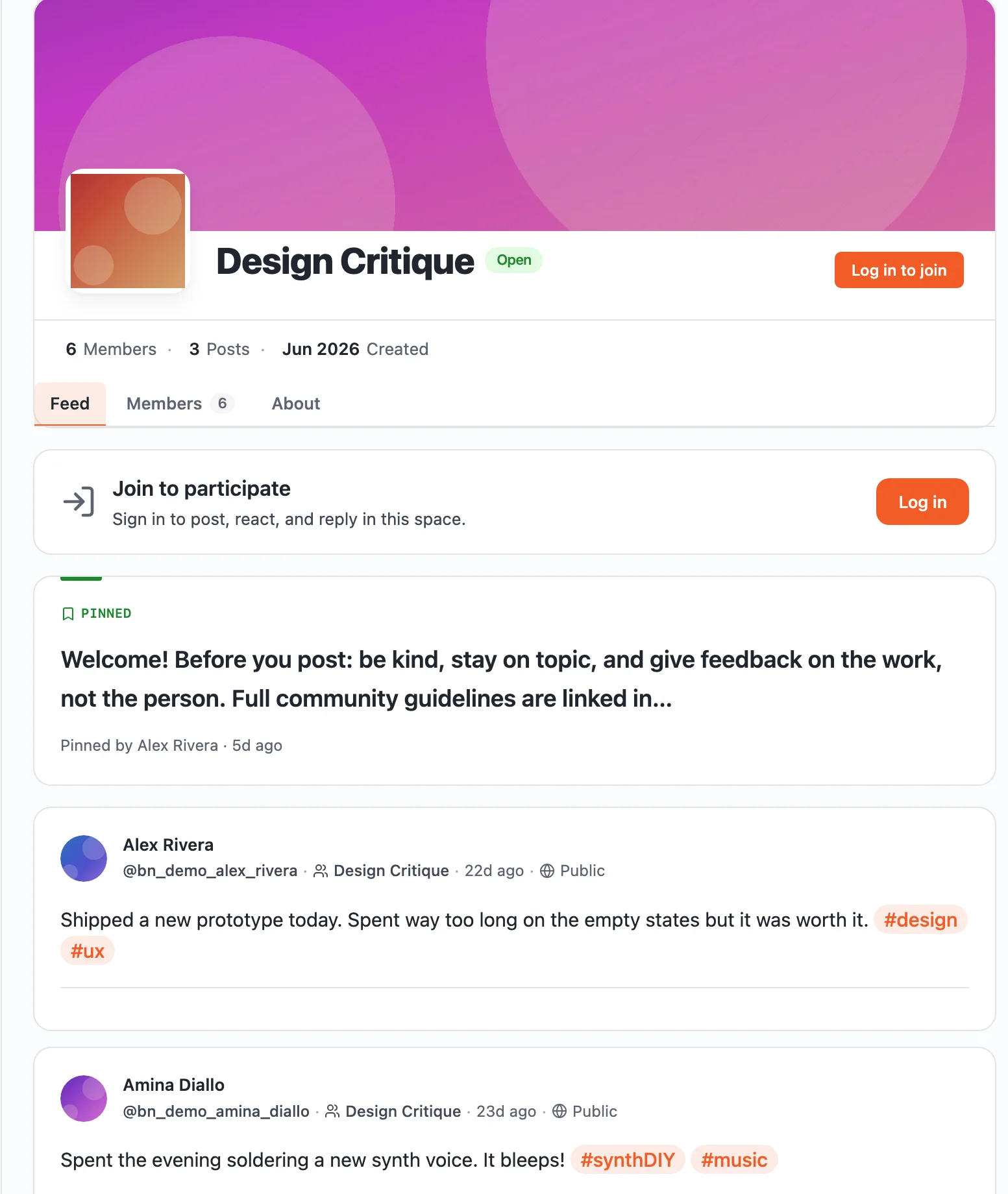
One moderator, pinned ground rules set once, and genuine member-to-member activity happening without anyone on payroll writing every reply. That’s the entire margin argument made visible: the cost here is close to fixed, one person’s occasional attention, while the value, real engagement, real questions answered by peers instead of a support agent, scales with the space’s activity without the cost scaling alongside it.
The trap: measuring activity instead of return
The specific trap is reporting on the community with numbers that look like health but don’t actually answer the growth-or-margin question. Posts per week, active member count, average session time, all real, all easy to put in a slide, and none of them tell you whether the community is actually returning more than it costs. A community can hit every activity number on the dashboard and still be a pure cost center nobody’s checked honestly in two years.
The fix isn’t abandoning activity metrics, they’re useful for day-to-day management. It’s refusing to let them stand in for the Rule of 40 question when it’s time to actually justify the budget line to someone who controls it.
Where this actually lives inside BuddyNext
If you’re running the community on BuddyNext, the free tier’s Explore, search, and public Spaces do real, unglamorous margin work: they let one moderator’s ground rules produce genuine peer-to-peer activity without per-interaction staffing cost, the same structure shown above. Pairing it with WB Gamification for retention, the mechanism the AARRR retention piece covers, turns the growth side of this equation into something you can actually track cohort by cohort, active-in-community versus not, instead of guessing.
The pushback: “community isn’t supposed to pay for itself”
A fair position, and worth taking seriously rather than dismissing. Some communities exist for reasons that were never meant to be financial, brand goodwill, a genuine sense of obligation to customers, culture. Forcing every one of those into a strict Rule of 40 justification can flatten something that was never supposed to be measured that way.
The distinction worth making is between a community that’s a deliberate, accepted cost, chosen with eyes open the same way a company chooses to sponsor a local event, and a community that’s quietly assumed to be paying for itself with nobody ever actually checking. The first is a legitimate business decision. The second is the version that gets cut in the next budget review with no warning, because nobody built the case for it while they had the chance.
The test, if you want one
Pull the real monthly cost of running the community, every line, moderation time priced honestly, platform cost, incentive budget. Then pull whatever real return numbers exist: support deflection, retention delta between community-active and inactive segments, community-attributed expansion revenue. If those return numbers don’t exist yet, that’s the actual finding, not a footnote, a community nobody has ever measured is a community nobody can actually defend when the budget gets questioned.
A community that costs more than it demonstrably returns isn’t automatically a failure. It might be a deliberate, accepted cost, the same way marketing sponsors a booth at a conference that never directly closes a deal. But it should be a choice someone made on purpose, with real numbers in front of them, not a line item that’s been coasting on activity charts nobody ever translated into growth and margin.
Related reading