
5 min read
The Retention Stage Every Fitness Community Underbuilds

Week one of a fitness community is easy. People join fired up, post their first workout, react to everyone else’s. If you only looked at week one, you’d think the whole funnel was working. Then week two arrives, and the fitness industry’s oldest, most well-documented problem shows up right on schedule.
If you’ve read the piece on the growth loop hiding in fitness communities, that one was about Referral, getting real achievements in front of people who aren’t members yet. This is about the stage right before it, the one that decides whether there’s still a member left to share anything by the time week three arrives.
In this pieceThe week-two problem, and why it’s not new
Why motivation was never a retention strategy
A real streak, not a mockup
What actually breaks Retention here
The pushback: “some drop-off is just human nature”
Where this actually lives inside BuddyNext
Why this isn’t the same as a motivational push notification
Turning it into something you actually check
The week-two problem, and why it’s not new
Gyms have known this for decades without needing a framework to name it: the January rush, the visible drop by week three, the quiet plateau by February. It’s not a mystery and it’s not unique to fitness communities specifically, it’s Retention, the third AARRR stage, and it’s the stage almost every fitness product underbuilds relative to how much effort goes into Acquisition and Activation.
A fitness community can nail the first two stages completely, easy signup, a great first workout log experience, and still lose the majority of new members by week three, because nothing about a strong first week actually predicts a strong fourth week. They’re different problems that happen to look similar from the outside.
Why motivation was never a retention strategy
The default plan for fitness retention is usually some version of “keep people motivated,” and motivation is a weather pattern, not infrastructure. It’s genuinely high in week one and genuinely lower by week four for almost everyone, including people who go on to maintain the habit long-term. Betting Retention on a feeling that predictably fades is building on the one part of the system guaranteed to weaken right when it matters most.
What actually holds people through the dip isn’t more motivation. It’s structure that doesn’t depend on motivation being high: a streak that’s visible and worth protecting, a small habit loop that runs on autopilot once it’s established, a reason to check back in that isn’t “do I still feel like it.”
A real streak, not a mockup
Here’s what that structure actually looks like on a real profile, reachable without an account.
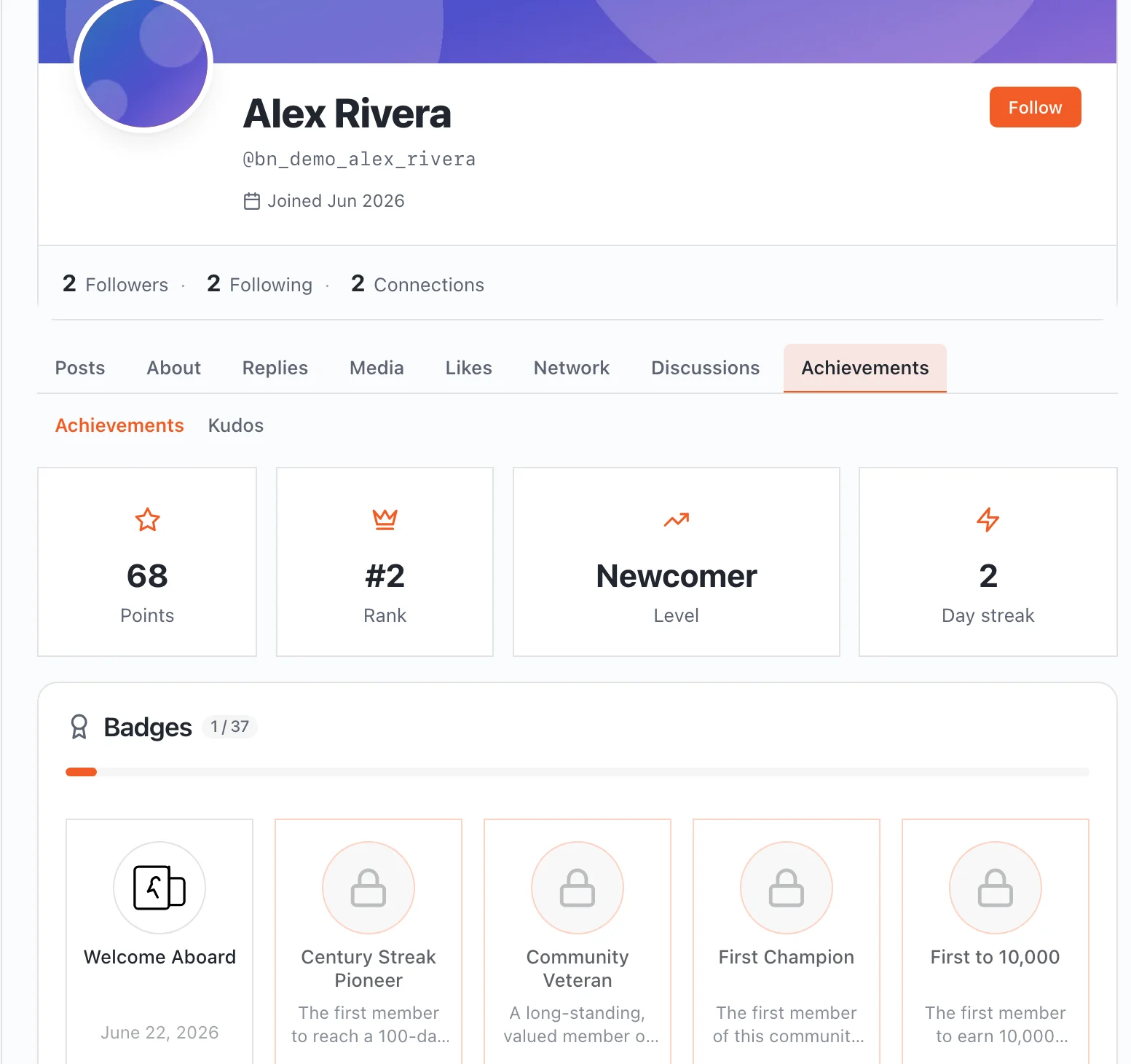
Notice the streak counter sitting right next to points and rank, not buried in a settings page. A visible, current streak works precisely because it doesn’t depend on how motivated someone feels that day, it depends on not wanting to lose a number that’s already been built up. That’s a completely different psychological lever than motivation, and it’s the one that actually survives week two.
What actually breaks Retention here
The first failure is a streak or progress system that resets silently and without consequence. If missing a day costs nothing visible, the system is quietly teaching every member that missing days doesn’t matter, which is the opposite of what a retention mechanic is supposed to do.
The second is treating week one’s engagement as representative. A community that measures its health by week-one activity is measuring the easiest week there is. The real test, and the number almost nobody tracks on purpose, is week four against week one for the same cohort.
The third is silence at exactly the wrong moment. The member who was active for ten days and hasn’t logged in for four is in the highest-leverage moment for a well-timed nudge, and it’s also the moment most platforms say nothing at all, because there’s no system watching for a streak that just broke.
The pushback: “some drop-off is just human nature”
True, and worth being honest about rather than promising to solve. Some percentage of any fitness community’s new members were never going to stick with a fitness habit at all, regardless of what the platform does. No retention mechanic fixes that, and claiming otherwise sets an impossible bar.
The mistake is treating the entire week-two drop as unavoidable human nature. Comparing communities with strong streak-and-structure mechanics against ones without shows a real, consistent gap, which means at least part of the drop-off is structural, not just willpower running out on schedule.
Where this actually lives inside BuddyNext
If you’re running the community on BuddyNext paired with WB Gamification, entirely free, streaks and badges are visible on the profile by default, the same stat cards shown above. Notifications can be tuned to fire exactly when a streak is at risk, not on a generic daily schedule that ignores whether anyone actually needs the nudge that day.
Why this isn’t the same as a motivational push notification
A fair question: isn’t a “you can do it, don’t give up” notification basically the same thing? It’s actually the opposite mechanic. A motivational message tries to manufacture the exact resource, willpower, that’s already running low by week two. A streak-protection nudge doesn’t ask anyone to feel more motivated, it just makes the cost of missing a day visible and specific: you have a twelve-day streak, and it ends today if you don’t show up. That’s a completely different psychological trigger, loss aversion instead of inspiration, and it works considerably better once initial motivation has naturally faded.
Turning it into something you actually check
Weekly, alongside the fitness north star check from the companion piece in that series: of everyone active in week one of this cohort, what percentage are still active in week four. Track it by cohort, not as a blended average, or a strong month of new signups will hide a Retention problem the same way a strong Acquisition number hides everything downstream of it.
The member who shows up in week one was never the hard part. The one still showing up in week four is the entire game, and it’s decided by structure, not by how inspired anyone still feels by then.
Related reading