
22 min read
Course Launch Action Plan: A Proven Six-Week Playbook

Maya taught Spanish for eleven years before she ever put a course online. Community college, weekend workshops, three semesters of adjunct hell at a school that kept cutting her hours. She had a following, a reputation, and a folder on her desktop labeled “course idea” that had been sitting untouched for two years.
What finally moved her wasn’t inspiration. It was a Tuesday afternoon when a student asked, for the fourth time that month, whether she offered anything online. She said yes. She hadn’t built anything yet. She gave herself six weeks to make that true.
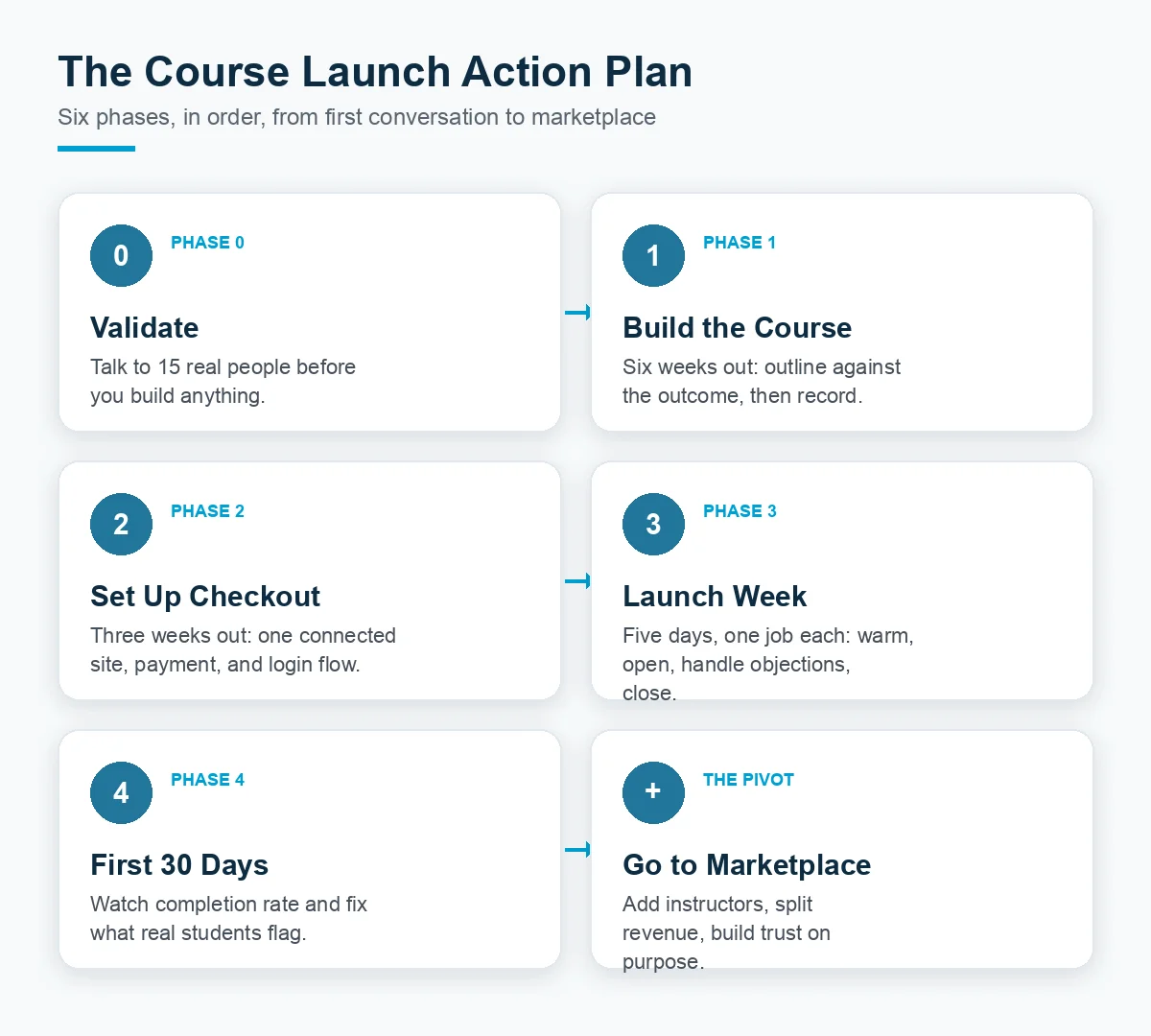
This is the course launch action plan she followed, cleaned up and generalized so it applies whether you’re launching your first course next month or turning a single class into a small academy. It’s organized by phase because that’s how launches actually unfold, but the timeline bends. Some people need ten weeks. Some need three. What doesn’t change is the order.
Why most course launches actually fail
Not because the video quality was bad. Not because the market didn’t want it.
They fail because the creator builds the entire course before checking whether anyone would pay for it, then spends launch week discovering that “interested” and “willing to pay” are two different audiences. Or they fail because the technical setup ate three of the six weeks, leaving no time to actually tell people the course exists. Or, the quieter failure mode: the course launches fine, sells a handful of seats, and then dies, because there was never a plan for what happens after week one.
A launch has three points of failure, and they happen in a predictable order. Validation fails first. Then execution. Then retention. Most advice online only covers the middle one.
A creator forum Maya read while building her course had a thread from someone who’d spent four months on a course, filmed sixty lessons, and sold two copies in launch week. Sixty lessons. Two sales. The content wasn’t the problem. Nobody had confirmed, before month one of filming, that a market existed at that price. That’s the failure this whole plan is built to prevent, and it’s the reason Phase 0 comes before anything with a camera in it.
Phase 0: Before you touch a page builder
Maya’s first move wasn’t building anything. It was messaging fifteen students directly and asking one question: would you pay for a structured version of what I teach in class, delivered online, at your own pace?
Nine said yes immediately. Three asked what it would cost. Two didn’t answer. One said no, she preferred live classes.
That’s a signal most people skip past because it feels like busywork when what they really want is to start filming. But the fifteen-minute conversation told Maya three things a market survey never would: her price point (three students volunteered a number before she asked), her format preference (self-paced won, live lost), and her actual buyer, which turned out to be different from who she expected. Her best prospects weren’t beginners. They were intermediate students who’d hit a plateau and wanted something more intensive than a weekly class could offer.
Skip this step and you build for an imaginary audience. Do it and you build for the one that already trusts you.
If you don’t have fifteen people to ask, you have a smaller problem to solve first: build an audience of any size before you build a course. A newsletter with forty subscribers who open every email beats a course sitting in front of zero.
What to lock down in this phase:
- A one-sentence description of who the course is for, specific enough that it excludes people
- The transformation, stated as a before/after, not a list of topics covered
- A price, tested against at least five real conversations, not guessed from a competitor’s page
- The delivery format your actual audience prefers, not the format you’d enjoy building most
Three questions, asked out loud to real people, will tell you more than three weeks of market research. This phase should take days, not weeks. If it’s dragging past a week, you’re overthinking a decision that talking to five more people would settle faster than more analysis will.
Pricing is a decision, not a guess
Maya almost priced her course at $19. It felt safe. Low enough that nobody would object, which is exactly the reasoning that traps most first-time creators into underpricing.
A cheap price doesn’t just cap your revenue. It changes who buys and how they show up. A $19 course attracts browsers who forget they bought it. A $149 course attracts people who show up to lesson one because they’ve committed real money to being there. Research on large-scale online course completion backs this up directly: paid, credentialed courses see completion rates several times higher than free ones. Not because expensive content is better, but because a buyer who paid more has more reason to finish.
Three of Maya’s fifteen conversations in Phase 0 gave her a number before she asked. Two said “somewhere around $150,” one said “I paid $200 for a worse course last year.” That’s not a scientific pricing study. It’s a real data point from a real buyer, and it’s worth more than a competitor analysis spreadsheet, because it tells you what your specific audience already believes something like this is worth.
If you’re still guessing, anchor against the alternative your buyer is actually comparing you to. Not other online courses. The private tutor at $60 an hour, the semester of community college tuition, the six months of trial and error they’d otherwise spend figuring it out alone. A course priced at $197 looks expensive next to a $19 competitor and looks like a bargain next to twelve hours of private tutoring.
A payment plan solves more objections than a discount does. Splitting $197 into three payments of $69 doesn’t cost you revenue the way a coupon does, and it removes the single biggest reason a qualified buyer hesitates at checkout: not doubt about the course, just not having the full amount available that specific week.
Phase 1: Six weeks out, building the course itself
Maya blocked two weeks for content. She used one and a half.
The trick wasn’t working faster. It was refusing to build a masterpiece. Her course had eight modules in her head and four in the final outline, because she cut everything that wasn’t required to get a student from “I know some Spanish” to “I can hold a ten-minute conversation without freezing.” Everything else became a bonus module added after launch, once she knew which students actually finished the core material and asked for more.
This is the part where creators lose weeks they don’t have. The fix isn’t a hack. It’s a sequencing decision: outline before you film, and outline against the outcome, not against everything you know.
Start with the last lesson. What can a student do at the end that they couldn’t do at the start? Work backward from there, and cut anything that doesn’t serve that specific outcome, even if it’s interesting, even if you’re proud of it, even if a colleague suggested it. A tighter course that gets finished beats a comprehensive one that gets abandoned at lesson three, and completion rate is the metric that actually predicts whether students refer you to someone else.
Record in batches. Maya filmed all four modules over three days instead of spreading them across the full six weeks, because context-switching between “content mode” and “everything else mode” cost her more time than the recording itself. She didn’t have professional lighting. She had a window that faced north and a fifteen-dollar lapel mic. Nobody who bought the course mentioned production value in a review. Several mentioned that she explained things clearly and didn’t waste their time, which is the actual bar. A free transcription tool cleaned up her captions afterward; if you want a fuller rundown of what’s worth adopting at this stage, we’ve rounded up the best AI education tools for teachers and students separately.
Build your assessment layer while you’re still in the content headspace, not after. A short quiz at the end of each module, a way to check whether a concept landed. This matters more than it sounds like it should: students who get quick feedback on whether they understood something finish courses at meaningfully higher rates than students left to guess. If you’re building on Learnomy, this is built into the course structure directly, multiple quiz formats depending on whether you want a quick check or something closer to a real assessment, so it’s not a separate system bolted on afterward.
By the end of week two, you should have a complete, unpolished course. Not a perfect one. A complete one.
Phase 2: Three weeks out, the website and the checkout
Here’s where the six-week plan almost died. Maya spent four days trying to get a page builder plugin to do what she wanted, gave up, tried a second one, gave up again, and lost most of a week she didn’t have to lose. If you’re still comparing options at this stage, it’s worth seeing the full spread of WordPress LMS plugins before committing to one, since switching later costs far more than choosing carefully now.
The problem wasn’t her. It’s that most course creators are trying to stack four separate tools, a website builder, a membership plugin, a payment processor, and a quiz tool, and get them to talk to each other correctly under deadline pressure. Every seam between those tools is a place where something breaks the week before launch.
What actually saved her timeline was collapsing that stack. She built the site itself on BuddyNext and ran the course, quizzes, and Stripe checkout through Learnomy sitting on top of it, so there wasn’t a separate payment plugin arguing with a separate membership plugin arguing with a separate quiz tool. One system, one admin screen, one place where a broken setting could hide.
Whatever you build on, three things need to work before you move to launch week:
The enrollment path. A visitor should get from “interested” to “enrolled” in under four clicks. Test this yourself, on a phone, on a slow connection, as if you’d never seen the site before. Every extra click between interest and purchase loses you students who would have paid.
The payment flow. Test a real transaction with a real card, not just the sandbox mode. Refund yourself afterward. Confirm the confirmation email actually arrives, and that it arrives somewhere other than spam.
The first-login experience. What does a student see thirty seconds after paying? If the answer is “a blank dashboard with no clear next step,” you’ve spent five weeks getting someone to buy and then lost them at the finish line. The first screen after purchase should point at exactly one action: start lesson one.
Pricing page copy matters less than people think at this stage. What matters is that the page loads fast, states the price without hiding it behind a “contact us” button, and answers the two questions every buyer has in their head: what do I get, and what happens if I’m not satisfied. A simple refund policy, stated plainly, converts better than an elaborate sales page with none.
What it actually costs to get here
Maya’s total spend across six weeks: $180. A domain, a year of hosting, a lapel mic she already owned, and a course platform on a plan that covered everything else, checkout, quizzes, certificates, membership, without stacking a separate tool for each. No ad spend. No freelance video editor. No course launch coach.
That number matters because a lot of would-be creators stall out believing they need thousands of dollars before they can start, usually because they’ve seen a launch case study from someone running paid ads on top of an audience they’d already spent a year building. That’s a different game than a first launch to a warm, small list. Bootstrapped and free-tool-heavy is not a lesser way to start. It’s the way almost every successful course creator actually started, before the case study got written about the version three launches later.
Where the money is worth spending, if you have it: a real logo instead of a free template, five dollars a month for a decent email tool once your list passes a few hundred people, and eventually, once you know the course sells, professional editing on lesson one specifically, since that’s the lesson that decides whether a student trusts the other seven.
The two weeks before doors open
Emails alone don’t fill a launch. Maya’s list was forty people because she’d been teaching for eleven years, and even then, forty people is a small number to build a business on. Most first-time creators have less. So the two weeks before Phase 3 aren’t idle time, they’re where the audience for launch week actually gets built.
A waitlist beats a cold announcement. “Course opens in two weeks, join the waitlist to get early access and a founding-member price” gives people a reason to raise their hand before they’re asked to buy anything, and everyone who raises their hand becomes someone you can message directly instead of hoping they see a post.
Beta students are worth more than their enrollment fee. Maya gave three former students free access to the finished course a week before launch, in exchange for one thing: an honest testimonial and permission to use it. Two delivered. Those two sentences did more for her Tuesday email than anything she could have written about herself, because a prospective buyer trusts a peer’s account of finishing the course over a creator’s claim about how good it is.
If you teach in any kind of community, a local Facebook group, a subreddit for your subject, a Discord for people learning the same skill, showing up there with something genuinely useful two weeks out does more than showing up with a sales pitch on launch day. A free mini-lesson, a useful thread answering a question people actually have, posted without a pitch attached, builds the trust that makes the pitch land later.
People can tell the difference between someone contributing and someone extracting, and it shows in how launch week emails get treated once they land in an inbox that already recognizes the sender’s name.
None of this needs to be big. It needs to happen on purpose, on a schedule, instead of getting skipped because building the course itself felt more urgent.

Phase 3: Launch week
Launch week isn’t one day. It’s five, and each one has a different job.
Monday is for warming the list. Not selling yet. A message to your audience that the course is opening this week, with the actual transformation restated in one line. This is the email that gets forwarded to a friend, if it’s specific enough to be worth forwarding.
Tuesday is doors open. The cart goes live. The email is short. It links, it states the price, it states when the price changes or the cart closes, and it stops. Long launch emails on day one underperform short ones, because the goal on day one isn’t to convince skeptics, it’s to convert the people who were already sold and just needed the link.
Wednesday and Thursday are for objections. Different email, different angle, aimed at the people who opened Tuesday’s email and didn’t buy. Answer the actual reasons people hesitate: is this right for my level, how much time does it take per week, what if I fall behind. Real questions, answered directly, work better than generic testimonials.
Maya ran a 20-minute live Q&A on Wednesday evening instead of writing a third email. Six people showed up. Two enrolled on the call, watching her answer someone else’s question in real time about whether the course covered past-tense conjugation, which happened to be the exact thing they’d been unsure about. A live session does something a written email can’t: it lets a hesitant buyer watch you answer a stranger’s doubt and recognize their own doubt getting answered along with it.
Friday is the close. If there’s a deadline, and there should be one, this is the day it’s real. Scarcity that isn’t real trains your audience to ignore your next launch. Scarcity that is real, a genuine price increase or a genuine cutoff, works because people believe it.
Maya’s numbers: 40 people on her warm list, 34 opened the Tuesday email, 11 enrolled by Friday. An 8% conversion from list to buyer isn’t a huge number. It’s a real one, and it’s higher than most people’s first launch, because the audience had already been qualified back in Phase 0.
One thing worth saying plainly: launch week will feel like nothing is happening for long stretches, and then everything happens in the last six hours before a deadline. That’s not a sign something’s wrong. That’s how launches with a real deadline behave, every time.
Phase 4: The first thirty days
The mistake that kills second launches isn’t a bad first launch. It’s a first launch with no follow-through, so there’s no data to make the second one better.
Watch three numbers in the first month. Completion rate, the percentage of students who finish the course, tells you whether the content itself is working. Time-to-first-lesson tells you whether the onboarding is working, because a student who doesn’t start within 48 hours of buying rarely starts at all. And direct feedback, actual messages from actual students, tells you things a dashboard never will.
Maya emailed every student individually at the two-week mark. Not a survey. A real question: what’s been the hardest part so far? Six replied. Three said the same thing, that lesson three moved too fast. She fixed lesson three before her second cohort ever saw it. That fix came from thirty minutes of reading real replies, not from a month of analytics.
This phase is also when you decide whether to keep enrollment open, close it into cohorts, or run it as an evergreen offer. There’s no universally right answer. Cohorts create urgency and community, evergreen removes the ceiling on revenue, and plenty of successful creators run both, an evergreen self-paced track alongside a periodic live cohort at a higher price. What matters is deciding on purpose instead of drifting into whichever option required the least setup.
The mechanics differ more than the marketing copy suggests. Evergreen means someone can buy on any given Tuesday and start immediately, which maximizes revenue but removes the shared start date that makes students feel like they’re moving through material alongside peers. Cohorts mean everyone starts together, content can drip out week by week instead of arriving all at once, and a shared deadline pushes completion rates up in a way self-paced access rarely matches on its own.
Maya went evergreen for the core course, since her students were adults fitting lessons around jobs and couldn’t commit to a fixed weekly schedule, but added a cohort-based advanced conversation group later specifically because that group benefited from momentum a self-paced format couldn’t create. Drip scheduling, whether by fixed date or by days-since-enrollment, is the detail that makes a cohort feel like a cohort instead of just a course with a start date attached to it.
After launch week ends, the slower growth starts
Launch week gets all the attention because it’s compressed and dramatic, a countdown with a number attached to the end of it. What actually builds a course business is what happens in the months after, when there’s no deadline pushing anyone to act.
Maya’s second and third enrollments after launch week didn’t come from another email blast. They came from a search result. A student had typed “how to stop translating in your head when speaking Spanish” into Google, a problem Maya answered inside lesson four of her own course, and found a blog post she’d written the month before launch, built directly from that same lesson, sitting on page one for a question with almost no competition.
That post existed because she’d pulled the specific, oddly-phrased problems her own students struggled with and answered each one in its own article, instead of writing generic “how to learn Spanish faster” content competing against a thousand identical versions of itself.
This is where a course archive becomes a content advantage nobody talks about enough. You’ve already done the hard part, identifying the exact confusions your specific audience runs into, in language they’d actually search for, because you heard them ask it out loud or type it in a support message. Turning six of those into standalone articles costs an afternoon and compounds for years, in a way a single launch week email never can, because search traffic doesn’t stop showing up once the cart closes.
The compounding works the other direction too. Every student who finishes and refers someone is doing the discovery work an ad budget would otherwise have to buy. Track where enrollments actually come from, not because tracking is inherently virtuous, but because most creators assume their next ten students will come from the same channel as their first ten, and it’s rarely true. Maya’s first cohort came almost entirely from her existing students. Her fifth came mostly from search and referral, two channels that barely existed for her in week one.
The marketplace pivot
Six months after her first launch, Maya had a waitlist for a level of Spanish she didn’t teach. She knew exactly who did, a colleague from her adjunct days who taught advanced grammar better than anyone she’d met. So she asked him to build a course on her platform, and split the revenue.
This is the point where a single-instructor site becomes something closer to a marketplace, and it’s a different kind of build than the first launch. The technical requirements shift: instructor accounts with their own dashboards, a commission split that tracks and pays out automatically, a way for each instructor’s courses to feel distinct while still living under one brand. It’s worth comparing a few WordPress eLearning platform options at this stage specifically for multi-instructor support, since not every platform that handles a single teacher well handles five.
It’s also a different kind of trust problem. Students bought from Maya because they knew Maya. A new instructor on the same platform hasn’t earned that yet, so the platform itself has to do some of the trust-building, consistent quality bars across instructors, a review system, clear pricing, an application process that isn’t just “anyone can post a course.”
Maya’s application process was three questions long: what would you teach, why are you the right person to teach it, and a link to something you’d already taught, a recorded class, a YouTube video, anything showing you in front of students. She rejected two applicants in the first year, politely, because the fit wasn’t right for her audience specifically.
A marketplace that accepts everyone trains its own students to distrust everyone on it.
That gatekeeping did more for the marketplace’s reputation than any review system could, because students learned that getting listed on Maya’s platform meant something, instead of meaning nothing at all.
Revenue split is the other trust question, and it runs in both directions. Instructors need to see, without asking, exactly what they earned and when they’ll get paid. Maya’s colleague checked his payout dashboard weekly for the first two months, not because he distrusted her, but because a new financial relationship earns trust through visibility before it earns trust through history. A platform that makes an instructor email someone to ask “did my payment go through” has already lost a chunk of the goodwill a clean, automatic payout would have built for free.
The technical piece is more solvable than most people expect. Learnomy’s instructor revenue-sharing follows the same model Udemy uses, instructors keep a share, the platform keeps a share, payouts get tracked automatically instead of someone doing math in a spreadsheet every month. What that means practically is the difference between “I’d love to add other instructors someday” and actually doing it isn’t a six-month development project. It’s a setting.
Two instructors turned into five within the year. Maya didn’t teach every course anymore. She curated who got in, kept teaching her own advanced conversation classes, and the platform kept most of what made her original site work: one brand, one login, one place students trusted, just with more people teaching under it.
Not every course creator wants this. Plenty are happier staying solo, and there’s nothing wrong with a business that’s just you and your students. But if you’re building the first version of your site with an eye toward this later stage, it changes one decision now: build the marketplace capability into the foundation instead of bolting it on after the fact. Retrofitting instructor accounts, commission tracking, and a review system onto a platform built assuming one teacher is a harder rebuild than most people budget for.
The dead giveaways of a launch that isn’t ready
A few signals, gathered from watching a lot of these go wrong.
The sales page mentions the course but never states the price. This isn’t mysterious marketing. It’s a page the creator was afraid to finish.
The course has more modules than the creator has finished filming, and launch is a week away. This gets rationalized as “I’ll finish module six before students get there,” and it almost never happens on schedule.
There’s no plan for what a student sees in the first five minutes after paying. Everything after the purchase button was an afterthought.
Every email in launch week says the same thing in different words. If Tuesday and Thursday’s emails could be swapped without anyone noticing, one of them isn’t doing its job.
The word “urgent” appears in the copy but nothing about the offer is actually time-limited. Students figure this out faster than creators think, and it costs trust on the next launch.
Questions that come up every time
Do I need a big audience to do this? No. Maya launched to forty people. What you need is a small number of people who already trust you enough to answer a direct message, which is a lower bar than a large following and a more honest predictor of launch week sales.
What if I have no list at all? Then Phase 0 becomes Phase -1: spend a month building even a small one before setting a launch date. A single useful post a week in a community where your future students already gather, collected into an email list through something genuinely helpful, not gated behind a hard sell. Forty real subscribers beats four thousand people who followed an account for a giveaway two years ago and never opened an email since.
Should I pre-sell before the course is finished? Often yes, and it’s the single best validation signal available, real money changing hands before you’ve sunk six weeks into content nobody wants. The risk is obvious: you’re now on a public deadline to deliver. That pressure is usually a feature, not a bug. It’s the same deadline discipline that got Maya’s course built in six weeks instead of drifting for another two years in a folder on her desktop.
What if launch week underperforms? It happens, and it’s data, not a verdict. Look at where the drop happened. If people opened the email but didn’t click, the offer wasn’t compelling enough. If they clicked but didn’t buy, the page or the price has a problem. If they bought and didn’t finish, that’s a Phase 4 problem, not a Phase 3 one. Each failure point has a different fix, and a launch that undersells still tells you exactly where to look before the next one.
Where a course launch action plan actually starts
Maya’s course now runs alongside four others on the same site. None of it happened because she found a shortcut. It happened because she followed an order: validate before building, build before decorating, launch with a real deadline, and pay attention to what real students said in the first month, before worrying about what came after that.
Six weeks is enough time for the first version. It’s not enough time to make it perfect, and it was never supposed to be. Perfect ships in the second cohort, built from what the first one taught you.
If you’re at the point where the website and checkout are the part slowing you down, that’s usually a sign the stack has too many separate pieces arguing with each other. Worth looking at what a single connected setup, something like BuddyNext for the site and Learnomy for the courses and payments, would save you in that specific week. Not because the tools are the hard part. They’re not. The hard part is everything in Phase 0, and no plugin does that for you.
Related reading