
6 min read
Who’s Still Here After the Challenge Ends?


Every fitness community looks alive during the 30-day challenge. Daily check-ins, a leaderboard people actually refresh, a group chat that won’t stop buzzing. Then the challenge ends, and two weeks later it’s just you posting a workout screenshot into silence.
That’s not a coincidence, and it’s not because the people who joined were never serious. It’s because “run a 30-day challenge” and “build an accountability habit” are two different projects, and most fitness communities only ever built the first one.
In this pieceWhat the challenge was actually testing
The value moment that actually counts
What a real accountability group looks like
Why the good ones die right after the challenge
What streaks actually measure that a leaderboard can’t
The pushback: “isn’t a leaderboard motivating”
Why this isn’t just a tracking app with a comment section
Turning it into something you actually check
What the challenge was actually testing
A challenge works because it manufactures a reason to show up that expires. Everyone’s watching the same leaderboard, everyone knows the exact day it ends, and that countdown does the motivating for you. It’s borrowed urgency, and borrowed urgency always gets returned.

Total workouts logged during a challenge tells you almost nothing about whether the community itself is doing any work. One obsessive member logging twice a day can make the number look healthy while everyone else quietly stopped opening the app a week in. You’ve seen this leaderboard before. It rewards the person who needed it least.
The value moment that actually counts
For a fitness community, the honest value moment isn’t “logged a workout.” Plenty of people log workouts alone in a spreadsheet and never think about it twice. The moment that counts is showing up because you knew someone would notice if you didn’t, and someone actually did.
A community that’s earning its keep looks like this: a member logs a session, gets a reaction or a comment from someone else within the day, and comes back a second week because of it, not because a countdown told them to. Strip out the leaderboard and ask a narrower question. Who came back a second week without a challenge running. That’s your real signal.
What a real accountability group looks like
Here’s a real example instead of a hypothetical one, a Space called Trail Runners, a genuine small accountability group inside a BuddyNext community, no challenge running, no countdown, just people who show up.

Notice what you’re actually looking for here. Not how many posts, how many of those posts got a real response from another member, and whether the same names keep showing up week over week rather than a rotating cast who each posted once and vanished. A healthy accountability group looks almost repetitive from the outside, the same handful of people, showing up again, which is exactly the opposite of the constant-new-faces energy a 30-day challenge launch generates.
Why the good ones die right after the challenge
The leaderboard rewards volume, not consistency, so it quietly punishes the average person who’s doing exactly what they should be doing. Someone showing up three times a week, every week, for months, ranks below someone who logged every single day for thirty and then vanished.

A community built entirely around one big event has no reason to exist between events. If there’s no ongoing accountability structure, streaks, small weekly check-ins, someone actually replying, the silence after the challenge isn’t a failure of the members. It’s the predictable result of a structure that was only ever built for thirty days.
The third failure is quieter. Nobody actually acknowledges anyone. People log workouts into a feed that nobody reacts to, and a feed that never reacts back trains people to stop bothering within a couple of weeks, challenge or no challenge.
What streaks actually measure that a leaderboard can’t
A leaderboard measures a moment. A streak measures a pattern, and a pattern is what you actually want in a fitness community, because a pattern is what a habit looks like from the outside.
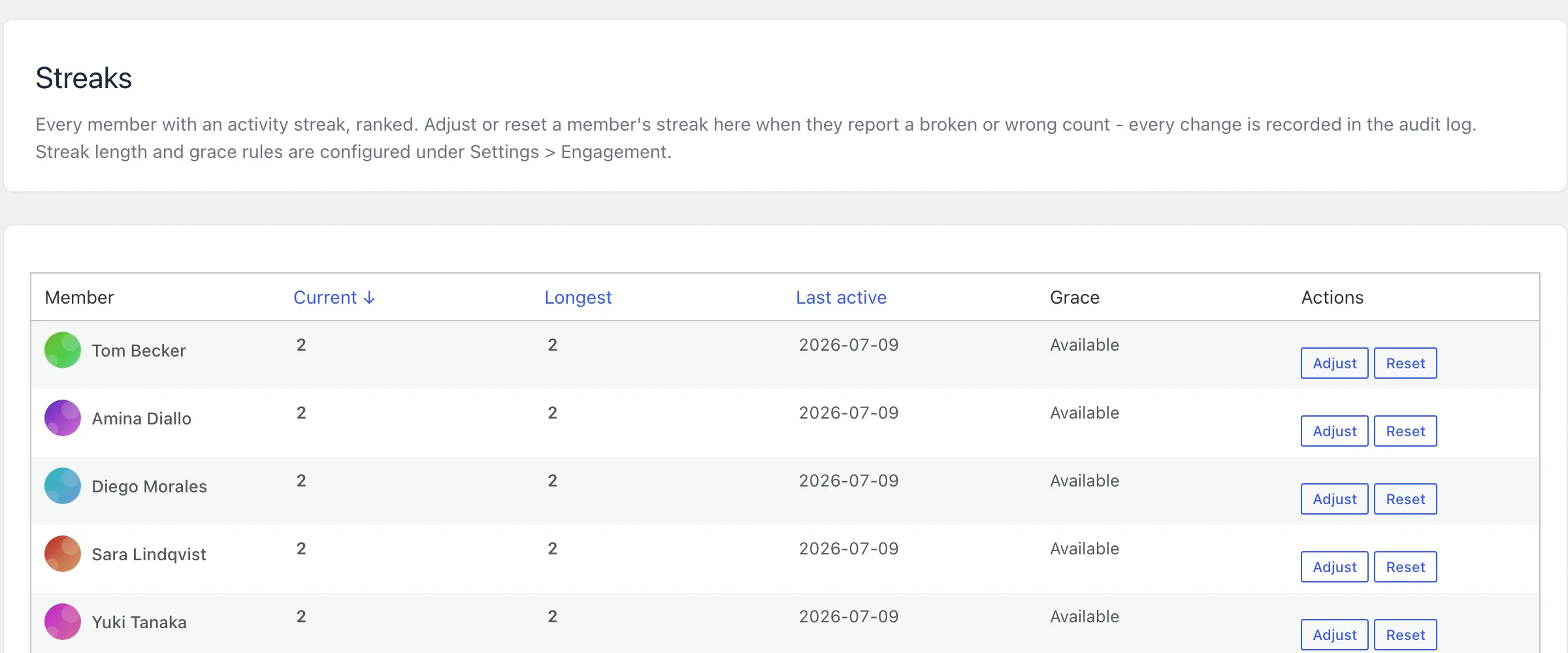
A grace-day streak, one that survives a single missed day without resetting to zero, is quietly a better accountability tool than almost anything else in this space, because it rewards the thing you actually want, showing up most of the time, over a long stretch, instead of punishing one bad week hard enough that people give up entirely. A rigid never-miss-a-day streak does the opposite. It turns one sick day into a reason to quit the whole system, which is the last thing an accountability tool should do.
The pushback: “isn’t a leaderboard motivating”
It is, for exactly the people who least need the extra push, the ones already showing up every day without help. For everyone else, a public ranking that they’re losing is at best neutral and at worst actively discouraging, and “everyone else” is most of your community.
The honest answer isn’t to delete the leaderboard, competition genuinely works for some people and there’s no reason to take that away from them. It’s to stop treating it as the metric and start treating it as one feature among several, sitting alongside streaks, kudos, and small-group accountability, so the people who thrive on ranking get their leaderboard and the much larger group who thrive on quiet consistency get tracked by something that actually rewards them instead of quietly telling them they’re behind.
Why this isn’t just a fitness tracking app with a comment section
Standalone fitness trackers already log workouts fine, streaks and all, without any community layer at all. So it’s fair to ask what the social piece is actually buying you beyond a nicer feed.
A solo tracker’s streak breaks in private. Nobody notices, nobody asks, and the app’s response to a missed day is a notification you can silence forever with one tap. A streak inside a community breaks in public, or at least semi-public, visible to the small group who’d actually say something. That visibility is the entire mechanism. It’s not that community members are watching out of judgment, it’s that a quiet “haven’t seen you post this week, everything okay” from someone who knows your name does something a push notification structurally cannot.
That’s worth exactly nothing to someone who’s already consistent on their own. It’s worth a great deal to everyone else, which, same as the leaderboard problem above, is most people.
Turning it into something you actually check
Weekly, not per-challenge. Track members with an active streak, not total workouts logged, streaks reward consistency in a way a leaderboard never will. Track average time to first reaction on a logged workout, because a log nobody acknowledges might as well not exist. And track second-week return rate specifically for anyone who joined during a challenge, since that number tells you whether you built a habit or just ran an event.
WB Gamification, which is entirely free, already ships streaks with grace days, a GitHub-style activity heatmap, and kudos for peer recognition, so the accountability layer doesn’t have to be built from scratch or bolted on as a separate tool. If you want to see exactly where this kind of activity data actually lives once it’s running, free tier versus the fuller dashboard, the walkthrough on tracking this inside BuddyNext covers it screen by screen.
Run the challenge if you want, it’s a fine way to get people in the door. Just don’t mistake the leaderboard for the metric. The number that matters is who’s still showing up in week six, long after the countdown hit zero and nobody was watching anymore.
Related reading