
7 min read
WordPress vs Joomla vs Drupal: Which CMS Is Right for Your Site


Anyone planning a website on a content management system (CMS) usually starts with the same question: WordPress, Joomla or Drupal? The choice is hard because the three platforms share so much. All three are free, open source and backed by large communities. This post compares them on ease of use, design, functionality, SEO, support and security, and then looks at how the wider CMS market looks today.
Last updated: 6 November 2026
Quick answer
For most websites, WordPress is the right CMS: it is the easiest to learn, has the biggest library of themes and plugins, and runs about 39.5% of all websites (58.2% of CMS-based sites) per W3Techs on 6 November 2026. Choose Joomla for built-in multilingual and access control with some learning time, and Drupal for complex, developer-led, high-security builds.

CMS market share in 2026
These three platforms have dominated the open-source CMS space for well over a decade, but their positions are now very different. The table uses figures from W3Techs content management system usage statistics, dated 6 November 2026. W3Techs also reports that 32.2% of the sites it monitors use no known CMS.
| CMS | Share of all websites | Share of CMS-based sites |
|---|---|---|
| WordPress | 39.5% | 58.2% |
| Shopify | 5.3% | 7.9% |
| Wix | 4.2% | 6.1% |
| Squarespace | 2.4% | 3.6% |
| Joomla | 1.1% | 1.6% |
| Drupal | 0.6% | 0.9% |
WordPress is far ahead of both Joomla and Drupal. Hosted builders such as Shopify, Wix and Squarespace have also overtaken the two older open-source rivals in share, which tells you where most new small sites end up. Share is not the same as quality, though, and Drupal in particular is often chosen for large institutional sites where a small share still means serious traffic.
Similarities between Joomla, WordPress, and Drupal
All three platforms are free, open-source software under the GPL license. You can download them at no cost, use them and modify them as you wish.
Each has built its own community of developers, users, trainers, designers and volunteers. These communities improve the platform by sharing knowledge, organizing events, supporting users and fixing issues.
All three run on PHP and a database such as MySQL.
All three use themes or templates for design, and plugins, extensions or modules to add features.
WordPress vs Drupal vs Joomla
WordPress is open-source software for building websites, blogs and apps. Joomla is an award-winning CMS for websites and online applications. Drupal is a CMS for building everything from small sites to large platforms. The sections below compare them on the points that matter most when you choose.
Ease of use
Drupal
Installing Drupal is simple because most web hosts offer a one-click installer. After that you configure the site name, tagline and email address.
The Drupal admin area is tidy and minimal, but the simplicity ends quickly. Drupal is known for flexibility, and that flexibility costs ease of use. The core is focused on being strong and secure, so it has limited features out of the box, and nearly everything you want to add comes from modules.
There is a module for almost any feature, but finding the right one takes time. You have to research modules, choose one, install it and configure it correctly. Drupal is harder than the other two CMS platforms here, and it targets developers more than beginners.
WordPress

Most WordPress hosts include one-click installation. You enter the site name and email address and your site is ready to configure.
The WordPress dashboard is simple and focuses on the options people use most. For a basic blog you can add content and publish the same day. For other kinds of sites, choose your theme with care, because many themes are built for specific purposes.
If a feature is missing, search the WordPress plugin directory, install a plugin and activate it. Working with WordPress themes and plugins is much easier than with Drupal themes and modules, which is why WordPress is the most beginner-friendly of the three.
Joomla
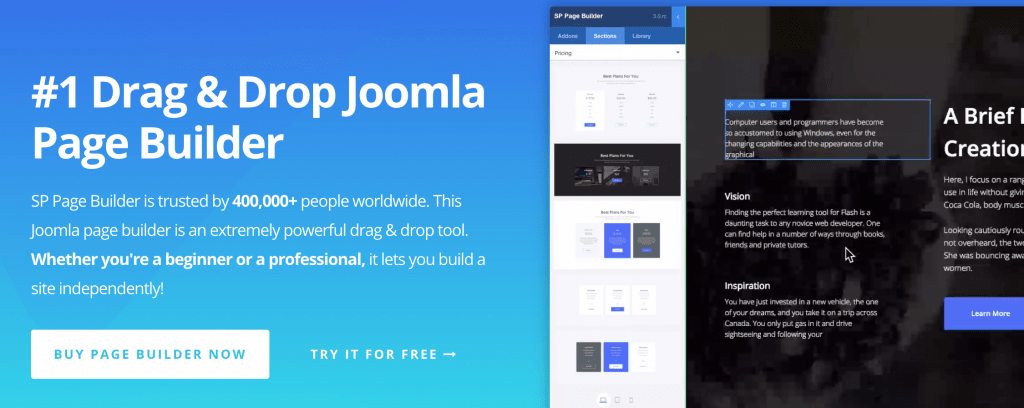
Joomla also installs with one click on most hosts. After installation you set up the site and its basic configuration.
The Joomla admin area feels busier than WordPress or Drupal, with more sections on screen. Like the others, Joomla uses templates for design and appearance.
Beginners often find it confusing at first. You can add an article much as you would in WordPress, but managing modules and their positions takes more effort. Once you understand how the interface is organized, it gets easier.
In short, WordPress wins on user-friendliness. It is the right pick for a beginner who wants a fast, feature-rich way to build a site. Joomla is a good choice if you can spend time learning it and want its flexibility. Choose Drupal if you already have web development skills.
Design and functionality
All three platforms use themes or templates for design and modules, plugins or extensions for features.
Drupal

Drupal is hard to beat on flexibility. It has a strong core with a good security record and you add functions through modules. The look of a Drupal site depends on the theme you install.
Modules are where Drupal gets its power. A search of the Drupal.org module directory returned 56,831 modules on 6 November 2026, so a module exists for nearly any feature (that count covers modules for all Drupal versions).
Drupal is very flexible and extensible, but the learning curve makes it a weaker choice for beginners. It fits teams that have coding skills or time to learn.
WordPress
For design and functionality combined with ease of use, WordPress stands out. Most WordPress site design comes from the theme, and the choice is very wide.
The official WordPress.org theme directory lists 8,881 free themes, and you can install them straight from the dashboard by going to Appearance, Themes and choosing Add New. Joomla and Drupal do not offer the same one-step flow for an official theme directory.
WordPress plugins add features such as SEO, speed, marketing, security or eCommerce to a WordPress site. The WordPress.org plugin directory lists 74,143 free plugins as of 6 November 2026.
That combination of themes and plugins is why WordPress offers the widest range of design and functionality choices.
Joomla
Joomla also uses templates for design, but its choice is smaller than WordPress or Drupal. Third-party template makers are the main source, so there are fewer free Joomla templates.
Joomla extensions add features in the same way as Drupal modules and WordPress plugins. According to the Joomla website, the Joomla Extension Directory lists over ten thousand extensions and templates, and you can install them from inside the Joomla admin.
SEO, support and security
All three platforms follow established security practice. Drupal has a strong default security posture, while WordPress and Joomla are secure when you keep core, themes and extensions updated and manage access carefully.
For SEO, WordPress has an edge because it began as a blogging platform. It has an SEO-friendly structure with tags, categories and many SEO plugins. Joomla and Drupal have SEO and marketing extensions and modules too.
Support matters as well. All three are community-driven, so you can find help in support forums and documentation.
Other CMS options worth knowing
Not every site needs an open-source CMS. Shopify, Wix and Squarespace are hosted platforms where the vendor handles updates and hosting, which suits small shops and brochure sites. They give you less control over code, data and hosting costs, and moving away later can be hard. WordPress sits in the middle: you own the site, and you can choose how much work to hand to a host or agency.
For community, membership or social sites, WordPress with BuddyPress is a common route. Wbcom’s Reign theme is built for that use case.

Conclusions on CMS platforms
WordPress, Joomla and Drupal are all capable CMS platforms, so none is a bad choice. What matters is fit. Choose WordPress for the widest ecosystem and the gentlest learning curve, Joomla for built-in features with a moderate learning curve, and Drupal for demanding projects with developer resources. Test your shortlist with a staging site before you commit.
Frequently asked questions
Which CMS is most popular?
WordPress. W3Techs reports it is used by 39.5% of all websites and has a 58.2% share of CMS-based sites as of 6 November 2026. Shopify is second with 7.9% of CMS-based sites.
Is WordPress better than Joomla or Drupal?
For most people, yes, because it is easier to learn and has the largest library of themes and plugins. Drupal can be the better choice for complex, developer-led projects, and Joomla suits teams that prefer its built-in structure.
Are Joomla and Drupal still maintained?
Yes. Both remain active open-source projects. The Joomla website lists the Joomla 6 line, and Drupal.org lists modules for Drupal 11 and newer. Their share of the web is small compared with WordPress.
Is Drupal more secure than WordPress?
Drupal has a strong default security posture, but a well-maintained WordPress site can be secure too. Most hacks come from outdated plugins, weak passwords or poor hosting, whatever the CMS.
Is WordPress free?
The software is free under the GPL license. You still pay for hosting and a domain, and optionally for premium themes and plugins.
Should I use Wix or Shopify instead of an open-source CMS?
If you want a small site or shop with minimal setup and no technical work, a hosted builder is a fair choice. If you want control of your data, code and hosting, an open-source CMS such as WordPress is better.
Related reading