
8 min read
Website Builders To Try Out As Alternatives To WordPress


If you’re seeking to go online quickly, access our assortment of the best website builder( Alternatives To WordPress ) options of 2020.
Website builders have been prevalent for multiple years, but the latest generation now makes terrific use of current technologies such as responsive and mobile platforms to present an improved service. The finest website builder software enables businesses and individuals to create everything from a one-page site to a professional online store, without requiring any HTML or design experience.
Whether you’re a multinational corporation or sole trader, nearly every business requires an online presence - in other words, a website. An increasing number are including bells and whistles such as an email list or form facility, domain name registration, and plenty more.
While the majority are paid, some free website builders are also available, though they tend to possess more restricted functionality than ones built for business use.
Furthermore, website builders are available that serve specifically for photographers, musicians, and online art portfolios.

Website Builders To Try Out As Alternatives
The following is a rundown of the finest website builder choices presently available.
1. Wix
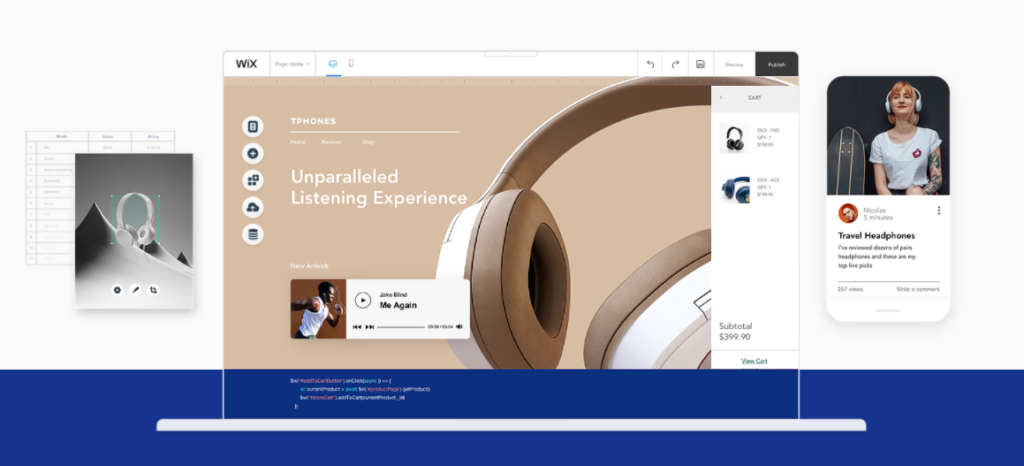
Wix is among the most common online website creators, presenting a variety of plans and products. The free version possesses Wix branding, restricted storage space (500MB), and bandwidth, but shifts to the most popular plan (restricted) without any Wix ads. You get unrestricted bandwidth (so it’s name) and 10GB storage, together with a free domain, Google Ad vouchers, and much more. The e-commerce plans begin with the “Business Basic” plan with a cost of $17 every month.
A wonderful assortment of 500-plus templates kick-starts the design process off to a rapid start. The drag-and-drop editor offers you all types of tools and features to explore - video backgrounds, an image editor, social buttons, animations, an integrated site blog - and nearly everything can be tuned, tweaked, and restyled. Moreover, as of currently, Wix has launched Wix Turbo, which raises the speed and performance of websites considerably.
The entire core editing functions are truly smartly designed and function more like a native app than your average website builder. Wix does have a few weaknesses, with tech support appearing slightly sluggish and restricted in some respects. But there’s no refusing that the superb editor and range of top-quality templates make it simple for web-building novices to build something exciting. The e-commerce plans begin with the “Business Basic” plan with a cost of $17 every month. If you decide to go with Wix, you can always check out Wix coupons to save some money on your purchase.
Also Read: How To Create A Site To Sell Your Services Online
2. Squarespace

A professional website builder with amazing templates. Another cable provider, Squarespace’s website builder, offers a plethora of features along with a few elegant-looking templates. The service is slightly expensive, with the cheapest Personal plan costing $12 a month, paid yearly. To be fair, you do obtain plenty of features like unlimited bandwidth and storage, SSL security, SEO features, image and video galleries, intelligent image optimisation, performance-boosting CDN support, a powerful blogging platform, a professional web store, and various others.
Among the initial things that grab your attention are the templates. They are attractively designed and conveniently accessible, as you can shift them at will if you feel later that you don’t like a specific template. The website editor itself is extremely minimalist and somewhat bland in appearance, but it shouldn’t fool you, as several options and features are available here. This is because they are only displayed when you place your mouse cursor over their individual elements.
If you encounter any issues, Squarespace offers excellent support, and their support team is quite knowledgeable. In addition to their support pages, which feature FAQs, video tutorials, and guides for various support topics, a live chat is also available on weekdays from 4 am to 8 pm EST, and email support is available 24/7.
3. IONOS by 1&1
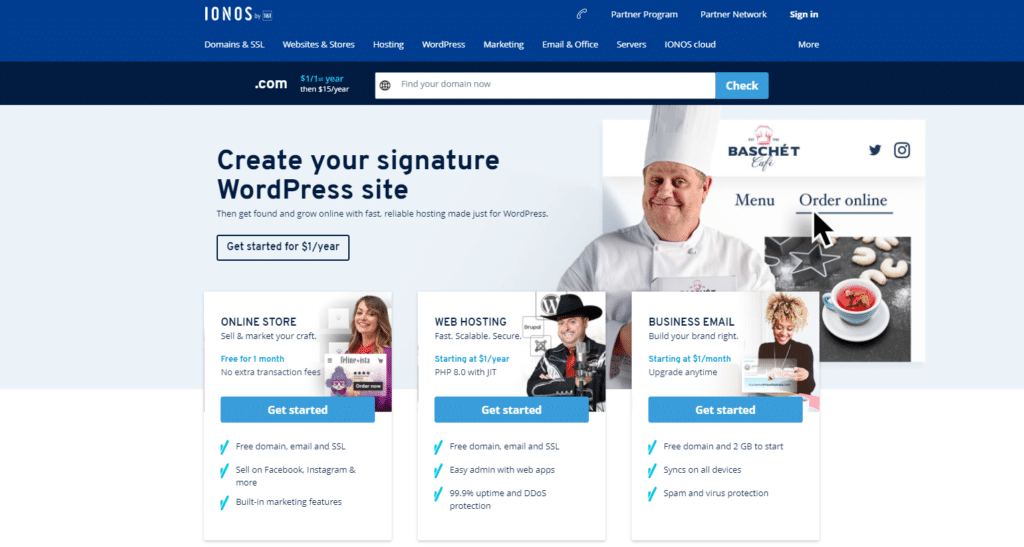
There’s plenty to appreciate here in terms of a strong drag-and-drop editor swelling with professional features and greatly customizable templates. However, at the outset, let’s make it plain that this isn’t the most inexpensive service around.
They don’t offer a free plan, but the basic plan costs only $7 a month (the first month is a free trial, and you can cancel anytime). The website builder comes with a free domain for 1 year, a free SSL certificate, and a professional email address.
IONOS by 1&1 offers an extensive array of responsive templates and an editor that provides numerous potential modifications and tweaks, all accompanied by extensive visual feedback and context-sensitive menus to streamline the entire process. What’s clever here is that the high-level matter is simple to use and comprehend for beginners, yet expert users can dive more deeply into the menus to truly play around and customise elements. You also receive your individual personal consultant free of charge.
Other beneficial features include the ability to direct traffic to your old website, allowing you to import content from there directly into your latest site. This could be a big timesaver for some. There is also an e-commerce plan starting at $30 a month.
4. Weebly- Alternatives To WordPress

Another powerful site builder, with a few innovative templates and numerous powerful features, is Weebly. Weebly is another well-known name in the website-building world, offering a robust editor and a comprehensive set of features. A free plan is also available, which, like Wix, restricts storage space to 500MB and displays ads on your site.
Nevertheless, if you shift to the Professional plan - at $12 each month - the ads and storage limit are removed, and you obtain a free domain and also support for a web store, including nearly 25 products. The supercharged Business plan enables you to build sites with unrestricted web store products and high-end store features, such as discount coupons and product reviews, at a retail price of $25 per month.
The service offers numerous professionally designed web templates, covering nearly every type of site. The drag-and-drop editor is cleanly designed, although you don’t receive complete control over where you can place elements on the page, and the interface can appear slightly cluttered. Furthermore, there is no global Undo feature.
Similar to Wix, the tech support was found to be slightly wobbly in terms of sluggish responses. However, Weebly offers a range of powerful features, some extremely stylish templates, and easy access to free images for your site, which is another boon.
Also Read: Advantages Of Building A Website Using WordPress Over Weebly
5. Shopify- Alternatives To WordPress

Shopify is the finest comprehensive e-commerce website builder on the market - it’s intuitive, strong, and loaded with excellent sales tools. Not just that, but you’ll also get access to more than 1200 apps to better your online store in all the main areas for selling online. In brief, Shopify is a one-stop e-commerce shop.
In terms of design, your Shopify store will garner accolades. The builder offers 10 free themes and over 50 paid options, is entirely mobile-responsive, and is developed by independent designers. Although there isn’t a free plan, Shopify offers a 14-day free trial. Normally, you’ll obtain a more extensive collection of sales tools on the higher-priced plans.
When it comes to online selling, there are typically transaction fees to consider. Shopify allows waiver of all transaction fees on their end by using Shopify Payments. This implies that you’ll pay the standard credit card rate of 2.2% + 20p for each transaction on the Basic plan.
However, do observe that you’ll need to pay transaction fees above the credit card fees if you employ an alternative payment gateway, like Stripe or PayPal.
Also Read: Building an eCommerce Website Quickly
6. BigCommerce- Alternatives To WordPress

If you’re looking to build an e-commerce empire quickly, this is the ideal platform. We appreciate the sheer quantity of BigCommerce’s top-quality, built-in features, which can help your business reach new, impressive heights. In contrast to Shopify, all you need for developing a company is already there - searching for and installing apps is not required.
Nevertheless, BigCommerce loses points due to its lack of intuitiveness. In contrast to Shopify, BigCommerce is more difficult to use and lacks a mobile app to aid in selling on the go. Nevertheless, following the first initial curve, you’ll discover extreme satisfaction in the powerful tools of the platform. It also offers a 15-day free trial period and doesn’t charge any transaction fees on any price plans. After the free trial period, you can upgrade to a paid plan, charged in US dollars.
One thing to bear in mind is that you’ll need to upgrade to a higher plan if your annual sales exceed a specific amount. For instance, if you’re undergoing the Standard plan and your yearly sales cross $50,000, you’ll need to upgrade to the Plus plan, which has a limit of $150,000. The Pro limit is $400,000, and following this, you’ll need to spend an additional $150 each month for every extra $200K in online sales.
Also Read: Check Out This 5 Step Checklist To Open eCommerce Store
7. Framer templates
For those who seek a more interactive and dynamic approach to web design, Framer is a must-try. Originating from a design and prototyping background, Framer has evolved to offer a robust web builder platform tailored for designers and developers alike. One of its standout features is Framer templates, which allow users to kick-start their design process with pre-designed layouts that can be easily customised to fit any brand or style.
One of the strongest suits of Framer is its integration of design and code. This makes it an ideal choice for designers who want to bring their web concepts to life without a deep understanding of programming. The interface is intuitive, combining drag-and-drop functionalities with a code editor for those who wish to delve into coding.
Framer’s pricing starts with a free plan, which offers basic functionalities. However, for more professional use, it’s recommended to check out their paid plans, which provide a richer set of features, including advanced animations, enhanced collaboration options, and more.
Moreover, the Framer community is active and ever-growing, offering a wealth of resources, from tutorials to user-created content, which can be a boon for those new to the platform. If you’re a designer or a developer keen on crafting unique, interactive web experiences, Framer is definitely worth checking out.

Conclusion on Alternatives To WordPress
As you’ve seen, there are numerous separate website tools available. They’ve become a significant force in the website-building industry. But that doesn’t imply their rivals are essentially worse options. It truly rests on your use case.
Interesting Read:
Create a WooCommerce Service Marketplace To Connect Freelancers To Businesses
Related reading