
4 min read
Where The AARRR Funnel Actually Breaks In Brand Communities

A brand community that runs on a support inbox almost always looks healthy at a glance. Tickets get answered. Customers say thanks. Nobody’s complaining on social media. And underneath that calm surface, two of the five AARRR stages are quietly failing, and nobody’s checking either one.
If you’ve read the piece on why brand communities have no growth loop, you already know the shape of this problem from one angle. This is the funnel version: which specific stage is broken, and what actually fixes it.
In this pieceWhy Acquisition usually isn’t the problem
Where it actually breaks: Retention and Referral
A real space where both stages actually work
Why a ticketing system structurally can’t fix this
The pushback: “our customers just want answers, not a community”
Where this actually lives inside BuddyNext
Why this isn’t the same as an NPS survey
Turning it into something you actually check
Why Acquisition usually isn’t the problem
Brand communities rarely struggle to get people in the door. You already have customers, which means Acquisition is mostly solved before the community even launches, you’re pulling from an existing base with an existing reason to be there. That’s exactly why it’s the wrong place to focus, and exactly where most teams focus anyway, because it’s the stage with the most obvious levers: more email invites, a banner in the app, a mention in the newsletter.
None of that fixes the two stages that are actually broken.
Where it actually breaks: Retention and Referral
Retention fails in a specific, quiet way. A customer has a problem, gets a good answer, and the interaction ends there. They got value once. They have no reason to open the community again until the next time something breaks, which might be months away, if ever. That’s not retention. That’s a rescue.
Referral fails for the same underlying reason. A great answer that lives inside a private ticket thread can’t be shared, because there’s nothing shareable to share. No link, no public page, nothing a customer could forward to a colleague with the same problem. The value existed. It just had no way to travel.
A real space where both stages actually work
Here’s what it looks like when both of those stages are actually built instead of assumed.
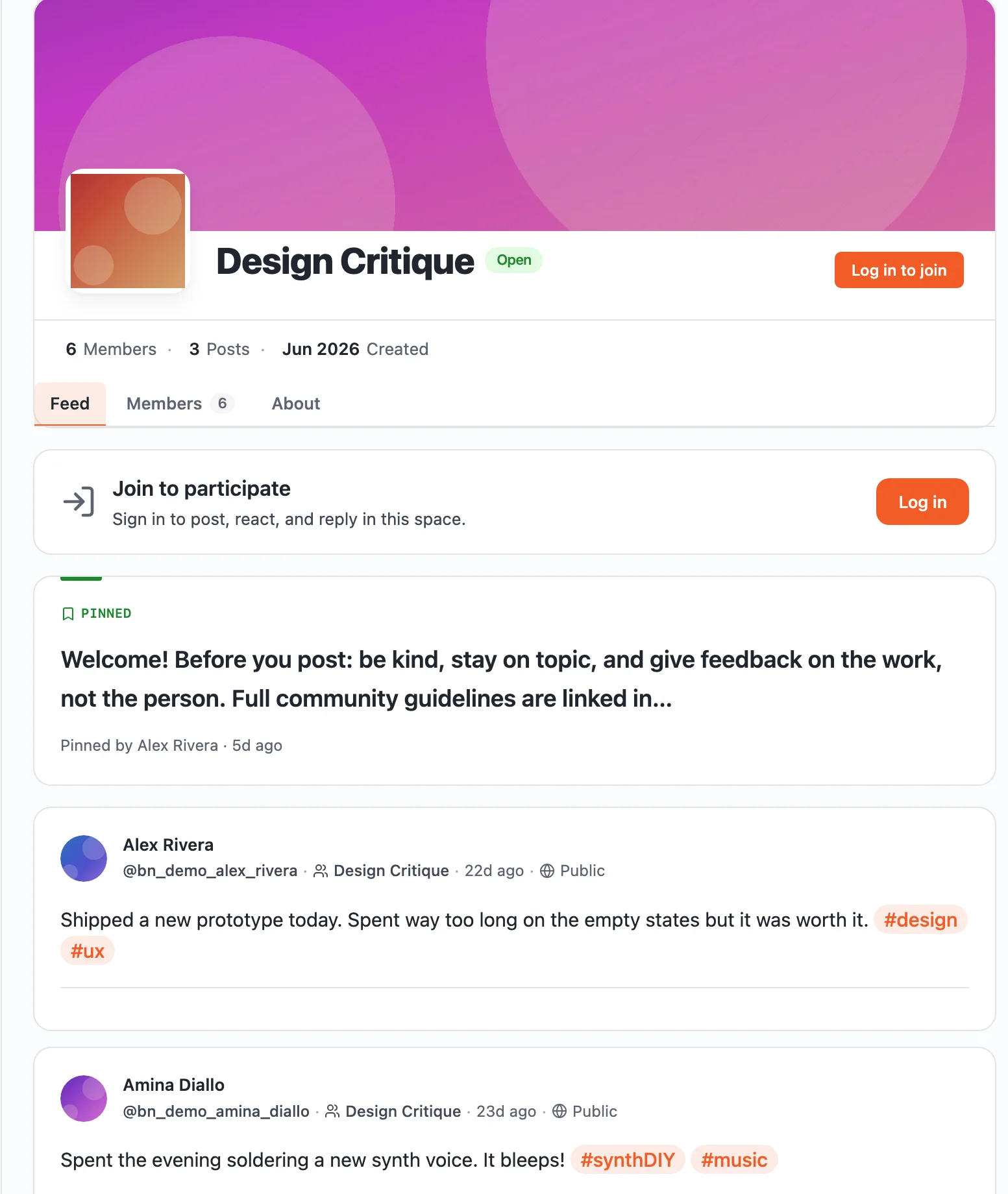
That’s a real, public Space, not a mockup: pinned ground rules from a moderator, genuine posts from real members, reactions, hashtags. Someone lands here for one reason and finds a reason to come back for a second, because there’s something to come back to beyond the single answer they arrived for. That’s Retention, built as a structural feature of the space rather than hoped for after a good interaction.
Why a ticketing system structurally can’t fix this
This isn’t a training problem or a tone problem. A ticketing system is architecturally incapable of producing either stage, no matter how good the support team is. Every thread is one customer, one agent, sealed the moment it’s marked resolved. There’s no “come back and see what else is here” because there’s no “here,” just a queue of closed tickets nobody revisits.
A community space fixes both problems with the same structural change: content lives somewhere persistent, public, and browsable, instead of vanishing into a closed thread the moment it’s resolved.
The pushback: “our customers just want answers, not a community”
Often true, and worth taking seriously rather than arguing past. Most customers with a support question want the question answered, fast, and don’t particularly want to join a community to get it. The fix isn’t forcing every support interaction into a public space. It’s making the public space available for the minority of interactions that are genuinely reusable, the questions other customers will hit too, while keeping fast, private, one-on-one support for everything else.
You’re not converting your support inbox into a forum. You’re building a second, smaller surface next to it, for the slice of content that’s actually worth Retention and Referral doing their job on.
Where this actually lives inside BuddyNext
If you’re running the community on BuddyNext, Spaces can be public by default, with real moderation, pinned posts, and a genuine member list, the exact structure shown above. Notifications and follows handle the “come back without being asked” half of Retention. None of it requires abandoning your existing support tool, it sits next to it, for the content that benefits from staying visible.
Why this isn’t the same as an NPS survey
A fair question: doesn’t a good NPS or CSAT score already tell you if support is working? It tells you if the single interaction went well. It tells you nothing about whether that customer ever came back, or whether their resolved problem ever helped anyone else. A high satisfaction score and a completely broken Retention and Referral stage can coexist for years, because satisfaction is measured at the moment of the ticket, and these two stages are only visible afterward.
The gap between “the customer was happy” and “the customer came back, and brought someone with them” is exactly the gap AARRR is built to expose.
Turning it into something you actually check
Weekly, alongside the north star check from the companion piece in that series: of the customers who got a resolved answer this month, how many returned to the community for a second, unrelated reason. And how many resolved answers are sitting in a public, findable space versus a closed ticket nobody will ever see again. Both numbers are usually close to zero the first time anyone actually checks them, which is exactly the point of checking.
A ticket answered once is a cost you pay every time it happens again. A customer who comes back on their own, and brings someone with them, is the two stages most support-first communities never actually built, sitting there unbuilt the entire time.
Related reading