
14 min read
How To Build An NFT Marketplace on WordPress in 2026

The NFT space has changed dramatically since the speculative peaks of 2021. Today, building an NFT marketplace is less about chasing price surges and more about delivering real utility - think real-world asset tokenization, digital event tickets, in-game item ownership, and verified digital identity. If you have a WordPress site and want to launch a marketplace that sells NFTs or enables vendors to offer digital assets, this guide walks you through everything you need to know in 2026.
This article covers what an NFT marketplace is, why it still makes business sense to build one, what features matter, how the development process works, and how plugins like Dokan and Woo Sell Services can power your platform on WordPress.
Top Takeaways
- The NFT market has matured past speculation. Builders who focus on utility - gaming assets, ticketing, RWA tokenization - are finding sustainable audiences in 2026.
- Multi-vendor plugins like Dokan let you run a full-featured NFT marketplace on WordPress without building custom blockchain infrastructure from scratch.
- NFT marketplaces earn revenue through listing fees, transaction commissions, and premium vendor plans - not just token price appreciation.
- Choosing the right blockchain (Ethereum, Polygon, Solana, or a layer-2) shapes your cost structure, speed, and target audience.
Why Building an NFT Marketplace Still Makes Sense in 2026
After the boom-and-bust cycle of 2021-2022, NFTs attracted a reputation for being purely speculative. That narrative misses what has actually happened since then: the market filtered itself. Projects with real use cases survived and grew. Marketplaces focused on genuine asset ownership - not just speculation - are now building sustainable revenue models.
The Shift to Utility-Driven NFTs
In 2026, the NFT use cases driving the most traction are not speculative art flips. They are:
- Real-World Asset (RWA) Tokenization: Fractional ownership of physical assets - real estate, fine art, commodities, invoice financing - represented as NFTs on-chain. This market has seen significant institutional interest.
- Event Ticketing: NFT tickets eliminate fraud, enable transparent resale markets, and give event organizers royalties on secondary sales. Artists and venues are adopting this actively.
- Gaming Assets: Play-to-earn and own-to-play games have matured. Players genuinely own in-game weapons, characters, and land parcels as NFTs tradeable on external marketplaces.
- Digital Identity and Credentials: Verifiable credentials, professional certificates, and membership tokens issued as NFTs on blockchain. These cannot be forged and port across platforms.
- Music and Creator Rights: Musicians tokenize royalty streams, giving fans a share in future earnings. Platforms like Royal pioneered this and others have followed.
A marketplace that targets one of these niches in 2026 has a clearer value proposition than a generic “buy and sell digital art” platform did in 2021.
Business Model: Commissions Not Tied to NFT Prices
One thing that has not changed: marketplace operators earn commissions on every transaction, regardless of whether NFT prices go up or down. OpenSea charges 2.5% on sales. Blur, Rarible, and others use different fee structures - some zero-fee to capture volume, then monetizing through token incentives. As a marketplace owner, you set your own commission model and collect fees on every trade that passes through your platform.
What Is an NFT Marketplace?
An NFT marketplace is a platform where users can mint, list, buy, sell, and transfer non-fungible tokens. NFT stands for non-fungible token - a cryptographically unique digital certificate that proves ownership of a specific digital (or physical) asset. Unlike Bitcoin or Ether, which are interchangeable, each NFT is one-of-a-kind.
Marketplaces typically work like this:
- Users connect a cryptocurrency wallet (MetaMask, Phantom, Coinbase Wallet, etc.).
- Creators upload a digital asset and mint it as an NFT on the chosen blockchain.
- The NFT is listed for a fixed price or auction.
- Buyers purchase using cryptocurrency.
- The smart contract automatically transfers the NFT and routes payment to the seller (minus the marketplace commission).
Smart contracts are the core of any NFT marketplace. They handle the transaction logic between buyer and seller without requiring a centralized intermediary. The identifying metadata of each NFT - its provenance, ownership history, traits - lives on the blockchain and cannot be altered.
Friendly Entry Point for Blockchain Newcomers
Well-designed NFT marketplaces still serve as a gateway into the broader blockchain world. When someone buys a gaming NFT or an event ticket, they set up a wallet, interact with a smart contract, and gain practical experience with on-chain assets. From there, the jump to other DeFi products - staking, liquidity pools, lending - is much smaller. This gives marketplace operators a built-in funnel for long-term user education and retention.
NFT Market Overview in 2026
The NFT market went through a significant correction from its peak. What emerged is a more structured space with clearer use case categories. Gaming NFTs, tokenized real-world assets, and digital collectibles with ongoing utility have shown the most staying power. The marketplaces that survived the downturn did so by offering lower fees, better liquidity, and more specialized inventory - rather than relying on FOMO and price speculation.
The infrastructure has also improved considerably. Layer-2 solutions like Polygon and Arbitrum have reduced transaction (gas) fees to near-zero on many platforms. Solana remains a popular choice for gaming NFT marketplaces due to its speed and low cost. Ethereum still dominates high-value art and RWA tokenization.
The NFT projects that matter in 2026 are the ones where owning the token changes what you can do - not just what you can brag about.
Must-Have Features for an NFT Marketplace
Building a competitive NFT marketplace in 2026 means going beyond the basics. Here are the core features your platform needs:
1. NFT Catalog and Discovery
At its core, an NFT marketplace is an eCommerce platform for digital assets. You need a storefront that makes inventory easy to browse and discover:
- Categories and subcategories (art, gaming, music, collectibles, RWA, tickets)
- Filters by blockchain, price range, rarity, creator
- Top charts and trending collections
- Collection pages grouping related NFTs
- Saved searches and watchlists
2. Crypto Wallet Integration
Wallet connectivity is table stakes. Your marketplace needs to support the wallets your target audience uses. For Ethereum-based platforms, MetaMask is still dominant. For Solana, Phantom is the standard. Multi-chain marketplaces should support both.
WalletConnect has become the standard bridge for connecting mobile wallets to desktop platforms. Implementing WalletConnect v2 gives you access to hundreds of wallets without building individual integrations. If you are targeting mainstream consumers who have no crypto wallet yet, consider offering an embedded wallet option via services like Privy or Magic.link - they let users sign up with an email address and manage keys in the background.
3. Minting
Let creators mint NFTs directly on your platform. A good minting flow captures the digital file, prompts for metadata (name, description, traits, royalty percentage), and deploys the NFT to the blockchain. Lazy minting - where the NFT is only written to the blockchain when sold - reduces upfront gas costs for creators and lowers the barrier to listing.
4. Buying and Selling Mechanisms
- Fixed price listings - simple buy-now at a set price
- English auctions - open bidding with a reserve price and time limit
- Dutch auctions - price starts high and drops over time
- Offers and counter-offers - buyers submit offers on any listed NFT
- Bundle listings - sell a group of NFTs as a single lot
5. On-Chain Royalties
Creator royalties on secondary sales became contentious in 2022-2023 when some marketplaces made them optional to attract volume. The outcome was mixed. In 2026, the better approach is implementing ERC-2981 (the NFT Royalty Standard) on Ethereum, or equivalent standards on other chains. This lets creators set a royalty percentage that reputable marketplaces honor. Royalties of 2.5-10% are typical for art and music. Gaming items often have zero royalties to encourage trading liquidity.
6. Advanced Features Worth Adding
Beyond the basics, there are several features that differentiate serious platforms from basic demos:
- NFT-backed loans: Let holders borrow against their NFTs without selling. Platforms like NFTfi pioneered this. Adding a lending layer gives holders a reason to stay on your platform.
- Fractional ownership: Split a high-value NFT into multiple tokens, allowing smaller investors to hold a share. This is particularly relevant for RWA marketplaces.
- P2P NFT trading: Direct swaps between wallets without cash changing hands.
- Token gating: Restrict access to content, events, or community spaces based on NFT ownership. This transforms your marketplace into a membership platform.
- Analytics dashboard: Creators and collectors want floor price history, volume charts, and rarity scoring for collections.
Key Factors When Building Your NFT Marketplace
1. Transparency
Every transaction on your marketplace should be verifiable on-chain. Users need to see full ownership history, sale prices, and royalty distribution. Blockchain’s public ledger handles this automatically - your job is to surface this data clearly in your UI. Show transaction hashes. Link to block explorers. Buyers in 2026 expect this level of visibility.
2. Security
NFT marketplace security covers two layers. First, your smart contracts must be audited. Exploits in smart contract logic have cost marketplaces and users hundreds of millions of dollars. Get a professional audit before handling real funds. Second, your web platform needs standard security hardening - secure wallet connection flows, CSRF protection, and no storage of private keys. Your platform should never ask for a user’s seed phrase.
3. Blockchain Choice and Decentralization
Choosing the right blockchain shapes almost every other decision:
| Blockchain | Best For | Fee Level | Speed |
|---|---|---|---|
| Ethereum Mainnet | High-value art, RWA | High (variable) | ~12 seconds |
| Polygon (L2) | Gaming, mass-market NFTs | Very low | ~2 seconds |
| Arbitrum / Base (L2) | General purpose, low cost | Low | ~1 second |
| Solana | Gaming, high-volume trading | Very low | Sub-second |
4. Monetization Model
Your revenue model should be clear before you build. Common approaches:
- Transaction fee: 1-2.5% on every sale (most common). Set this low to attract volume; raise it gradually as your marketplace grows.
- Listing fee: A flat fee per NFT listed. This discourages spam listings but may deter creators early on.
- Premium vendor plans: Subscription tiers giving vendors lower fees, better placement, analytics, and promotional tools.
- Minting fee: A small fee to mint NFTs on your platform.
- Featured listings: Pay for placement in a curated spotlight section.
5. Smart Contracts
Smart contracts govern transactions between buyers and sellers without a middleman. They handle escrow, payment routing, royalty splits, and NFT transfer atomically - meaning all steps succeed or none do. For Ethereum, ERC-721 is the standard for unique NFTs. ERC-1155 supports both fungible and non-fungible tokens in one contract, which is useful for gaming items with multiple copies. Polygon and most EVM-compatible chains support both standards.
NFT Marketplace Niches in 2026
The strongest NFT marketplace businesses are niche platforms, not general-purpose clones of OpenSea. Here are the verticals with the most momentum in 2026:
- Gaming assets: Characters, weapons, land, in-game currency - all tokenized. Games like Axie Infinity and Illuvium drove early adoption. In 2026, the focus has shifted to games where NFT ownership is secondary to actual gameplay quality.
- Real-world asset tokenization: Fractional real estate, fine art, carbon credits, and invoice receivables are being tokenized by regulated platforms. This is an institutional-grade niche requiring legal compliance work, but the market size is significant.
- Event ticketing: NFT tickets for concerts, sports, and conferences. The resale market is transparent and programmable. Organizers earn royalties on every resale.
- Digital identity and credentials: Professional certifications, educational achievements, and DAO membership tokens. These are often soulbound (non-transferable) NFTs.
- Music and royalty rights: Artists tokenize a share of streaming royalty income. Fans invest and earn alongside the artist.
- Videogame items: Skins, weapons, characters traded inside or outside the game client via platforms integrated with the game’s economy.
- Investment and security tokens: Compliant security tokens representing shares or debt instruments. High regulatory overhead but growing interest from traditional finance.
How to Build an NFT Marketplace: Step-by-Step
Step 1: Choose a Niche
Start with a specific, defensible niche rather than a general marketplace. “NFT marketplace for independent musicians to sell royalty shares” is a better starting point than “buy and sell any NFT.” A clear niche helps you design the right features, attract the right creators, and market efficiently. Talk to potential creators in your target niche before writing any code.
Step 2: Define Your UX/UI Design
NFT marketplace UI has matured significantly. Users expect clean catalog pages, clear pricing, easy wallet connection flows, and transparent transaction history. Study what platforms like OpenSea, Blur, Magic Eden, and Foundation do well, then identify where they fall short for your specific niche. Your UI should reduce friction at every step - particularly wallet connection and minting, which still confuse new users.
Step 3: Front-End Development
For a WordPress-based marketplace, your front-end is largely handled by your theme and plugins. For a custom platform, React or Next.js are the dominant choices. Libraries like ethers.js (for Ethereum) and @solana/web3.js (for Solana) handle blockchain interactions. Use a proven wallet connection library like RainbowKit or wagmi rather than building connection flows yourself.
Step 4: Smart Contract Development and Audit
Your smart contracts govern all marketplace transactions. For most teams, using an audited, open-source contract framework (like OpenZeppelin) as a base is safer than writing contracts from scratch. Customize for your specific requirements - royalty splits, auction mechanics, access control. Before going live with real funds, get a security audit from a reputable firm. The cost is significant (often $10,000-$50,000 depending on complexity) but non-negotiable for a platform handling user funds.
Step 5: Test and Deploy
Deploy to a testnet first (Ethereum’s Sepolia, Polygon’s Amoy, Solana’s Devnet). Run full user flows: mint, list, buy, withdraw. Catch edge cases - what happens if a buyer cancels a transaction mid-way? What if the same NFT is listed twice? What if gas prices spike during an auction? Only move to mainnet once all flows are validated on testnet. After launch, plan for ongoing monitoring of contract events and a process for handling user disputes.
Building Your NFT Marketplace on WordPress with Wbcom Designs
If you already have a WordPress site and want to add marketplace functionality without building blockchain infrastructure from scratch, Wbcom Designs has two products that work well together for this use case: Dokan and Woo Sell Services. These plugins give you a multi-vendor marketplace foundation on WordPress, which you can extend with NFT-specific integrations and WooCommerce add-ons.
1. Dokan - Multi-Vendor Marketplace for WordPress
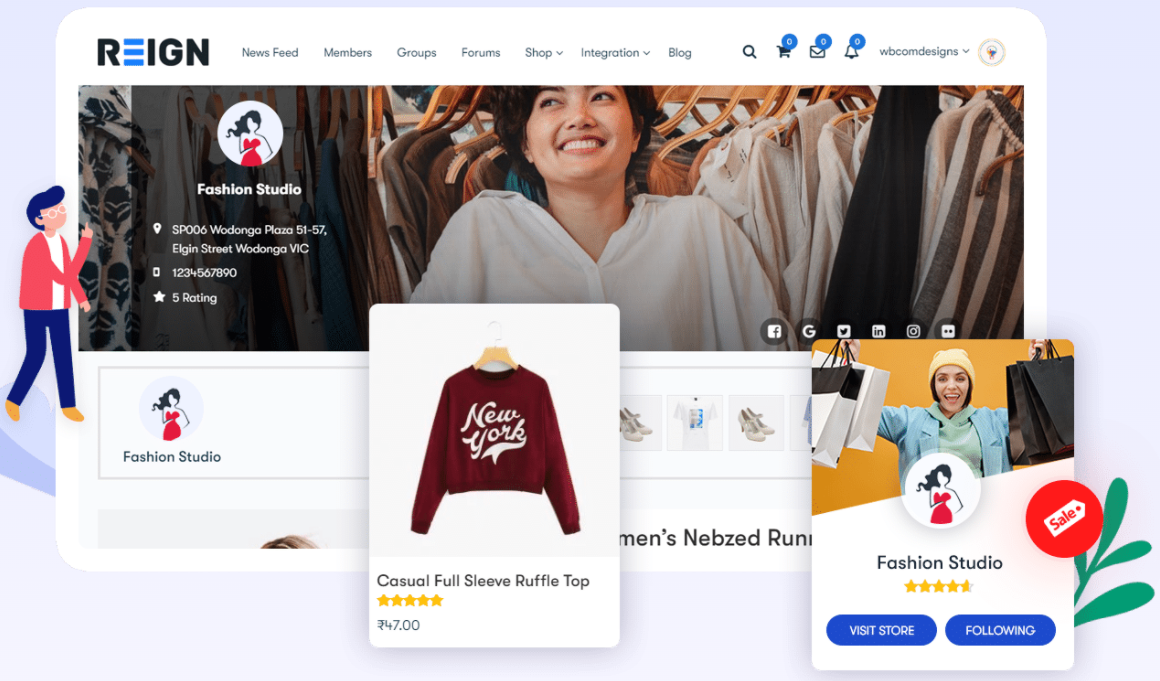
Dokan is the leading multi-vendor plugin for WordPress, now used by over 100,000 marketplaces worldwide. It lets you run a marketplace where multiple vendors can register, list products, manage their own stores, and receive payments - all on a single WordPress site. Think of it as the WooCommerce layer for your NFT marketplace front-end.
For Marketplace Admins
- Customization: Configure the marketplace UI, set commission rates per vendor, manage product approval workflows, and customize the checkout experience as your platform scales.
- Vendor and Customer Management: Manage vendor profiles, product catalogs, and customer accounts from a unified admin panel. Set permissions for what vendors can and cannot do.
- Automation: Automatic payment routing to vendors, order tracking, and commission calculations reduce the manual overhead of running a marketplace with many sellers.
- Reports and Analytics: Track sales by vendor, product, and time period. Generate revenue reports, commission summaries, and campaign performance data to guide decisions.

For Vendors (NFT Creators)
- Vendor Dashboard: Each NFT creator gets their own dashboard to manage listings, track orders, view earnings, and handle customer communications - all from a browser-based interface.
- Promotion Tools: Vendors can run coupons, discounts, and featured listings to promote their NFTs within the marketplace.
- Database Management: Import and export product data, manage tax settings (relevant for jurisdictions with NFT tax requirements), and track detailed sales history.
- Multi-Store Support: A single vendor can operate multiple stores or collections under different names, useful for artists with distinct creative identities.
2. Woo Sell Services - Service-Based NFT Offerings
Woo Sell Services extends WooCommerce to support service-based products - which maps directly onto NFT-adjacent services like custom NFT creation commissions, smart contract deployment, collection art, and blockchain consulting. If part of your marketplace involves creators offering services (not just finished digital assets), Woo Sell Services handles the workflow between buyer and seller.
Key features for an NFT service marketplace:
Backend Management
- Manage all services from a central service page
- Set delivery dates per service variation (e.g., “3-day NFT portrait commission”)
- Assign support agents to orders for high-touch service relationships
- Manage live conversations between buyers and sellers
- Configure email notifications at each stage of the service workflow
- Send customers automated prompts to fill in project requirements
Selling Services as Products
- Dedicated order management section per service
- Post-delivery review and rating system for accountability
- Structured requirement collection from buyers before work starts
- In-built chat between customer and vendor throughout the project
- Customer approval/rejection of final deliverable before order is marked complete
Easy Setup
- Install and configure in minutes on any WooCommerce site
- Ideal for service-oriented digital marketplaces
- No complex blockchain knowledge required for the marketplace operator
What Does It Cost to Build an NFT Marketplace?
Cost varies significantly based on how much you build from scratch versus using existing tools.
| Approach | Estimated Cost | Time to Launch | Best For |
|---|---|---|---|
| WordPress + Dokan + NFT plugin | $500 - $5,000 | 2-8 weeks | Startups, proof of concept |
| White-label NFT marketplace platform | $5,000 - $20,000 | 4-12 weeks | Speed to market, limited custom needs |
| Custom development (NFT-specific) | $50,000 - $200,000+ | 6-18 months | Unique features, large scale |
The largest cost variable is smart contract development and audit. A basic minting and trading contract might be adapted from open-source templates for a few thousand dollars in developer time. A complex contract with fractional ownership, lending, and custom royalty logic - audited by a reputable firm - can cost $50,000 or more before you write a single line of front-end code.
Ongoing costs to budget for:
- Blockchain infrastructure (RPC node providers like Alchemy, Infura, or QuickNode)
- IPFS or Arweave storage for NFT metadata and media files
- WordPress hosting and plugin licenses
- Security monitoring and smart contract maintenance
- Legal and compliance (especially for RWA or security token marketplaces)
Summary
Building an NFT marketplace in 2026 is a more grounded and technically clearer proposition than it was at the height of the hype cycle. The speculative froth is gone; what remains is genuine infrastructure for digital ownership. Gaming studios want marketplaces for their in-game assets. Musicians want platforms that let fans invest in their royalties. Real estate firms are exploring tokenized fractional ownership. Event organizers want programmable tickets with built-in resale royalties.
If you are building on WordPress, a combination of Dokan’s multi-vendor capabilities and Woo Sell Services gives you a working marketplace foundation you can launch and iterate on without months of custom development. Start with a clear niche, get your smart contracts audited before handling real funds, and design for the user who has never touched crypto before. The barrier to entry for your audience is lower than it has ever been - your job is to keep it that way.
Ready to start your WordPress marketplace? Wbcom Designs can help you get there faster with expert guidance and the right plugin stack.
Related Reading:
Related reading