
5 min read
The One AARRR Stage Hobby Communities Are Afraid To Build

Ask most hobby community owners about Revenue, the fifth AARRR stage, and you’ll hear some version of the same hesitation: charging money feels like it would ruin the thing that made people want to join in the first place. So the stage just stays unbuilt, indefinitely, out of a fear that’s understandable and, in most cases, solvable without becoming the thing anyone was afraid of.
If you’ve read the piece on why hobby community work never gets found, that one was about Referral, giving finished work a permanent home. This is the stage most hobby communities skip entirely, and it’s usually skipped for reasons worth examining rather than accepting by default.
In this pieceWhy the other four stages usually already work here
The actual fear behind skipping Revenue
A real, simple pricing page, not a mockup
What makes monetizing a hobby community safe
The pushback: “money changes everything about a hobby space”
Where this actually lives inside BuddyNext
Why optional Revenue isn’t the same as selling out
Turning it into something you actually check
Why the other four stages usually already work here
Hobby communities have an advantage most other niches would envy: Acquisition, Activation, Retention, and Referral tend to work almost by default, because people join a hobby community already carrying genuine enthusiasm for the thing itself. Activation happens the moment someone posts their first project. Retention happens because the hobby itself is the retention mechanic, not something the platform has to manufacture. Referral happens because finished work is inherently shareable, the exact argument from the growth loop piece.
Revenue is the one stage that doesn’t happen by default, because unlike the other four, it requires a deliberate decision the owner has to actually make, and most owners avoid making it.
The actual fear behind skipping Revenue
The fear is rarely “will anyone pay.” It’s “will asking for money change what this community is.” That’s a legitimate concern, not a rationalization, hobby spaces run on trust and shared enthusiasm in a way that a poorly-designed paywall can genuinely damage.
But skipping Revenue entirely doesn’t protect the community, it just caps what the owner can sustainably build. A hobby community that never generates any revenue is entirely dependent on the owner’s free time and goodwill indefinitely, which is its own kind of fragility, just a quieter one that doesn’t show up until the owner burns out or life gets in the way.
A real, simple pricing page, not a mockup
Here’s what a real Revenue stage can look like when it’s built simply, reachable without an account.
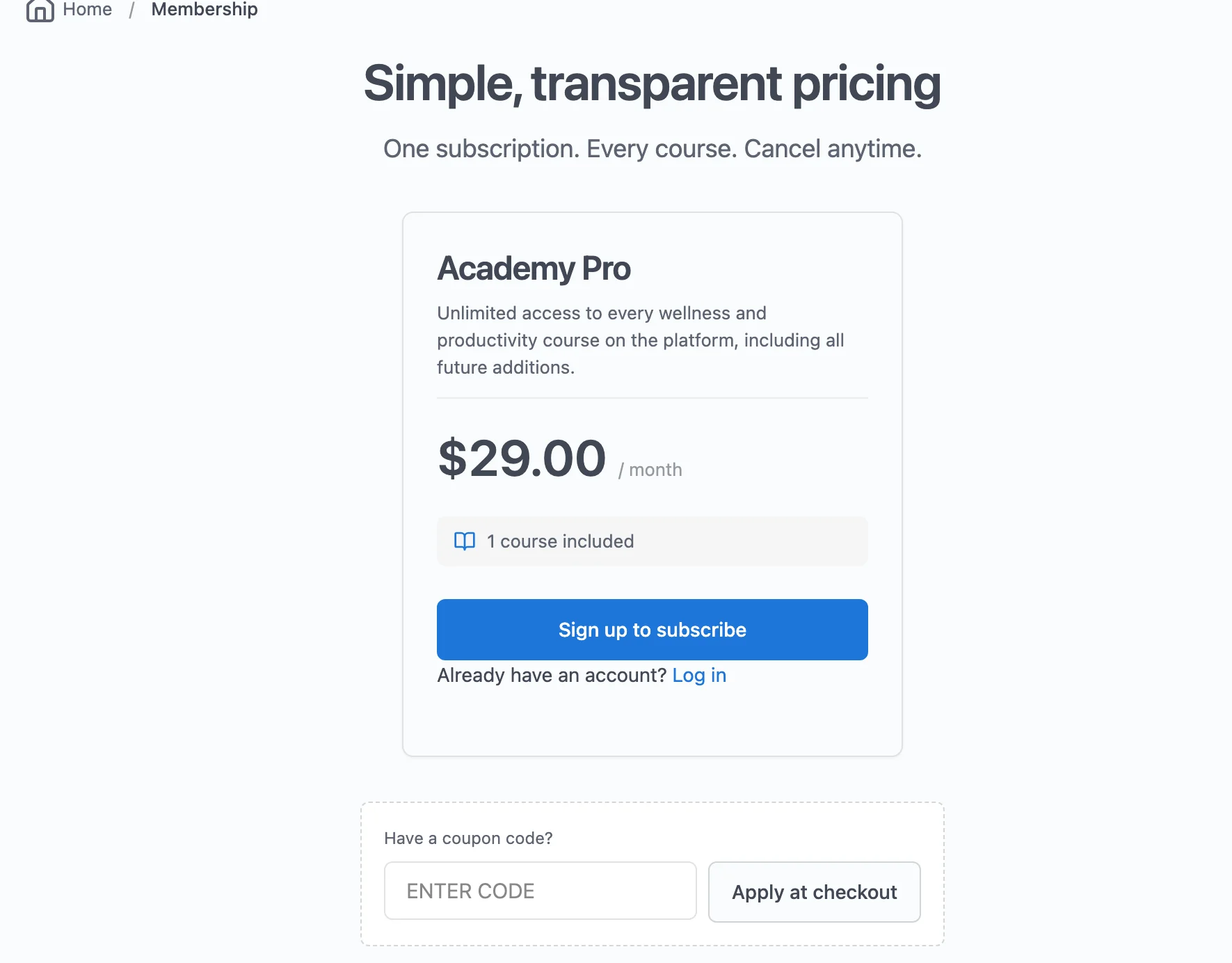
One plan. One clear price. A coupon field for flexibility. A gift option for members who want to sponsor someone else’s access. Nothing about this page pressures anyone into anything, and nothing about it is hidden behind dark patterns or forced upgrade prompts. That’s the entire template for Revenue that doesn’t feel like selling out: transparent, optional, and genuinely proportional to what it unlocks.
What makes monetizing a hobby community safe
The first requirement is that the free tier stays genuinely good. If Revenue is built by deliberately making the free experience worse, that’s the version of monetization hobby communities are right to fear. If it’s built by adding something new and optional on top of an unchanged free experience, the fear mostly doesn’t materialize.
The second is that what’s being charged for is actually worth the price on its own terms, not artificial scarcity. Extra storage for a photography community, a curated critique session, early access to a group project, these are real value, not a paywall dressed up as a feature.
The third is that paying is never required to belong. The moment Revenue becomes the price of admission rather than an optional layer on top, a hobby community starts filtering for wallets instead of enthusiasm, which quietly changes who’s in the room in a way most owners didn’t intend and would regret if they noticed it happening.
The pushback: “money changes everything about a hobby space”
Sometimes it does, and it’s worth naming honestly rather than dismissing. A community that goes from fully free to aggressively monetized, fast, with paywalls appearing where free access used to be, absolutely damages trust. That’s a real failure mode, not a hypothetical one.
It’s not, however, an argument against Revenue existing at all. It’s an argument for Revenue being additive and optional rather than a bait-and-switch on something that used to be free. Those are different actions with very different outcomes, and conflating them is what keeps most hobby community owners stuck at zero.
Where this actually lives inside BuddyNext
If you’re running the community on BuddyNext, membership tiers can be layered on top of a fully-featured free plan rather than replacing it, the exact structure shown above: one paid tier, clearly priced, with the core community experience, Explore, posting, connections, still free for everyone. Coupons and gifting mean the paid tier can be extended generously to members who couldn’t otherwise afford it, without turning it into a blanket giveaway.
Why optional Revenue isn’t the same as selling out
A fair distinction worth making explicit: “selling out” describes changing what a community is in order to extract more money from it. Optional, additive Revenue doesn’t change what the community is, the free experience stays exactly as good as it was. It just adds a second door for the members who want something extra and are glad to pay for it, while the original door stays open and unchanged for everyone who isn’t.
Communities that make this distinction clearly, in the product and in how they talk about it, rarely get the backlash owners are afraid of. Communities that blur the line, where “optional” quietly starts feeling mandatory, are the ones that actually earn it.
Turning it into something you actually check
Monthly, alongside the companion piece on what makes a hobby community actually work: has the free experience gotten worse in the last quarter, in any way, in order to make the paid tier look better by comparison. If the honest answer is no, Revenue is very unlikely to be the thing that breaks trust. If the honest answer is yes, that’s worth reversing before it compounds into the exact outcome the original fear was about.
The community that stays free doesn’t get to grow past what one person’s spare time can sustain. The one that builds an honest, optional Revenue stage gets to exist for longer than that, without becoming the thing anyone was afraid it would turn into.
Related reading