
5 min read
How to Choose the Right Community Platform for Your Business

Most people choose a community platform for their business the way they choose a restaurant by the menu. They scan the feature list, count the checkmarks, and pick the one with the longest column.
I did this too, years ago. It’s the wrong instinct.
A feature list tells you what a platform can do. It tells you nothing about whether your community will actually feel alive on it. Those are two different questions, and only the second one matters.
So let me walk you through how I think about this now, after watching some communities catch fire and others go silent inside a month.
Start with the question almost nobody asks
Before you compare a single tool, answer this. What is the community actually for?
Not “engagement.” Not “building the brand.” Something specific. Are people coming to learn from you, to get unstuck, to meet each other, or to hand you product ideas?
Sit with that for a minute, because it decides everything downstream.
A support community lives or dies on search and clear threaded answers. A networking community needs rich profiles and a fast way to find the right person. A learning community needs structure and a sense of progress. Pick a platform tuned for one and use it for another, and you’ll feel the friction every single day. So will your members, even if they can’t name it.
Purpose is your filter. Everything else is noise until you’ve named it.
The rent you don’t see
Here’s where it gets uncomfortable.
Most hosted platforms, the ones you sign up for and launch in an afternoon, charge you more as you grow. More members, more money. Some cap you outright.
Sit with what that actually means. You do the hard work of attracting people and keeping them engaged, and the platform quietly raises the toll every time you succeed. Your win becomes their invoice.
That isn’t a partnership. That’s rent.
And rent hides a second cost. On a hosted platform you don’t own the relationship with your members. Their emails, their conversations, the whole web of who talks to whom, all of it sits on someone else’s servers under someone else’s terms. If they change the price, change the rules, or switch off the lights, your community leaves with them. You’re a tenant, and tenants get evicted.
This is the real case for self-hosting. Not that it’s cheaper, though it usually is. That you own the thing you built.
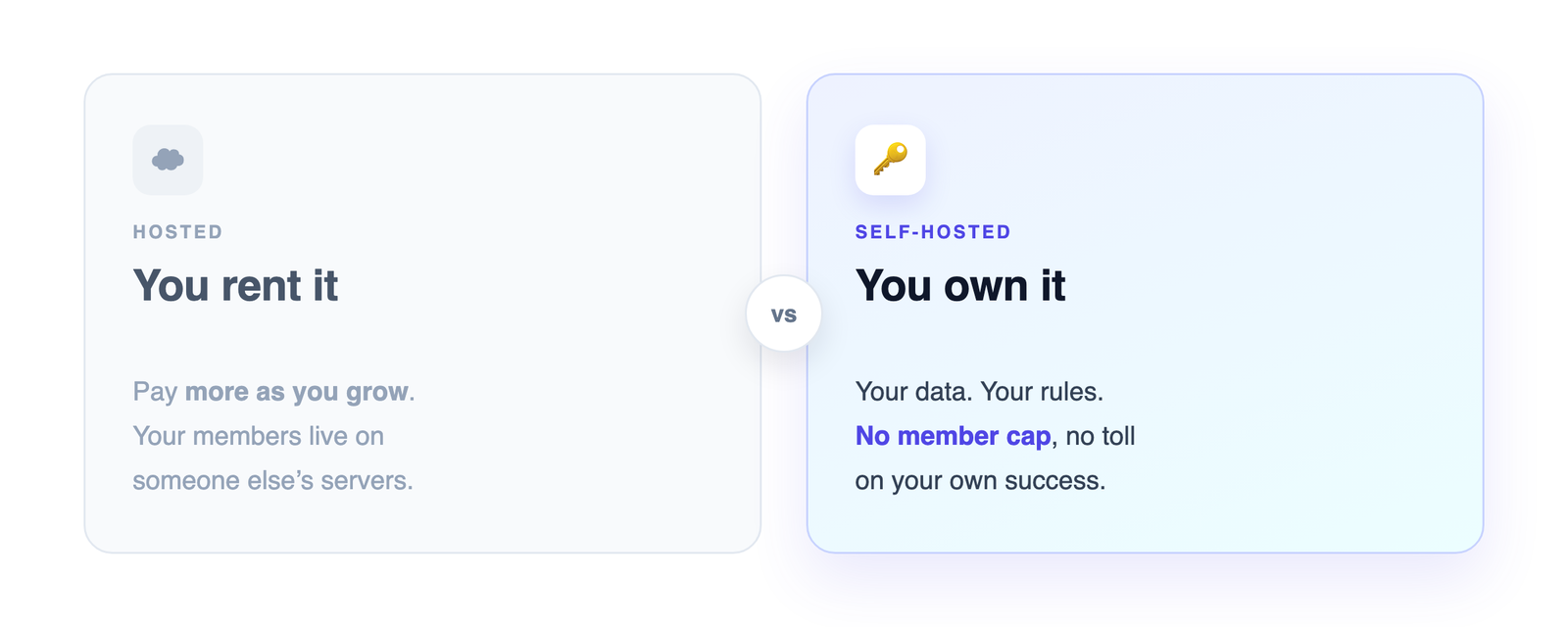
Self-hosted just means the platform runs on infrastructure you control, usually your own WordPress site, instead of a cloud you rent access to. You hold the data. You set the rules. Nobody can price you out of your own community.
The old objection was maintenance. You traded ownership for a pile of server headaches. That trade is mostly gone. Modern community plugins handle the hard parts, and what you keep is control that compounds year after year.
Features are table stakes, until they aren’t
Once you know your purpose and you’ve decided who owns the house, then you look at features. In that order, never the reverse.
Don’t drown in the list, though. A small number of things decide whether a room full of strangers becomes a community or stays a room full of strangers.
You need a heartbeat. An activity feed where people post, react, run a poll, argue in the comments. When that feed goes quiet, the community is already dead. It just doesn’t know it yet.
You need rooms. As a community grows, one big undivided space turns to chaos, so the ability to split people into groups or spaces, some open, some private, is what keeps a large community feeling small enough to care about.
You need a way for members to find each other. Searchable profiles and a real directory. That’s the entire point of a networking community, and quietly useful in every other kind.
And you need private messaging, so relationships form inside your walls instead of leaking out to some other app where you’ll never see them again.
Then there’s the part nobody wants to think about until it’s too late. Moderation.
Every community that grows attracts spam and, eventually, someone who wants to burn the place down. Reporting, roles, content controls: think of them as the immune system. You want them in place before the infection, not after.
Buy for the company you’ll become
The costliest mistake is choosing for the community you have instead of the one you’ll have in two years.
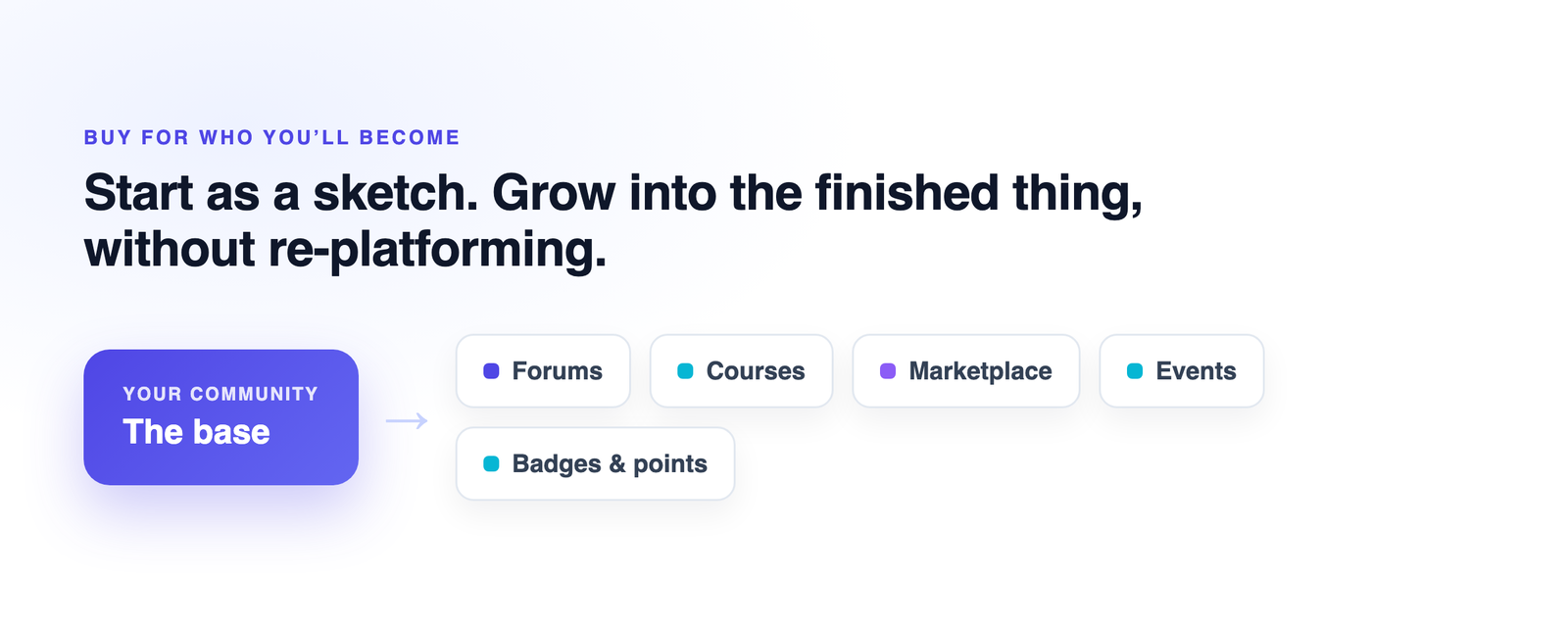
The community you launch is a sketch. In a year you’ll want forums. Then someone asks for courses. Then you’ll want to sell something, run events, hand out badges and points to reward the regulars.
If the platform can’t grow into any of that, you’re staring down a migration. And migrations bleed members. Every re-platform loses the people who don’t bother making the jump.
So pick something that extends. A base you can bolt a forum onto, then a learning system, then a storefront, without tearing up the foundation each time.
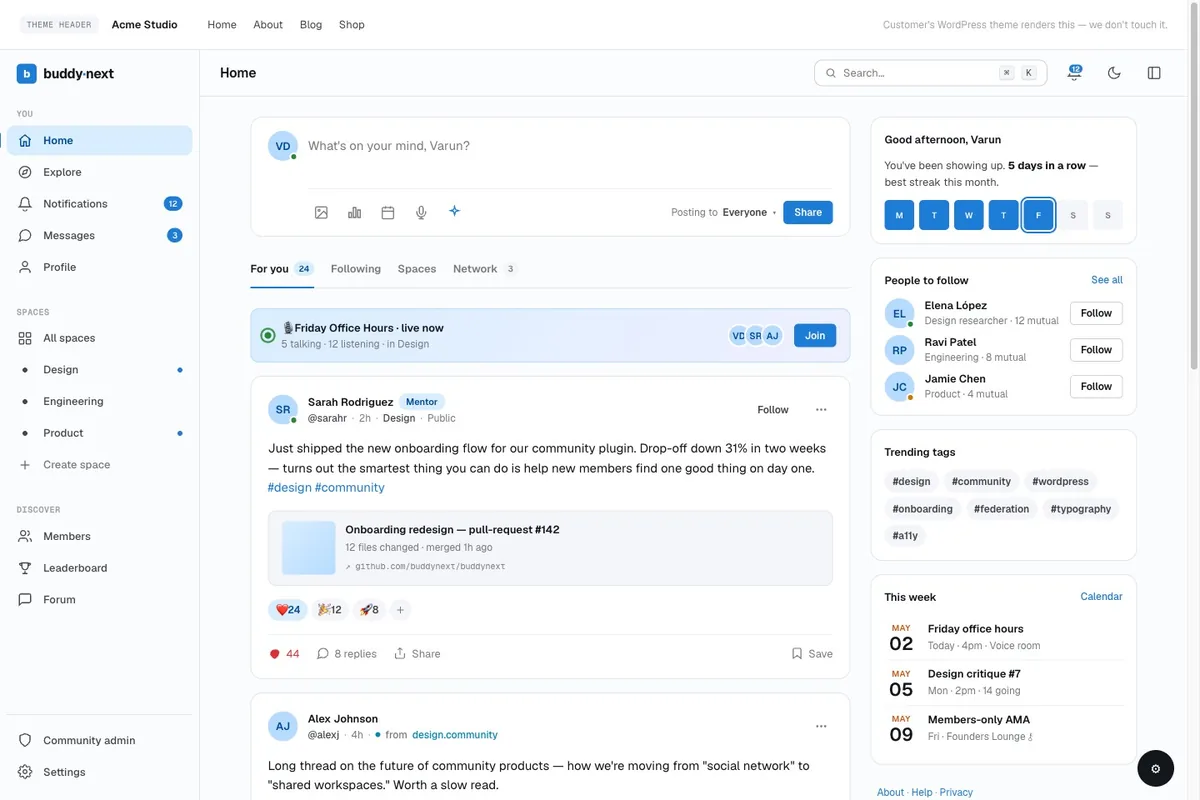
This is roughly the logic behind BuddyNext, which is one reason I point people to it when self-hosting is on the table. It runs on WordPress, so you keep ownership of your data by default, and it ships with the essentials I just described. A live activity feed with polls and reactions. Spaces you can set open, private, or secret. Rich member profiles with verified badges, sitting on a filterable directory. Private messaging. Moderation built in from the start.
The parts that map back to everything above are the ones I’d underline. There’s no member cap, so growing never costs you more. The free tier is a real product, not a countdown to a paywall. And when you’re ready to expand, it plugs into a set of apps for forums, courses, a marketplace, and more, so the sketch can become the finished thing without starting over.
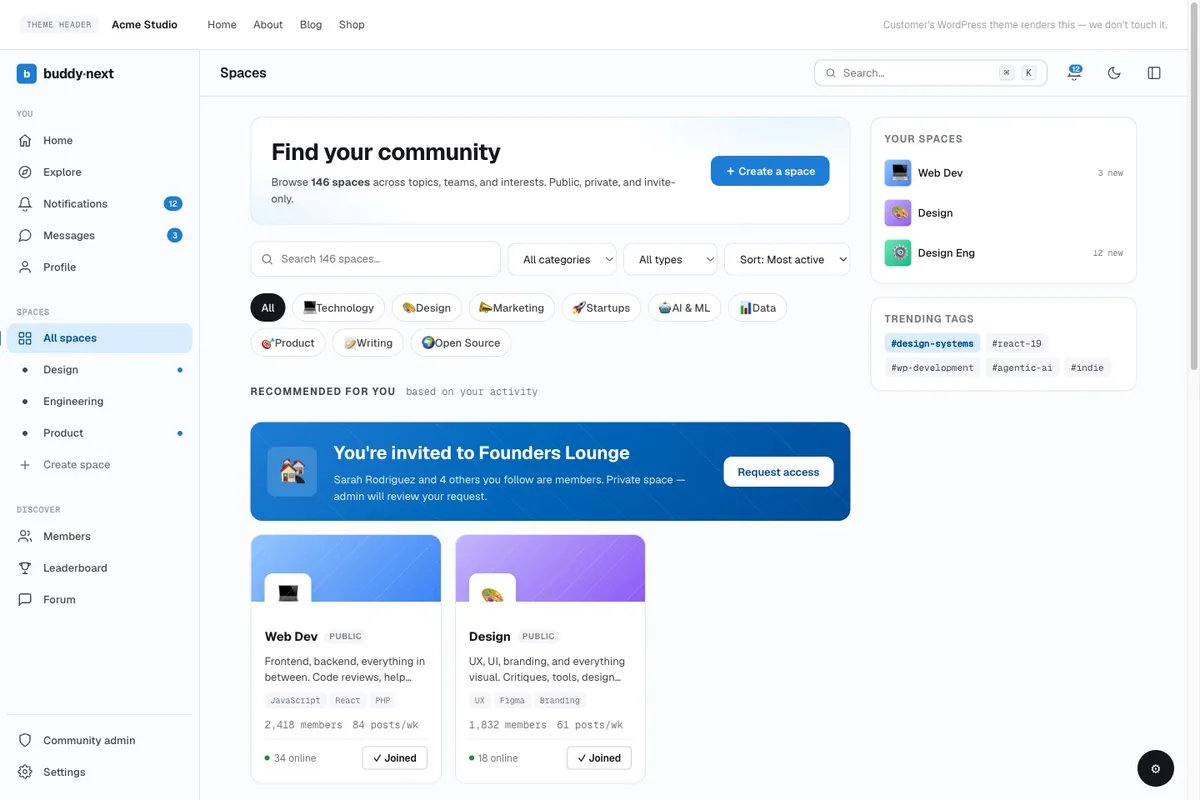
I’m not telling you it’s the only answer. I’m telling you it’s built around the right questions, and that turns out to be rarer than it should be.
Where that leaves you
So put the feature checklist down for a second.
Name what the community is for. Decide who owns it. Make sure it can outgrow the version you can picture today. Get those three right and the tool almost picks itself.
Get them wrong and you’ll spend next year migrating. Get them right and you’ll spend it building something people can’t find anywhere else.
The platform was never the community. But the wrong one will quietly strangle it before it ever gets to breathe.
Related reading