
10 min read
How to Create a Digital Product Marketplace on WordPress in 2026

Want to launch a digital product marketplace on WordPress? In 2026, the opportunity has never been better. Global digital product sales are growing fast, with creators selling everything from Notion templates and Canva assets to AI prompt packs and SaaS subscriptions. WordPress, combined with the right plugins and themes, gives you a solid foundation to build your own marketplace - one you fully own and control.
This guide covers everything you need: the best digital products to sell, the plugins that power your store, how to set up multi-vendor functionality, and how to market your marketplace for long-term growth. Whether you are starting fresh or modernizing an existing store, this is the complete 2026 playbook.
Why Sell Digital Products Online in 2026
Digital products have structural advantages over physical goods. Once created, they cost almost nothing to distribute, can be sold to thousands of customers simultaneously, and require no inventory or shipping logistics. Here are five reasons entrepreneurs are doubling down on digital product marketplaces:
- No inventory or shipping costs - Digital products are delivered automatically. No warehousing, no last-mile delivery, no returns on physical goods.
- Instantly scalable - Sell to one customer or ten thousand with the same infrastructure. Your margins improve as volume grows.
- Sell globally from day one - A buyer in Tokyo and a buyer in Toronto can both download your product in seconds.
- Recurring revenue potential - Subscriptions, license renewals, and membership bundles turn one-time buyers into long-term customers.
- Low barrier to entry - You can launch a focused digital marketplace in a weekend using proven WordPress tools without custom development.
Digital Products You Can Sell on Your WordPress Marketplace
The range of digital products has expanded significantly. Beyond classic ebooks and stock photos, there is a whole generation of high-demand digital goods that buyers are actively searching for in 2026.
Templates and Design Assets
- Notion templates - Project trackers, CRM dashboards, content calendars, personal productivity systems
- Canva templates - Social media kits, pitch decks, brand kits, resume templates
- Figma UI kits - Web design systems, mobile UI components, wireframe libraries
- WordPress themes and page builder templates - Elementor, Divi, Bricks, Kadence kits
- Spreadsheet templates - Google Sheets and Excel financial models, trackers, dashboards
AI Prompts and Tools
AI prompt packs are one of the fastest-growing digital product categories. Buyers pay for curated, tested prompts for ChatGPT, Midjourney, Claude, and other AI tools that help them accomplish specific goals faster.
- ChatGPT prompt libraries - For copywriting, SEO, coding, business, and creative work
- Midjourney style packs - Prompt recipes for specific visual aesthetics
- AI workflow bundles - Pre-built n8n or Make.com automation workflows
Educational Products
- Ebooks and guides - PDF downloads, how-to guides, industry reports
- Video courses - Pre-recorded training delivered via download or streaming
- Audio content - Podcasts, meditation packs, sound libraries, music samples
- Printable worksheets - Planners, educational materials, business forms
Software and SaaS Access
- WordPress plugins - Premium plugins, add-ons, license keys
- Chrome extensions and browser tools
- SaaS lifetime deals - Sell one-time access or annual subscriptions to your own software
- Code snippets and scripts - PHP snippets, JavaScript libraries, automation scripts
Services Sold as Products
With the right plugin, you can productize services - packaging consulting, development, design, or writing into purchasable items with defined deliverables. This is where EDD Sell Services and Woo Sell Services come in.
How to Build Your Digital Product Marketplace on WordPress
Here is the step-by-step process for setting up a fully functional digital product marketplace in 2026.
Step 1: Get WordPress Hosting
Start with managed WordPress hosting that can handle file downloads, payment processing, and consistent uptime. Solid options include Cloudways, SiteGround, Kinsta, and WP Engine. For a new marketplace, a mid-tier managed hosting plan is sufficient. You can scale up as traffic grows.
Install WordPress and configure a basic SSL certificate before adding any plugins. All payment flows require HTTPS.
Step 2: Choose Your Ecommerce Foundation
In 2026, you have two strong plugin options for powering a digital product store on WordPress: Easy Digital Downloads (EDD) and WooCommerce. Each has a distinct use case.
Option A: Easy Digital Downloads (EDD) - Built for Digital Products
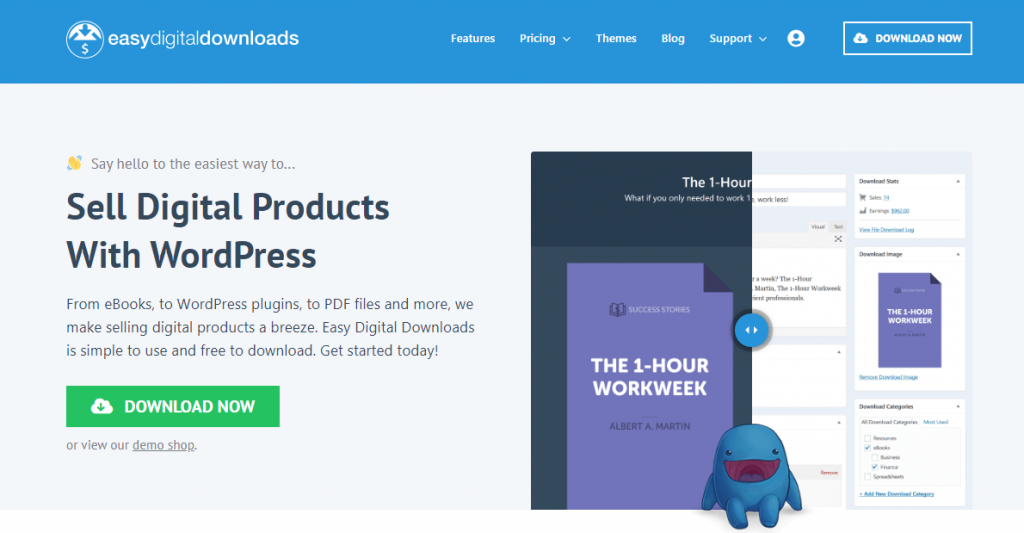
EDD is purpose-built for selling digital downloads. The plugin has matured significantly with EDD 3.x, which introduced a custom database architecture using dedicated tables instead of WordPress post meta. This means dramatically better performance and more accurate reporting as your catalog grows.
EDD 3.x highlights:
- Custom database tables for orders, order items, and customers - much faster than post meta at scale
- Native Stripe integration with 3D Secure and SCA compliance for European markets
- PayPal Commerce Platform integration with smart payment buttons
- Flexible discount codes: flat rate, percentage, product-specific, and customer-specific
- Per-product file access limits (restrict downloads by time period or attempt count)
- Customer purchase history with self-service download management
- Built-in REST API for headless storefronts or external integrations
- Software licensing add-on for selling plugin/software license keys
- Recurring payments add-on for subscription products
EDD works best when your primary catalog is digital files: ebooks, plugins, templates, audio, video courses, and similar downloadable goods.
Option B: WooCommerce - The Broader Ecommerce Platform
WooCommerce is the more general-purpose option. If your marketplace will sell a mix of digital and physical products, or if you need a richer ecosystem of extensions and payment gateways, WooCommerce is the right foundation.
WooCommerce works well for digital products when you need:
- Mixed physical and digital catalogs on the same store
- Virtual products and services alongside downloadable files
- A large library of third-party integrations (CRMs, ERPs, marketing tools)
- WooCommerce Subscriptions for recurring digital product access
- Dokan or WC Vendors for multi-vendor functionality
For a marketplace where sellers want their own storefronts and you want to take a commission, WooCommerce with Dokan is the standard combination. Our StoreMate Dokan theme is purpose-built for exactly this use case.
Adding Multi-Vendor Functionality with StoreMate and Reign Theme
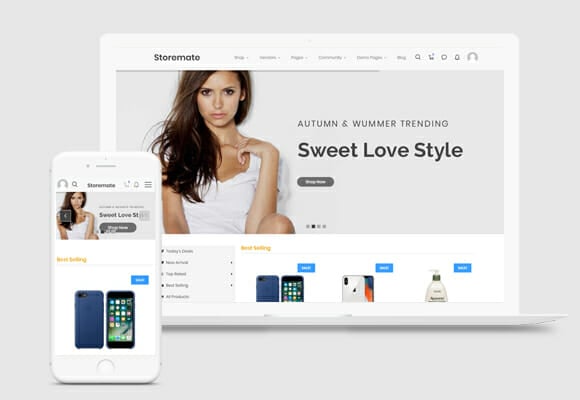
A single-vendor digital store is straightforward. But if your vision is a marketplace where multiple creators can open their own storefronts, list products, and receive payouts - like a niche version of Gumroad or Creative Market - you need a multi-vendor layer.
The StoreMate Dokan bundle gives you exactly this. It combines:
- Reign Theme - A flexible, modern WordPress theme built for marketplace and community sites
- Reign Dokan Add-On - Deep integration between Reign theme and Dokan’s vendor dashboard, store pages, and product listings
- Dokan Free Plugin - The multi-vendor engine that handles vendor registrations, product management, order routing, and commission payouts
With this bundle installed, each vendor gets their own storefront URL, product management dashboard, and earnings reports. You control commission rates, payout schedules, and product approval workflows from the admin panel.
The Reign Dokan Add-On provides pre-built page designs for vendor store listings, product archive pages, and vendor profiles - so your marketplace looks polished without custom theme development.
Selling Services as Products with EDD Sell Services and Woo Sell Services
Not every digital product is a file download. Many WordPress site owners want to sell services - development work, design projects, consulting sessions, content writing - in a product-like format where buyers can add to cart and check out without back-and-forth negotiation.
Wbcom Designs has two plugins built specifically for this:
| Plugin | Works With | Best For |
|---|---|---|
| EDD Sell Services | Easy Digital Downloads | Agencies and freelancers using EDD as their store foundation |
| Woo Sell Services | WooCommerce | Businesses running WooCommerce who want to add service products |
Both plugins let you define service deliverables, set requirements gathering questions at checkout, manage order conversations between buyer and seller, and mark orders complete when work is delivered. It brings the Fiverr-style service workflow into your own WordPress site.
Payment Setup for Your Digital Marketplace
Getting paid reliably is non-negotiable. Here is what to set up for a smooth checkout experience in 2026.
Payment Gateways to Enable
- Stripe - The default recommendation. Handles cards, Apple Pay, Google Pay, and bank transfers. EDD and WooCommerce both have first-class Stripe integrations with SCA compliance for EU buyers.
- PayPal - Still essential for markets where buyers prefer PayPal over cards. Enable PayPal Commerce Platform for the modern smart payment button experience.
- Local gateways - If your marketplace targets a specific region, add the relevant local payment method (Razorpay for India, Mollie for Europe, etc.).
Tax and Compliance
Digital product tax rules vary by country. EU VAT MOSS, US state sales tax, and similar regulations apply when you sell digital goods across borders. Both EDD and WooCommerce have tax extensions, or you can use a service like TaxJar to automate tax calculation and filing.
Protecting Your Digital Products
File protection is essential for any digital marketplace. Without it, buyers could share download links freely, cutting into your revenue.
- Time-limited download links - Both EDD and WooCommerce can generate download links that expire after a set time or number of attempts.
- License keys - For software and plugins, use EDD Software Licensing or WooCommerce’s equivalent to generate and validate license keys on activation.
- PDF stamping - For ebooks and guides, consider stamping the buyer’s name or email into the PDF at download time as a deterrent against sharing.
- Content protection - If you deliver content via streaming rather than download (video courses, for example), use a membership plugin to gate access by purchase status.
Marketing Your Digital Product Marketplace
Building the store is only half the work. Getting consistent traffic and converting visitors into buyers requires a deliberate marketing strategy. Here are the highest-leverage channels for a digital product marketplace.
SEO - Long-Term Organic Traffic
Digital product marketplaces are well-suited to content SEO because buyers actively search for specific products. Target long-tail keywords like “Notion project management template”, “ChatGPT prompts for marketing”, or “WordPress portfolio theme for photographers”.
- Write a dedicated landing page for each product category
- Create comparison posts (“Best Canva templates for real estate agents”)
- Publish tutorials that demonstrate your products in action
- Build internal links between related products and blog content
Email Marketing - Your Most Reliable Channel
An email list of past buyers converts better than any other channel. Set up a post-purchase email sequence that delivers value, introduces related products, and encourages repeat purchases. Tools like Mailchimp, Kit (formerly ConvertKit), and Klaviyo integrate cleanly with both EDD and WooCommerce.
Social Media and Community
Digital product buyers often gather in specific communities: Reddit forums, Discord servers, Facebook groups, X (formerly Twitter) lists, and LinkedIn groups. Find the communities relevant to your niche and become a genuine participant - share useful content, answer questions, and make your products discoverable naturally.
Pinterest and Instagram work particularly well for visual digital products like Canva templates, Notion dashboards, and design assets.
Affiliate Program
An affiliate program lets other creators and bloggers promote your products in exchange for a commission. Both EDD and WooCommerce have affiliate management add-ons. This is especially effective for marketplaces with higher-priced products where affiliates have a meaningful incentive.
Recommended Stack for 2026
Here is a practical, proven configuration for a WordPress digital product marketplace in 2026:
| Layer | Option A (EDD-based) | Option B (WooCommerce-based) |
|---|---|---|
| Hosting | Cloudways / SiteGround | Cloudways / SiteGround |
| Theme | Reign Theme | StoreMate Dokan |
| Ecommerce | Easy Digital Downloads 3.x | WooCommerce |
| Multi-vendor | EDD Marketplace or manual | Dokan + Reign Dokan Add-On |
| Services | EDD Sell Services | Woo Sell Services |
| Payments | Stripe + PayPal | Stripe + PayPal |
| SEO | Yoast or RankMath | Yoast or RankMath |
| Mailchimp / Kit | Klaviyo / Mailchimp |
Common Mistakes to Avoid
- Skipping SSL - Buyers will not enter payment details on an unsecured site. Install your SSL certificate before adding any products.
- No download security - Without link expiration or purchase verification, your files are freely shareable. Enable EDD or WooCommerce download restrictions from day one.
- Ignoring mobile - More than half of browsing traffic is mobile. Your product pages, checkout flow, and download experience must work flawlessly on phones.
- No refund policy - Digital products are harder to return, but having a clear refund policy builds buyer confidence and reduces chargebacks.
- Neglecting performance - A slow-loading marketplace loses sales. Use a caching plugin, a CDN, and optimize images. Managed WordPress hosts handle most of this automatically.
Start Building Your Marketplace Today
The digital product economy is growing, and WordPress gives you full ownership of your marketplace - no platform fees eating into every sale, no risk of being deplatformed, and complete control over your customer relationships.
The right starting point depends on what you are selling. If your catalog is primarily downloadable files, start with EDD 3.x. If you need a multi-vendor marketplace where creators can open their own storefronts, the StoreMate Dokan bundle with Reign theme gives you everything you need out of the box.
You don’t need a custom platform to run a professional digital marketplace. The right WordPress plugin stack gets you 90% of what any SaaS marketplace offers - at a fraction of the cost and with no revenue share.
If you are building a social marketplace that connects PeepSo community features with your EDD store, the PeepSo Easy Digital Downloads Integration lets members browse and purchase digital products without leaving the community experience. Browse the Wbcom Designs plugin catalog to find the right tools for your marketplace:
Related reading