

When I first started using Reddit for keyword research, I didn’t expect it to become one of my most insightful SEO tools.
Like most marketers, I relied on familiar platforms like Semrush, Ahrefs, and Google Keyword Planner. These tools are powerful and reliable, but they often focus on numbers showing what people search for rather than why they’re searching in the first place.
That “why” is what gives content its real impact. It’s the difference between writing something that ranks and creating something that actually connects with readers.
While researching gut health, a topic I personally care about, I began diving into Reddit threads. What I found was eye-opening. People weren’t just dropping keywords; they were sharing stories, frustrations, and personal experiments. Each post was filled with natural language and emotional context that standard SEO tools completely miss.
That’s when it hit me: Reddit isn’t just a social network. It’s a real-time conversation hub where your audience openly talks about their problems, preferences, and ideas.
So I decided to run an experiment. I wanted to see if I could use Reddit discussions to uncover real, high-intent keyword opportunities in the gut health niche topics that reflect what people genuinely want to know but can’t find elsewhere.
What started as a small experiment quickly became a repeatable research method. It’s now one of my favorite ways to uncover content gaps, understand true search intent, and build SEO strategies that resonate with real people.
Here’s exactly how I did it, step by step, and how it completely changed the way I approach keyword research.
Why Reddit Belongs in Your SEO Workflow
Reddit is where people go when they’ve already tried Google and still haven’t found the answer they need. It’s a community built on curiosity, frustration, and shared experience. When users ask questions there, they tend to write exactly how they think and speak. They’re not worrying about search optimization, they’re simply trying to solve a problem or understand something that matters to them.
That natural, conversational tone is what makes Reddit such a powerful tool for keyword research. It shows you the real language your audience uses, not the polished version that keyword databases simplify into monthly search numbers.
When I began looking into gut health topics on Reddit, this difference became obvious. Threads weren’t just filled with one-line questions; they were long discussions about symptoms, habits, diet changes, and emotions. People talked about what they had tried, what didn’t work, and how they felt about it. That’s the kind of depth no keyword tool can measure.
Here’s what stood out to me most during the process:
1. Conversational queries.
Redditors write exactly the way they think. Posts like “Why do probiotics make me bloated?” or “How long does it take to fix gut health after antibiotics?” show up again and again. These phrases may not always have huge search volume, but they reflect genuine curiosity. When you create content around these real questions, you’re speaking your audience’s language not just chasing keywords.
2. Pain points and frustrations.
The most valuable Reddit discussions often start with frustration. A user might say, “I’ve tried every probiotic brand and nothing works,” or “I’m following a gut health diet but still feel bloated.” These are signals of content gaps. If people keep asking the same questions, it means existing articles and videos aren’t solving their problem effectively. That’s where you can step in with something better.
3. Real context behind searches.
Traditional keyword tools show what people search for. Reddit shows why they’re searching. When you read through entire comment threads, you see what led them to that point their trial and error, their doubts, and their expectations. This context helps you craft content that doesn’t just rank, but actually helps.
The more I analyzed these threads, the clearer it became that Reddit gives marketers access to something deeper than metrics. It’s a direct line to human behavior.
Keyword tools give you data points.
Reddit gives you intent, emotion, and authenticity the missing half of SEO that turns numbers into meaningful insights.
Step 1 – Finding Relevant Subreddits
I started by typing “gut health” directly into Reddit’s search bar and switched to the Communities tab. Within seconds, I discovered a range of active spaces where people were openly discussing gut health from every possible angle.

Here are a few that immediately stood out to me:
- r/GutHealth : the main hub for people sharing personal stories, diet changes, and probiotic experiments.
- r/Gastroenterology : a more medical community, where discussions often include research papers and professional insights.
- r/LetsTalkGutHealth : filled with real-world experiences, home remedies, and lifestyle-based discussions.
- r/GutScience : a smaller but fascinating group that focuses on the connection between microbiome research and overall health.
Each of these subreddits had its own personality.
Some leaned scientific and data-driven, while others felt more personal and supportive. By exploring both ends of that spectrum, I started to understand how different audiences talk about the same topic and what kind of language each one naturally uses.
That difference in tone is critical for SEO research. It shows how to tailor content for professionals, casual readers, or people simply looking for relief.
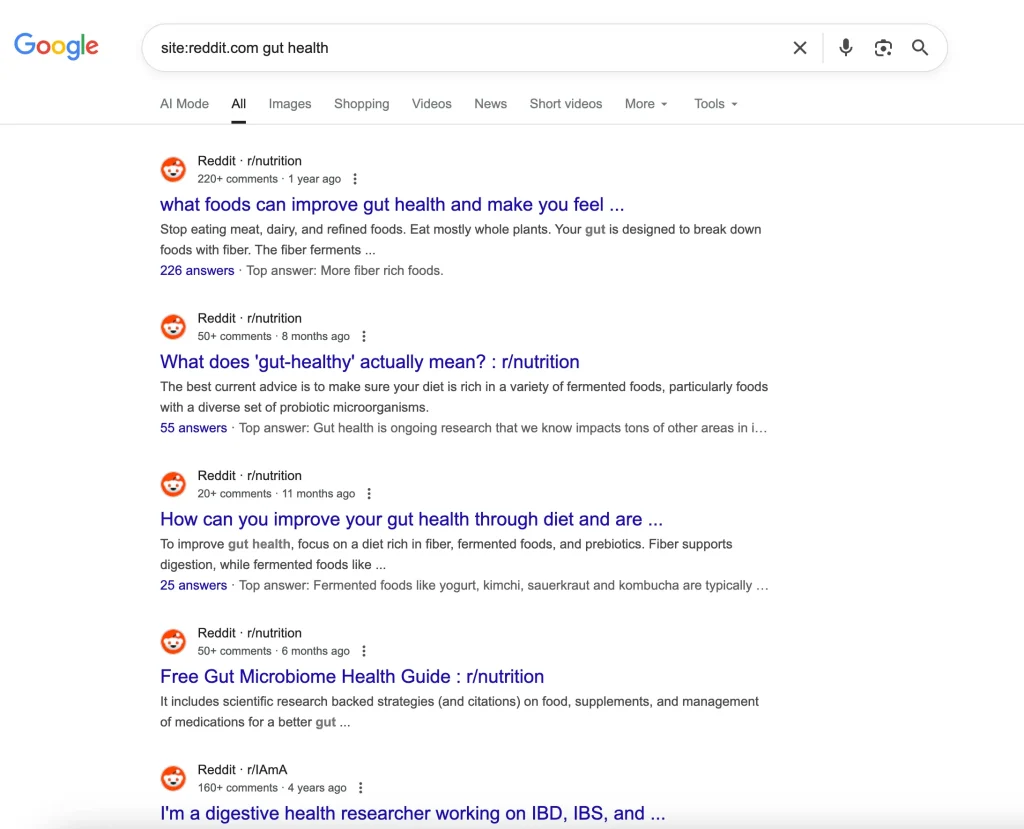
I also ran a Google search using:
site:reddit.com gut healthThis search instantly revealed more relevant discussions and smaller niche subreddits that didn’t appear in Reddit’s own results. It confirmed something important: Reddit’s internal search is good for surface-level discovery, but Google’s indexing often exposes hidden communities and long-form discussions that even Reddit’s algorithm overlooks.
Combining both methods gave me a well-rounded list of communities to analyze and probably a few my competitors would never think to explore.
Step 2 – Spotting the Right Discussions
After identifying the right subreddits, I began exploring them one by one to see where the most valuable conversations were happening. I started with r/GutHealth, entered “gut health” into the search bar, and sorted the results by Top (All Time) to bring up the threads that had attracted the most engagement.
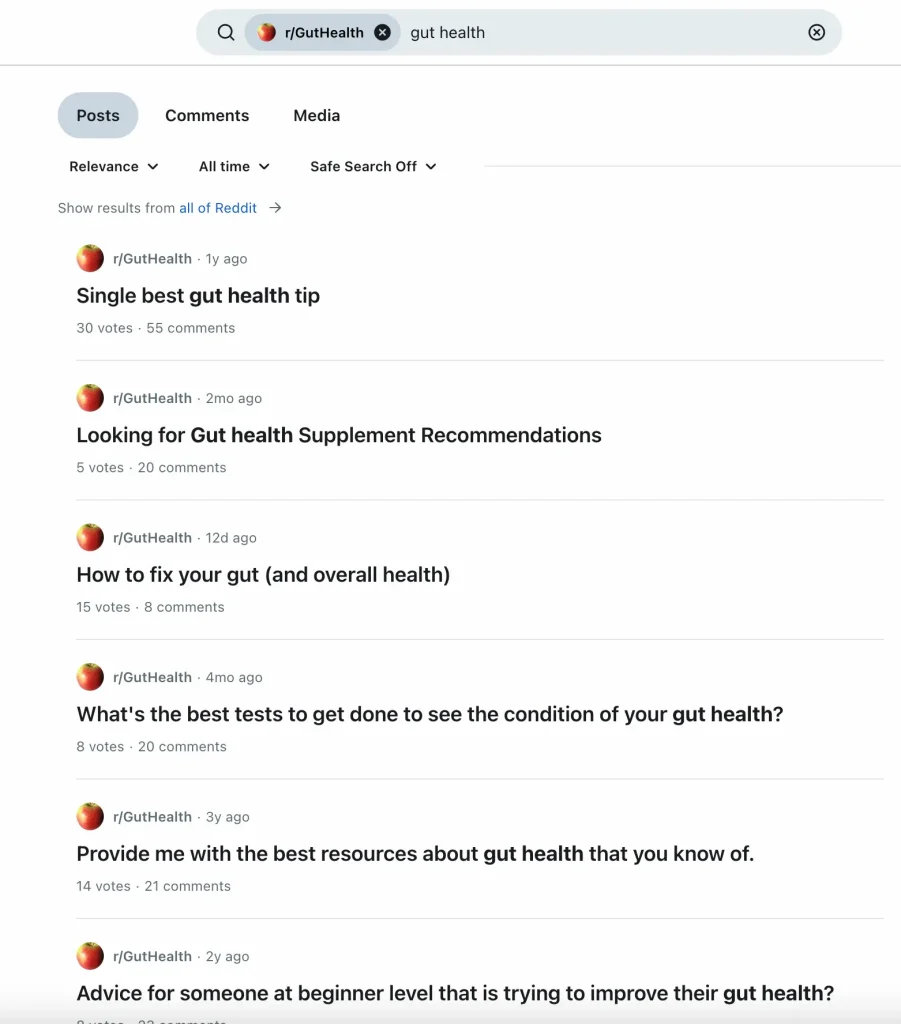
Immediately, I was drawn into a series of fascinating discussions:
- “My gut was a mess… I learned about the ‘second brain’ in my gut.”
- “Foods to improve your gut health.”
- “Thirty minutes of exercise daily significantly enhances gut health.”
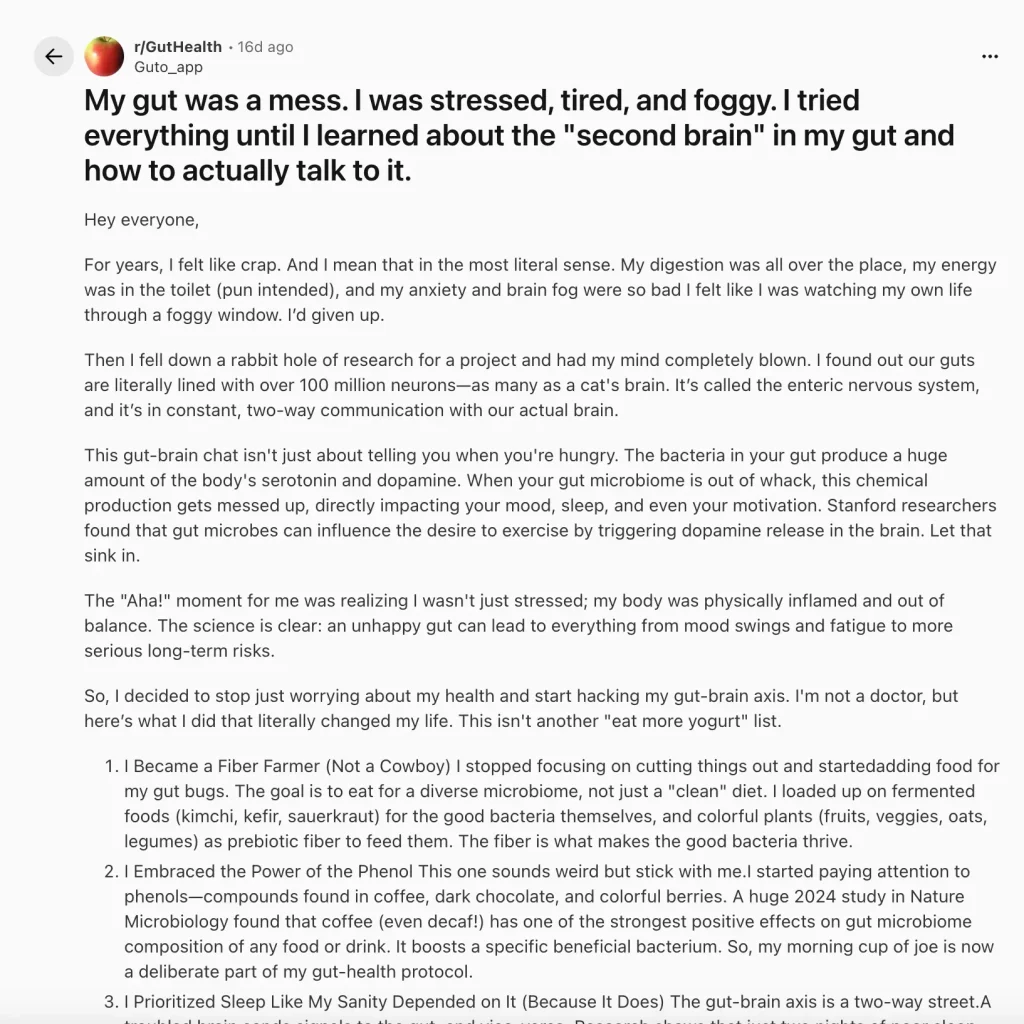
Reading through these posts felt like sitting inside a focus group that never ends. Each thread was full of people testing ideas, sharing their results, asking honest questions, and comparing notes. It wasn’t polished marketing talk it was raw experience.
As I scrolled through dozens of conversations, a few clear themes began to appear:
- Confusion about which foods genuinely improve digestion.
- Frustration with probiotic side effects and inconsistent results.
- Curiosity about the connection between exercise and microbiome health.
These weren’t just random comments. They were recurring patterns that revealed what people were truly struggling to understand.
Every question and anecdote pointed toward a gap in existing online information gaps that could be filled with content grounded in empathy and backed by research.
That realization reframed how I view Reddit: it’s not simply a place to collect keywords, but a living archive of real user intent. Each discussion gives you clues about the problems your audience is trying to solve and the language they use when describing them.
Using Google Search Operators to Uncover Hidden Threads
Once I’d gathered insights from Reddit’s internal search, I wanted to see what I might be missing. Reddit’s own search function is helpful, but it’s not designed for deep research. It tends to favor recent or highly upvoted content, which means many valuable older threads can easily get buried.
That’s where Google’s site search operator becomes incredibly useful. By combining the power of Google’s indexing with Reddit’s raw discussions, I could uncover conversations that were still ranking publicly often years after they were posted.
To start, I went to Google and typed:
site:reddit.com "restore gut flora after antibiotics"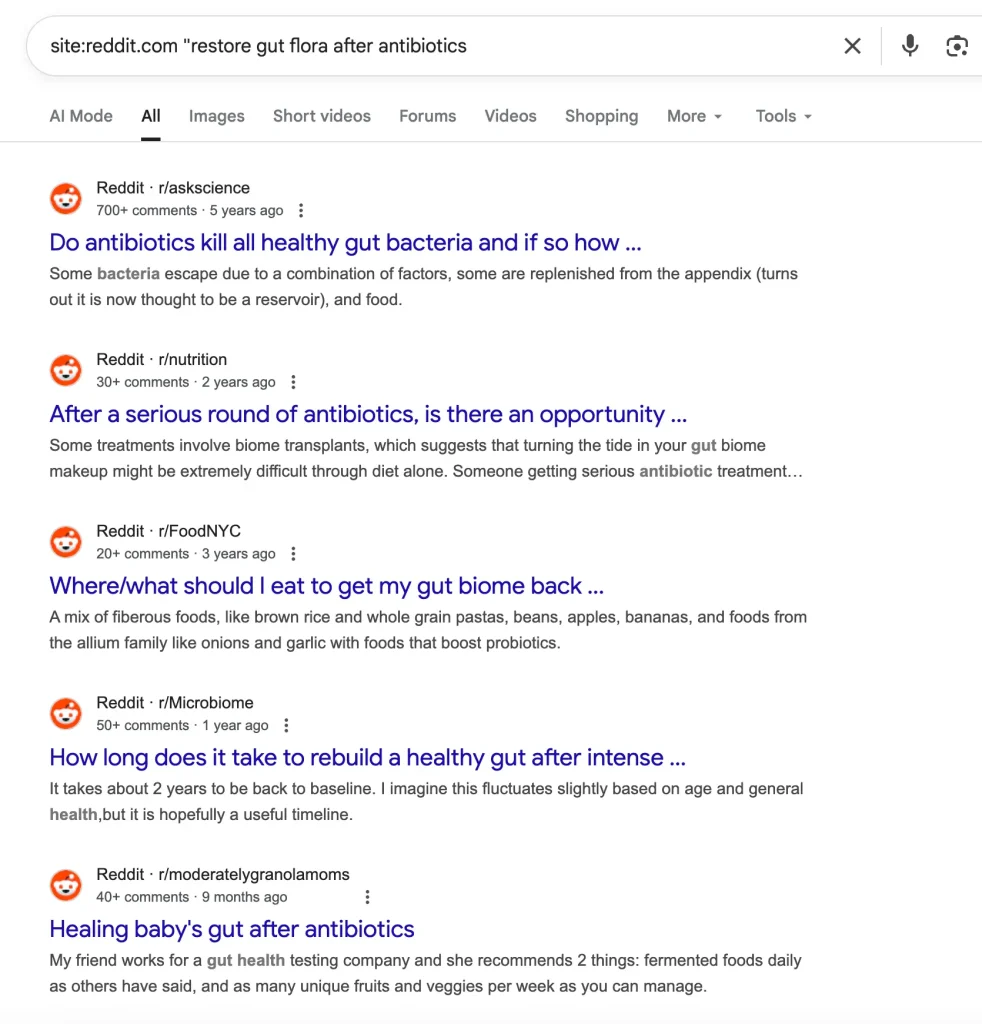
Within seconds, I found pages of threads across several different communities:
- r/AskScience – users asking about how antibiotics affect the microbiome.
- r/Nutrition – discussions around recovery diets and probiotic foods.
- r/Microbiome – more science-oriented conversations about bacterial balance.
- r/ModeratelyGranolamoms – personal stories about helping kids rebuild gut health after antibiotics.
It was fascinating to see how these same themes appeared across communities with completely different audiences. In one subreddit, the topic was treated as a clinical problem; in another, it was an everyday health concern.
By reading these threads, I could spot patterns that revealed both the depth of user interest and the longevity of the topic. If an old post from 2019 is still ranking on Google and attracting new comments, that tells you something: people are still looking for that answer today.
That’s what makes this method so powerful. Using Google’s site search isn’t just about finding more content it’s about finding content that has stood the test of time.
Here are a few more operator variations that worked especially well for uncovering intent-rich discussions:
site:reddit.com "why does my stomach feel heavy after probiotics"
site:reddit.com "gut health doesn’t work"
site:reddit.com "best foods for digestion"
Each of these searches revealed unique angles troubleshooting, frustration, and curiosity.
When you read enough of these threads back-to-back, you start to see the emotional heartbeat behind the data.
One person might be skeptical (“Probiotics don’t work for me”), another hopeful (“What finally fixed my digestion”), and another desperate (“Why am I still bloated after antibiotics?”).
This diversity of voices is what makes Reddit such an authentic keyword source. You’re not guessing what people feel about a topic; you’re seeing it in their own words.
And that emotional layer is exactly what helps transform an ordinary content plan into something truly audience-focused.
Step 4: Turning Reddit Conversations into Keywords
After hours of reading through Reddit discussions, I had pages of notes.
Each thread was packed with questions, personal experiences, and small clues that hinted at what people truly wanted to know.
At this point, the challenge was to organize that information in a way I could actually use for keyword research.
Instead of relying on an automated scraper, I took the manual route.
I opened a blank spreadsheet and started entering data line by line. It was slow work, but it gave me time to think about each post what the user was really asking, what emotion sat behind it, and how it might translate into search behavior.
To keep everything structured, I created four columns: Title, Context, Pain Points, and Keywords.
| Title | Context | Pain Points | Keywords |
|---|---|---|---|
| Foods to improve your gut health | Users share everyday tips like eating curd, green veggies, and whole grains. | Confusion about which foods genuinely help gut bacteria. | gut health foods, probiotic foods list, best diet for gut health |
| My gut was a mess. I learned about the “second brain.” | A personal story about overcoming fatigue and anxiety through gut healing. | Brain fog, low energy, and stress linked to digestion. | gut-brain connection, gut health recovery, probiotics for energy |
| 30 Minutes of Exercise Daily Enhances Gut Health | Conversation on how movement supports microbiome diversity. | Lack of awareness that exercise impacts digestion. | exercise for digestion, microbiome benefits of exercise, gut health routine |
| Restore gut flora after antibiotics | Users discuss recovery diets and timelines. | Conflicting advice about how long recovery takes. | restore gut flora after antibiotics, rebuild gut health, post-antibiotic diet |
Working manually like this forced me to slow down and pay attention.
I wasn’t just collecting data; I was listening for meaning.
For example, when someone wrote “I’ve been on probiotics for two months but still feel bloated,” I didn’t see that as a single query. I saw it as a series of related searches: “why am I still bloated after probiotics,” “how long do probiotics take to work,” “signs probiotics are helping.”
That kind of pattern recognition only happens when you read the discussions yourself.
Every thread adds context the sequence of events, the frustrations, the trial-and-error stories that helps you understand what the searcher really wants when they type that phrase into Google.
By the time I finished, I had a spreadsheet that felt less like a data sheet and more like a map of human behavior.
It showed me which topics were driven by curiosity, which came from pain or confusion, and which were fueled by success stories.
Those emotional cues became the backbone of my keyword strategy.
When you can connect keywords to the emotions behind them, your content instantly feels more personal and trustworthy and that’s something no automated keyword generator can deliver.
Step 5: Verifying and Expanding Keywords with Semrush
Once I had organized my Reddit findings into a spreadsheet, it was time to see which ideas had real-world search potential.
Even though Reddit gives you unmatched insight into how people talk, it doesn’t show you how many people are looking for those topics.
That’s where Semrush came in.
I opened the Keyword Strategy Builder and created a new list titled “Reddit Gut Health Keywords.” Then I added every term from my spreadsheet phrases like “restore gut flora after antibiotics,” “gut health foods,” and “fiber for digestion.”
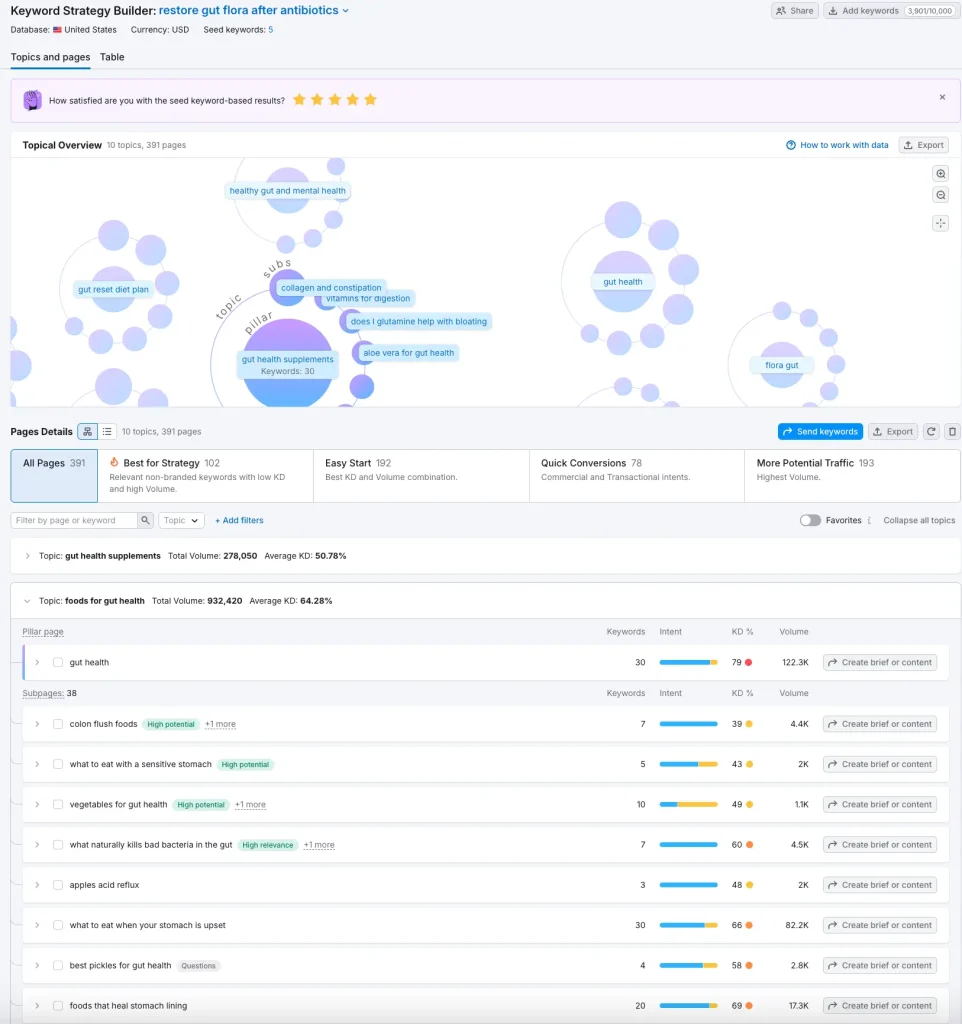
Within seconds, Semrush began populating key metrics like search volume, keyword difficulty (KD), and intent.
This was the data layer I needed to validate what Reddit had already told me qualitatively.
Some keywords surprised me.
A few phrases that appeared frequently on Reddit had almost no search volume, but that didn’t mean they were useless. In fact, these low-volume queries often represented emerging topics or specific pain points that haven’t yet been widely covered exactly the kind of content that can gain traction fast.
Other terms, though, had both meaningful volume and manageable competition.
Here’s a sample from my list:
| Keyword | Intent | KD % | Volume |
|---|---|---|---|
| colon flush foods | Informational | 39 | 4.4K |
| what to eat with a sensitive stomach | Informational | 49 | 2K |
| vegetables for gut health | Informational | 49 | 1.1K |
| what naturally kills bad bacteria in the gut | Informational | 60 | 4.5K |
| apples acid reflux | Informational | 48 | 8.2K |
What this table confirmed was simple but powerful:
Reddit had already surfaced the right topics; Semrush helped me prioritize which ones to pursue first.
I sorted my list by keyword difficulty to find low-competition opportunities terms that smaller or newer websites could realistically rank for. These became my “quick wins.”
Then I tagged the broader, higher-volume topics as “pillar ideas” for long-form, evergreen content that could serve as authority builders.
As I worked through the list, a pattern began to emerge.
The same emotional themes I saw on Reddit confusion, curiosity, and frustration were showing up again in the search data. The only difference was that now I could measure their reach.
It was a satisfying moment.
By combining human insight from Reddit with quantitative validation from Semrush, I wasn’t just guessing what people wanted to read. I was building a keyword plan that aligned empathy with evidence.
That mix of intuition and data is where the best SEO strategies live.
Reddit Taught Me What Keyword Tools Couldn’t
After completing this experiment, one truth became crystal clear: the best SEO insights don’t always come from tools. They come from people.
Traditional keyword research gives you numbers, trends, and difficulty scores. It’s useful, but also detached. Reddit, on the other hand, drops you into real conversations. You can see what frustrates people, what confuses them, and what excites them. That context gives meaning to the numbers you see later in Semrush or Ahrefs.
Looking back on the process, from exploring subreddits to clustering validated keywords, I realized that Reddit had reminded me of something important. SEO is not just about ranking higher; it’s about understanding human intent.
Here’s what I learned from this project:
- Reddit exposes unmet search intent. The most active discussions often highlight the exact questions people cannot find answered anywhere else.
- Manual analysis deepens understanding. Reading discussions personally instead of relying on automation helps you connect with your audience’s emotions.
- Pairing Reddit insights with data validation creates balance. Tools like Semrush confirm which ideas have measurable potential, while Reddit shows you which ones truly matter to readers.
- Topic clusters bring it all together. When you connect related ideas around shared pain points, you turn scattered keywords into a unified content strategy.
In the end, Reddit reminded me what SEO is really about: people.
Behind every keyword is someone looking for help, relief, or clarity.
That is why I now treat Reddit as a regular part of my keyword research workflow. It keeps my strategy grounded in real conversations, where intent, empathy, and curiosity drive meaningful content.
If you are searching for your next big SEO opportunity, pause the keyword tools for a moment.
Go see what your audience is already talking about.
That is where the best ideas are hiding.
About the Author
Shashank is an SEO strategist and content marketer who helps brands uncover opportunities hidden in plain sight. He specializes in blending human insight with data-driven research to create content that connects, ranks, and converts.
You can connect with him on Upwork for expert SEO and content strategy support.
